


A New York University Abu Dhabi student is helping to map out safe pathways for refugees by sending them live alerts on their mobile phones.
Refugees around the world make long, perilous journeys to escape violence in their home countries, but routes are often riddled with dangers.
The “Mapping Nyumbani” project – “nyumbani” meaning “home” in Swahili – is the brainchild of 24-year-old Tanzanian student Abdi Hamisi Ambari.
The system works by sending live communication alerts via text message to refugees, informing them of potential dangers at various points of their journey.
“Many refugees are taking pedestrian routes that could take several days. They are totally unaware of how extremely unsafe it is,” Mr Ambari, who graduated in interactive media studies this week, told The National.
“We are trying to create a model that can communicate to refugees and alert them to if they are safe or not.”
student at New York University Abu Dhabi
Mr Ambari joined forces with a telecoms company to build software that triggers a response when a mobile device enters or leaves a particular area.
The idea of mapping out safety routes was born out of one of his mapping classes at the university.
“It is called geofencing, where companies make virtual maps or zones and whenever anyone with a device with GPS enters that zone, the company is able to send communication to that device,” he said.
“Using the same technology, we are trying to mark out zones in the maps where refugees travel and send them instant messages on the safety of the location.”

Mr Ambari said the system works perfectly well for refugees since they always carry simple mobile phones.
“You don’t need a smartphone for this,” he said, noting that he also put together a group of volunteers, including refugees, to collect spatial data to identify points along various routes.
He hopes the system can be used into other refugee contexts and help anyone fleeing conflicts and violence.
The project is currently in the implementation stage, but is initially focused on refugees from Burundi who are fleeing the effects of civil conflicts for safe zones in Tanzania.
Mr Ambari said his personal relationship with the plight of refugees and his volunteering experience inspired him to look for solutions to the problems they face.

While volunteering at UK-based Na’amal, an NGO that conducts refugee upskilling programmes, Mr Ambari said he learnt the value of building solutions not only for the community but with them.
“The organisation is dedicated to accurately understanding and conveying the realities of refugee existence by learning directly from members of the refugee population,” he said.
“This is something I made sure to assign primary importance in the Mapping Nyumbani project.”
He has since joined Na’amal as its communication head.
“As we conduct our research and design solutions, we constantly ask if [the project] is solving the problem in a way that is contextualised to the community culturally, financially or otherwise,” Mr Ambari said.
“We have open feedback channels and we are proud of the many ways the members of the refugee community are taking an active role in developing Mapping Nyumbani.”
When his team began the project in September of last year, he knew that their first step would be to contact Burundi refugees currently residing in Tanzania’s Nyarugusu refugee camp.
During several interviews and conversations, he learnt about many people’s hopes, dreams, talents and life stories.
“It was a revelation of how rich a community the refugee community is in terms of talent, academic and professional potential, kindness, resilience and love,” Mr Ambari said.
“Also being at NYUAD and doing a tech-heavy programme where you are constantly pushed to use technology to make the world a better place, helped me dig for better solutions.”
-
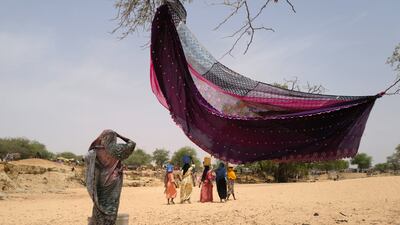
Women who fled the conflict in Sudan's Darfur region, and were previously internally displaced, carry water at a refugee camp in Borota, Chad. Reuters -

Sparks fly in front of the Milky Way. Ganesh Bagal / Shutterstock -

Turkish President Recep Tayyip Erdogan walks out of a voting booth at a polling station in Istanbul, during the country's parliamentary and presidential elections. EPA -
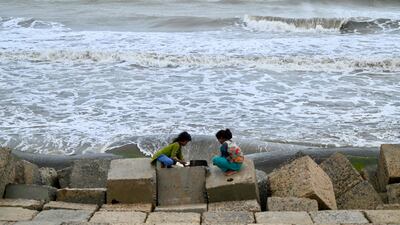
Children play near choppy waters on Shahpori island, Bangladesh, hours before Cyclone Mocha made landfall. AFP -
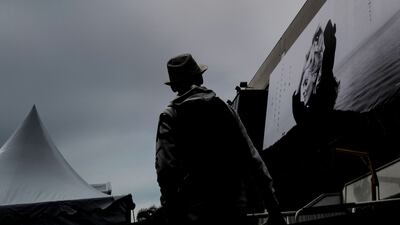
A poster for the 76th Cannes Film Festival featuring a photograph of actress Catherine Deneuve, on the facade of the Palais des Festivals, in Cannes south-eastern France. AFP -
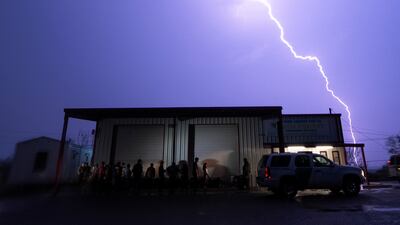
A lightning bolt lights up the sky during a storm as migrants wait to be processed by immigration officials, after they crossed the border into Texas from Mexico. AP -

Bobi, the world's oldest dog on record, looks on during his birthday party, after turning 31, in the rural village of Conqueiros, central Portugal. EPA -
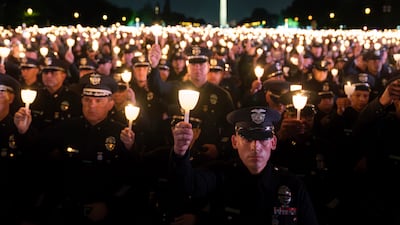
Policemen hold candles during the annual vigil to honour law enforcement officers who lost their lives in the line of duty, in Washington. AP -
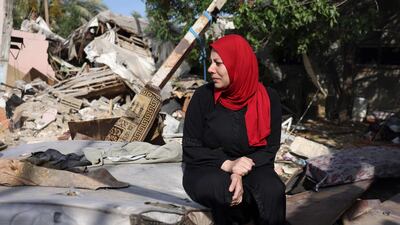
A woman sits amid the rubble of her house at Nusseirat refugee camp in Gaza, which was damaged during days of deadly fighting between Israel and the Palestinian Islamic Jihad militant group. AFP -
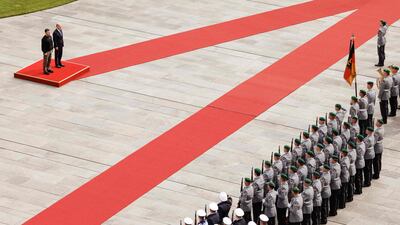
Germany's Chancellor Olaf Scholz, right, and Ukraine's President Volodymyr Zelenskyy listen to the national anthems during a welcoming ceremony for the Ukrainian leader, in Berlin. AFP -

Manchester City footballer Erling Haaland during warm-up before a match. Reuters



