


The James Webb Space Telescope has captured galaxies that were formed only 350 million years after the birth of the universe — the oldest ones ever observed.
An international team of astronomers used data from the $10 billion telescope to make the discovery, with findings published in two studies, including in science journal Nature Astronomy and another on the European Space Agency website on Tuesday.
The data shows the universe when it was only two per cent of its current age.
“It was crucial to prove that these galaxies do, indeed, inhabit the early universe. It’s very possible for closer galaxies to masquerade as very distant galaxies,” said astronomer and co-author Emma Curtis-Lake from the University of Hertfordshire.
“Seeing the spectrum revealed as we hoped, confirming these galaxies as being at the true edge of our view, some further away than Hubble could see. It is a tremendously exciting achievement for the mission.”

The light from these galaxies has taken more than 13.4 billion years to reach us.
This has also helped confirm that the world’s most powerful telescope can make such observations using light from ancient galaxies that has been travelling through our universe for billions of years.
Astronomers used the telescope’s near-infrared camera (NIRCam) and the near-infrared spectrograph (NIRSpec) to make the observations.
Helping to unravel mysteries of the universe
“For the first time, we have discovered galaxies only 350 million years after the big bang, and we can be absolutely confident of their fantastic distances,” said co-author Brant Robertson from the University of California Santa Cruz.
Even though the galaxies are extremely faint because of how far they are, it would still help astronomers explore their properties.
Astronomer Sandro Tachella from the University of Cambridge in the UK, said that the telescope could unlock many mysteries of the universe.
“It is hard to understand galaxies without understanding the initial periods of their development," he said.
"Much as with humans, so much of what happens later depends on the impact of these early generations of stars."
The telescope was launched on Christmas Day, 2021, to help reveal secrets of the universe and how it was formed.
The first image from the telescope was revealed by US President Joe Biden on July 11. It showed the galaxy cluster SMACS 0723 as it was 4.6 billion years ago.
Researchers have also been using the telescope to learn more about the solar system and its planets.
Last year, images that showed planet Jupiter in striking detail were released.
The planet, which is believed to have 79 moons, has a unique composition and inner structure that researchers want to study more.
Its atmosphere is made up of mostly hydrogen gas and helium gas, just like the Sun.
The gas giant is covered in thick red, brown, yellow and white clouds, which make it look like the planet has stripes.
Startling discoveries by $10bn space telescope — in pictures
-
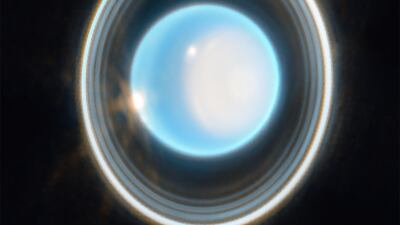
Uranus is surrounded by 13 rings and 27 small moons as it rotates at a nearly 90-degree angle from the plane of its orbit. Photo: Nasa -
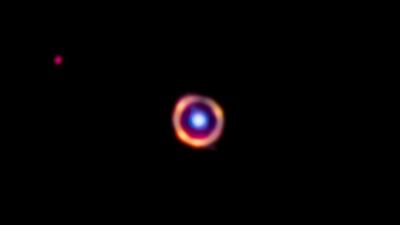
Complex organic molecules similar to smoke or smog in a galaxy more than 12 billion light-years from Earth. Photo: Nasa -

A delicate image of dust structures and bright star clusters taken by the James Webb Space Telescope. Photo: Nasa -
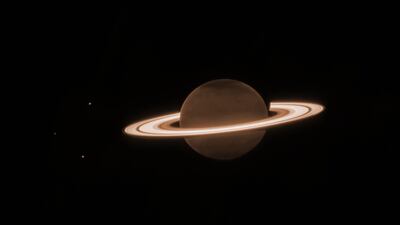
Saturn has seven rings with several gaps and divisions between them, as well as 53 known moons. Photo: Nasa -
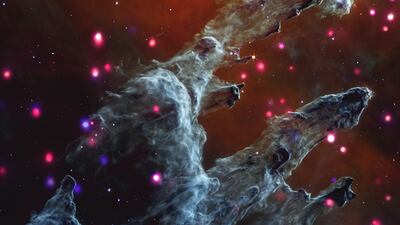
Star cluster NGC 346, spiral galaxies NGC 1672 and Messier 74, and the Pillars of Creation, towering tendrils of cosmic dust and gas at the heart of the Eagle Nebula. Photo: Nasa -
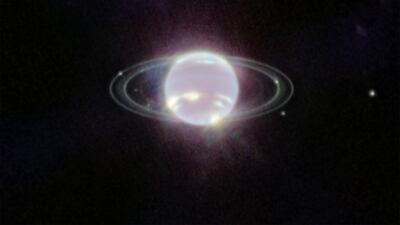
An infrared image of Neptune, the only planet in our solar system not visible to the naked eye. Photo: Nasa -
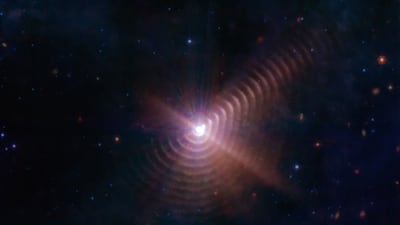
Every eight years, the two stars in this image are brought together by their orbits – creating colliding streams of gas that, under the right conditions, form a new ring of dust. Photo: Nasa -
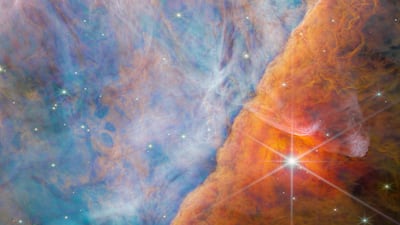
A part of the Orion Nebula known as the Orion Bar. Photo: Nasa -
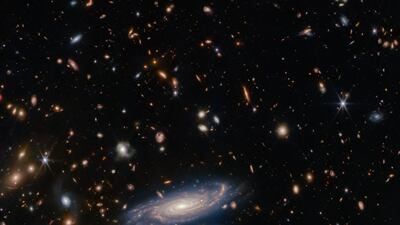
A crowded field of galaxies, along with stars crowned with the James Webb Space Telescope's signature six-pointed diffraction spikes. Photo: Nasa -
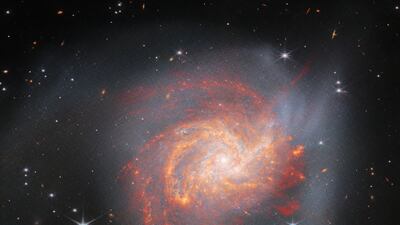
The NGC 3256 spiral galaxy was formed after a collision of two massive galaxies about 500 million years ago. Photo: Nasa -
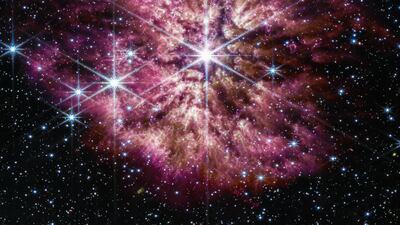
The Wolf-Rayet 124 star, featured in an image combining near-infrared and mid-infrared wavelengths of light. Photo: Nasa -
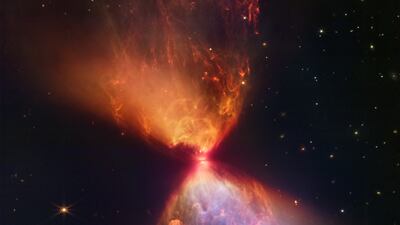
An hourglass-shaped cloud of dust and gas is illuminated by light from a protostar. Photo: Nasa -

Two views of the Southern Ring Nebula, which show the planetary nebula as a misshapen oval. Photo: Nasa -

A composite image of the Cartwheel Galaxy captured by the James Webb Space Telescope in August 2022. AFP -
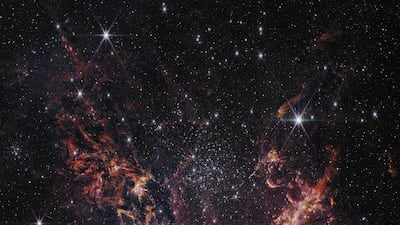
A cluster of stars in the Small Magellanic Cloud, near the Milky Way. Photo: JWST -
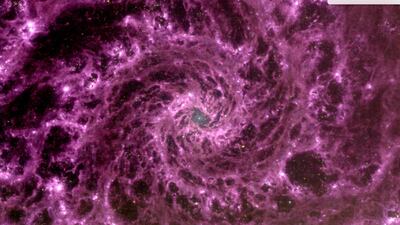
A colour composite image of the Messier 74 galaxy. Photo: JWST -
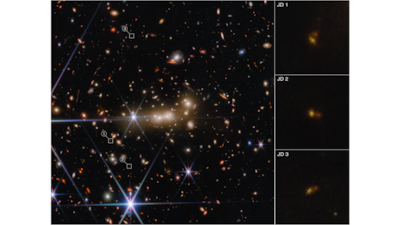
The gravity of galaxy cluster MACS0647 bends and magnifies light from the more distant MACS0647-JD. Photo: Nasa -
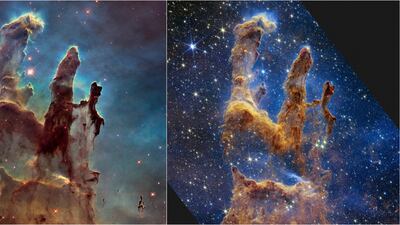
The 'Pillars of Creation' — clouds of hydrogen gas and dust 6,500 light years from Earth — captured by the Hubble Space Telescope, left, and James Webb Space Telescope. AP -

Dust rings resembling a fingerprint created by a rare type of star and its companion. PA -
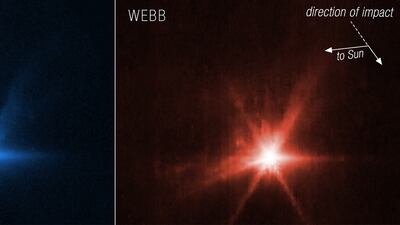
Images of the asteroid Dimorphos hours after Nasa crashed a spacecraft into it in September 2022. EPA -
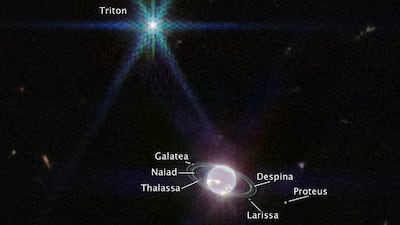
Neptune and seven of its 14 known moons. AFP -
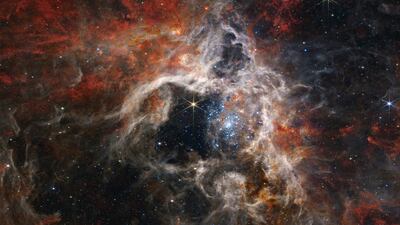
Thousands of young stars in a stellar nursery called the Tarantula Nebula. Photo: Nasa -

A image of an exoplanet — a gas giant with no rocky surface. Photo: Nasa, ESA and CSA -
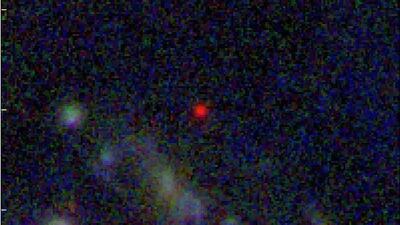
Glass-z13, the oldest galaxy to be detected, was formed about 300 million years after the Big Bang. Photo: JWST -
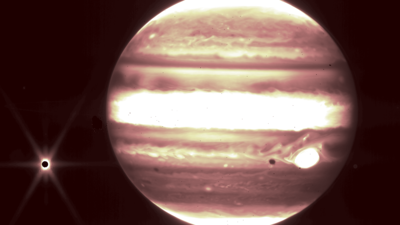
Jupiter and its moon Europa. Photo: Nasa -

Jupiter and its moons Europa, Thebe and Metis. Photo: Nasa -
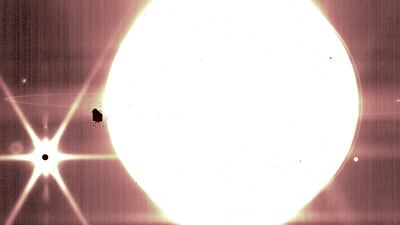
Another image of Jupiter and some of its 79 moons. Photo: Nasa -
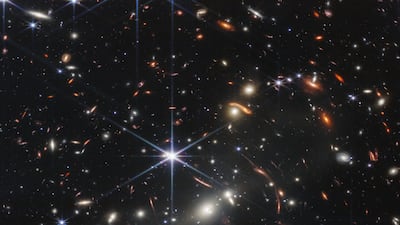
An image of galaxy cluster Smacs 0723 taken by the James Webb telescope. Photo: Nasa -
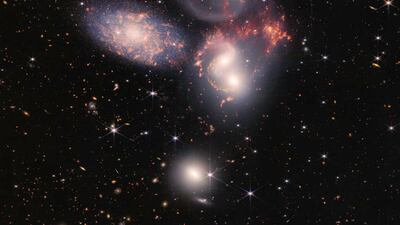
Stephan’s Quintet is an area in space that has five galaxies. Photo: JWST -
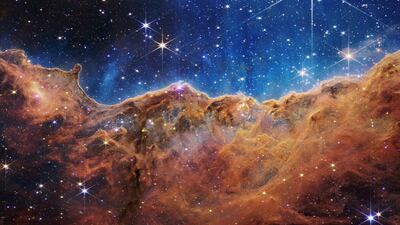
The 'Cosmic Cliffs' of the Carina Nebula. Photo: JWST -

An anniversary image shows the birth of a star in the Rho Ophiuchi cloud complex, the closest star-forming region to Earth. Photo: Nasa



