

UAE residents who lost thousands of dirhams to financial scams have urged others to take "extreme caution" over online payments and sharing personal details.
Several victims told The National they were caught out by phone calls purporting to be from police officers or others in authority.
Senior officials stressed that no law enforcement personnel would ever ask for anyone's bank account details.
"The key factor to bringing down the number of incidents and victims is by creating more awareness," said Yousif Al Ali, chief prosecutor at Dubai Prosecution's Bur Dubai division.
Dubai Prosecution, Bur Dubai division
"Official authorities would never ask you for this data.”
A survey last year by Visa and Dubai's Department of Economy and Tourism found one in three consumers in the Emirates struggle to spot the signs of fraud and scams. In the UAE, cyber crime costs $746 million a year and involves more than 166,000 victims, according to research by UK consumer watchdog Comparitech.
Worldwide, scams have been on the rise as more of our everyday lives involve online payments, with a sharp rise in crimes since the coronavirus pandemic began.
Fake threat over 'Covid violation'
Emmanuel Thomas, 51, a financial manager in a Korean company's Dubai office, lost Dh22,000 ($5990) last year to a fraudster.
He received a call from an unknown number from someone claiming to be an officer from Dubai Police.
The caller claimed that documents Mr Thomas had uploaded to the UAE's Al Hosn Covid-19 app were fake.
“I was driving and panicked ... he said I would be deported within 10 days,” said the Indian expat, who has lived in the Emirates since 2002.
“My daughter, who tested negative for Covid-19 in India, turned positive when she took a blood test in the UAE. She did undergo a quarantine but I thought we may have committed a violation."
_____________________________________
From phishing to smishing: know your scams
-
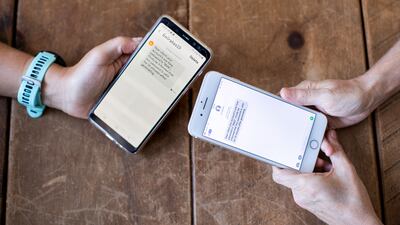
The use of technology in everyday lives has led to growth in scams and fraud. Reem Mohammed / The National -

Phishing is one of the most common methods used by fraudsters and it involves sending an unsolicited email that appears to be from a financial institution or online retailer. The National -
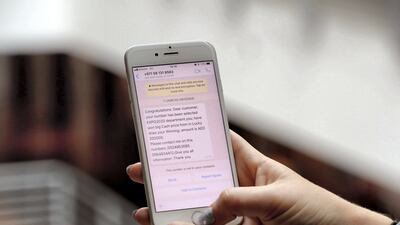
Smishing — the SMS equivalent of phishing — is where fraudsters falsify the telephone number so it appears to be a genuine text from a bank or well-known company. Chris Whiteoak / The National -

Vishing is the telephone equivalent of phishing and smishing. Fraudsters may pose as bank staff, police or government officials. Getty Images -

SIM swap involves fraudsters duplicating the SIM of your mobile number without your knowledge or authorisation, allowing them to conduct financial transactions with your bank. AP -

Identity theft is where someone illegally obtains your confidential information, through various ways such as theft of your wallet, bank and utility bill statements, computer intrusion and social networks. Getty Images -
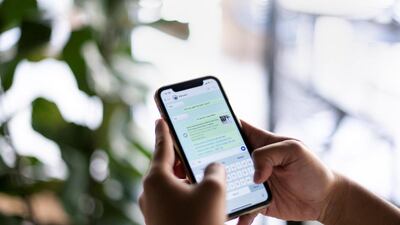
Prize scams involve fraudsters claiming to represent well-known organisations. They contact victims to tell them they have won a cash prize and request them to share confidential banking details to transfer the prize money. -
Instagram influencer Ramon Abbas, known as Hushpuppi, used a technique known as business email compromise. -

The tax authority said some bank customers in the UAE have received phishing emails impersonating financial institutions. EPA -

Jenny Ross, Which? Money editor, says: ‘Scammers are relentless when it comes to wanting our personal information and ultimately our money.’ PA -

Netflix's The Tinder Swindler tells the story of three women who say they were conned out of $500. Photo: @simon_leviev_official via Instagram


_____________________________________
An unsuspecting Mr Thomas shared his bank account and credit card details with the con man to rectify what was claimed to be a fine.
It was all the more plausible, he said, as officials had recently set out a zero-tolerance approach to Covid rule-breaking.
"The ‘officer’ read out my Emirates ID number and even asked me about my daughter who was on a visit," he said. "How could a fraudster have these information?"
“I did not get time to think. I even shared the OTP [one-time password] number that was generated. In a few minutes, Dh 22,000 was wiped off my bank account."
He said the caller continued to pester him and started asking for his wife’s account details.
“When I reached home, my college-going children spoke to the man and told me I got scammed," he said.
"Though I filed a police complaint and also reported the matter to the bank, I could not recover my money."
Scams involving police, Dubai's immigration authority and UAE Central Bank have become more common.
Authorities have warned residents not to divulge their bank details to strangers or click on suspicious emails.
Cryptocurrency trading
Publicity around the fortunes made on cryptocurrencies has led to many more people getting involved in trading.
With that comes new types of financial fraud.
Ankit, a Dubai resident who has a wholesale business in electronic goods, lost Dh100,000 two weeks ago to a cryptocurrency swindle.
“I had a big order and I was trying to convert by USDT [an asset-based cryptocurrency stablecoin] to dirhams," he said, asking that his surname not be used.
I found an agent through the Telegram app and I met his middleman in person and verified their wallet. We even did a small transaction and that earned my trust.
“I was confident because I am used to doing transactions like this for better exchange rates.”

Ankit realised he was walking into a trap after he transferred USDT worth Dh100,000 to the agent’s wallet.
“The next thing I know is that his phone is switched off," he said.
"The middleman washed his hands of the deal, saying the money had gone to his boss’ wallet and that he was unreachable.
"I should have been more careful and gone with a more credible agent."
Although police are investigating the transaction, Ankit said: "It is difficult to predict who is trustworthy and who is scammer."

Import duty and cheap meals
As awareness has grown around existing scams, criminals have branched out into new areas.
Police and prosecutors are particularly concerned about fake special offers for takeaway meals and delivery companies including Aramex and Emirates Post.
In the most convincing scams, the victim receives a link that asks them to pay an import tax.
This can be all the more convincing given recent changes to the threshold on goods imported from abroad.
Scammers have hired designers to make social media adverts as convincing as possible, while large Telegram groups with thousands of purchased phone numbers are used to spread fake links.
“Part of the gang is usually located outside the country and its role is to design fake social media pages and advertisements,” said Mr Al Ali.
“By clicking on the ads, choosing a product and making a payment, all credit card data is transferred electronically to an account."
Although it is difficult to empty someone's bank account without a full login and password, it is easy to quickly buy expensive goods online and sell them on.
“Victims who bought a meal as cheap as Dh30 find themselves charged thousands of dirhams for products they never receive," he said.
“People must know by now that they should never share such details or OTPs, especially since official authorities never ask for this data.
“I urge all members of the community not to click on any suspicious links or lucrative advertisements online.”

