


A leading stem cell scientist has said he was “totally blown away” by advances being made in the UAE.
Pekka Katajisto, director of the MetaStem Centre of Excellence at the University of Helsinki, spoke of the crucial work being carried out in both the Emirates and his homeland of Finland to extend and improve lives during a visit to Abu Dhabi.
He reflected on the progress of the Abu Dhabi Stem Cell Centre as well as the Emirati Genome Programme, which aims to boost understanding of rare genetic disorders and pave the way for early diagnosis.
“I am totally blown away and surprised to find so much activity here that is looking into stem cells and use of genomic data in the UAE,” Dr Katajisto, who is also a professor of ageing biology, told The National after meeting researchers and professors at the Abu Dhabi Stem Cell Centre on Wednesday.
“Somehow, I had the wrong impression that the country mainly focuses on the petroleum industry and, of course, tourism. I realised I haven’t been paying attention to the fast pace of research that is happening here. This has been really an eye-opening visit.
“There is a singularly genetic make-up here. You have a distinct a heritable disease gene load in here. We have our own. And both of us are tapping into the genomic information. In the coming years, it will become common to use genomic data for better health care.”
-
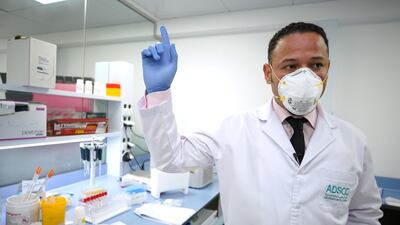
Dr Yendry Ventura began work to set up the Abu Dhabi Stem Cell Centre in late 2018. Victor Besa / The National -
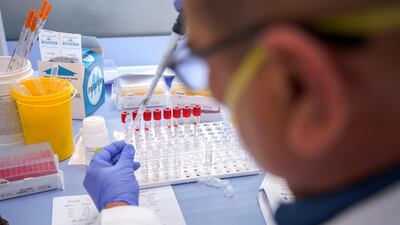
Antonio Alfonso Bencomo, laboratory head, prepares an immuno profile of a patient at the Abu Dhabi Stem Cell Centre. Victor Besa / The National -

Abu Dhabi Stem Cell Centre. Victor Besa / The National -
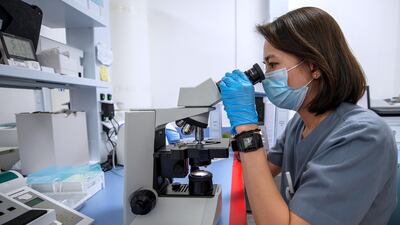
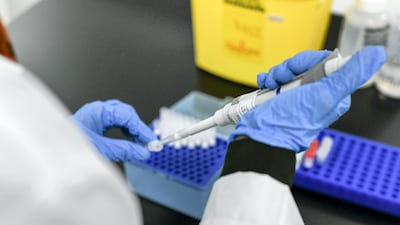
A lab technician at the Abu Dhabi Stem Cell Centre. Victor Besa / The National -
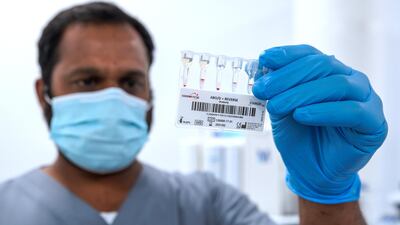
A lab technician performs a blood group analysis at the Abu Dhabi Stem Cell Centre. Victor Besa / The National -
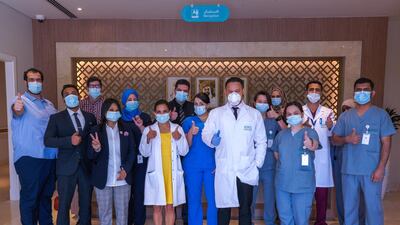
Dr Yendry Ventura and his team at the Abu Dhabi Stem Cell Centre. Victor Besa / The National -
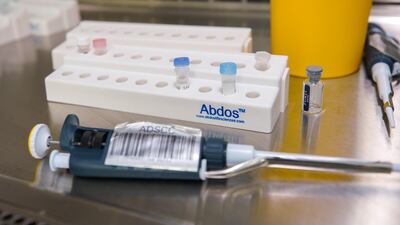
Abu Dhabi Stem Cell Centre. Victor Besa / The National -
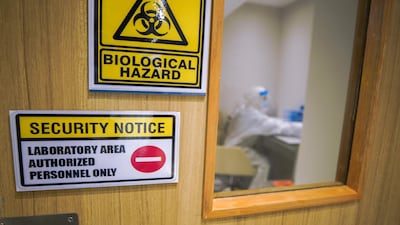
A laboratory technician in the Covid-19 laboratory at the Abu Dhabi Stem Cell Centre. Victor Besa / The National -
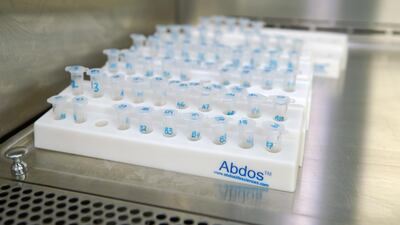
Inside the Abu Dhabi Stem Cell Centre. Victor Besa / The National -
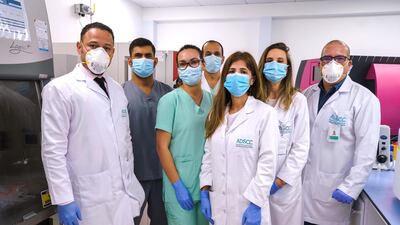
Dr Yendry Ventura, general manager of Abu Dhabi Stem Cell Centre with his team. Victor Besa / The National -
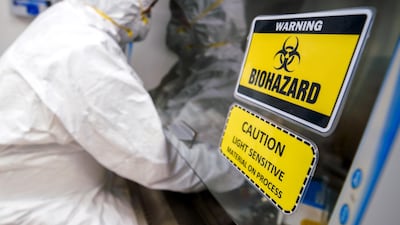
A technician in the Covid-19 laboratory at the Abu Dhabi Stem Cell Centre. Victor Besa / The National


The UAE has been making significant strides in stem cell therapy, which is viewed as key to enhancing health care, particularly in cancer treatment and life expectancy.
Earlier this year, the UAE successfully completed a bone marrow transplant by using longer-term cryogenic freezing of healthy cells.
Dr Katajisto said he is currently studying how insulin secretion can be restored in diabetic patients by transplanting beta cells isolated from the pancreas. Type 1 diabetes is caused by the destruction of pancreatic beta cells, resulting in patients having to replace the lost insulin with injections.
“Once we achieve that to a high enough level, then we have a living drug in our hands — a beta cell that can be transplanted into a human body that is lacking in production of insulin.”
Improving human lifespan
Speaking about his work on longevity and age-related diseases, Dr Katajisto said it was crucial as Finland deals with an ageing population.
“So, we are looking into ways of tissue metabolism and how to renew the muscle tissue, so that we are able to stop cell deterioration even as we age.”
In a young body, stem cells counter the wear and tear of tissue by replacing damaged cells with new ones. However, as we age, the capacity of stem cells declines and the resulting drop in tissue repair manifests as the functional decline associated with ageing, he explained.
Dr Katajisto’s research mainly focuses on understanding why stem cell activity deteriorates with age and how to develop stem cell-based strategies that focus on ageing-related diseases and ailments.
Through what is known as “reprogramming”, he said scientists are able to develop cells with better abilities to deal with many of the problems that an ageing body experiences.
A simple solution to improving health
While scientists are exploring ways to expand human lifespan, Dr Katajisto said we already have a good way of delaying ageing and extending lifespan.
“It is called calorie restriction. All you need to do is eat less. But this is what people don’t want to do.”
He said it has been scientifically proven in primates that, by taking away 30 per cent of the food that they eat, we can increase lifespan.
“You don't need a stem cell therapy. In mice, for example, we can expect to extend their lifespan about 16 to 20 per cent.”
“We have been studying this very intensely in our laboratory, isolating stem cells from the tissues of a mouse that has been on calorie restriction. When we do a tissue plate culture from a starving mouse, their cells regenerate much quickly.”
-
Emiratis in the UAE have been urged to voluntarily give an anonymous blood sample to help expand the data collection for the Emirati Genome Project. All photos by Khushnum Bhandari / The National -

The programme, which officially launched two years ago, has so far collected blood samples and buccal swabs from tens of thousands of people. -
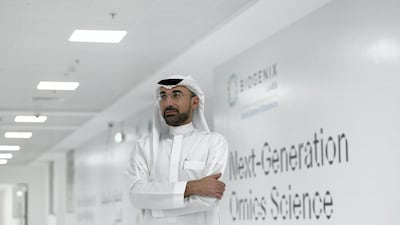
Dr Walid Zaher is the chief research officer for G42 Healthcare and one of the lead researchers for the Emirati Genome Programme -
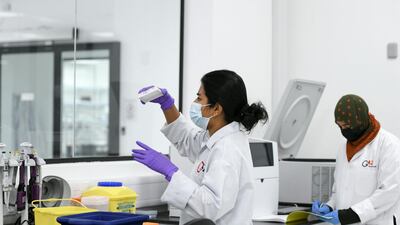
Using the data, experts say they can predict, and in some cases prevent, diseases before they happen -
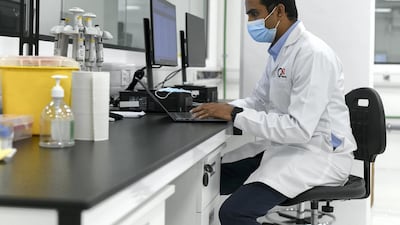
Researchers for the Emirati Genome Programme analyse sample data in the Omics laboratory -
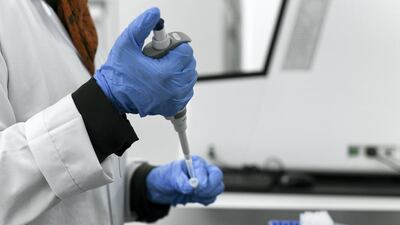
Researchers said the end goal is to collect samples from 100 per cent of the population -
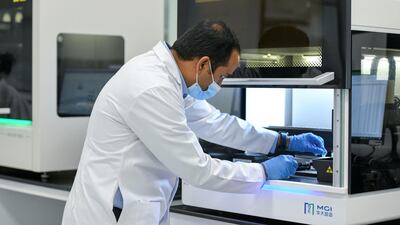
The risk of inheriting a gene mutation increases sharply when closely related individuals marry -
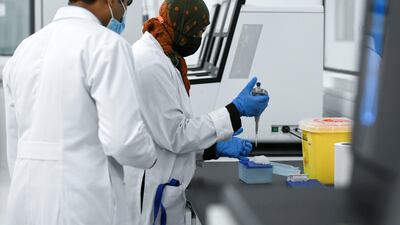
Teams working as part of the programme have already created the first reference genome from more than 1,000 volunteers -
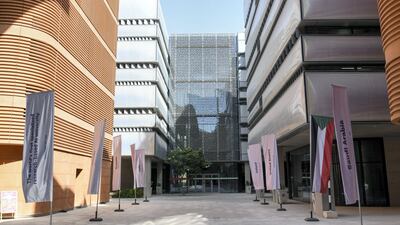
The Omics Centre of Excellence run by G42 Healthcare in Masdar City, Abu Dhabi -
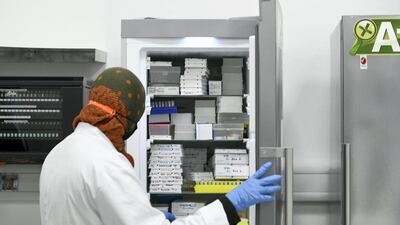
Using biotechnology and Artificial Intelligence, researchers can characterise things like genetic variation and understand how they relate to different diseases -
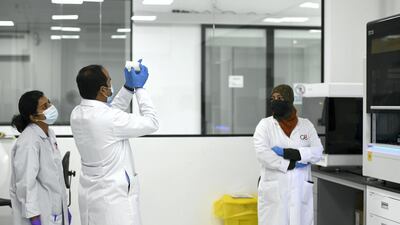
Volunteers can now submit DNA samples at a number of centres across Abu Dhabi including NMC Royal Hospital in Khalifa City, Bareen International Hospital, and NMC Specialty Hospital, Al Ain


The effects of calorie restriction in humans and other primates remain controversial.
But while addressing the issue of lifespan, and using transformative sciences, Dr Katajisto said there are ethical questions of how much we should alter the life cycle.
“Again and again, we get surprised how complicated it is to extend human lifespan because throughout human history, we have studied individuals who have lived longer than 120 years. That is what we see as the maximum lifespan now,” he said.
But, with traditional health care becoming better and better, people live longer but with age-related diseases.
“And eventually, when everybody lives long, everybody has a disease. That puts a burden on the healthcare system,” he continued.
“It is high time for us to be interested in the biology of what drives these diseases, especially the ageing-related diseases, because if we can then tap in there, we can basically give people more healthy years. That is more important.”

