The story of the UAE flag is well known, but one always worth retelling.
It was created by Abdullah Mohammed Al Maainah, then just 19, after reading a newspaper article about a contest to design the new nation’s flag.
Mr Al Maainah, who much later would become the UAE ambassador to Chile, only realised he won as he watched the flag being raised for the first time at Mushrif Palace on December 2, 1971.
The flag is celebrated every year on Flag Day, on November 3.
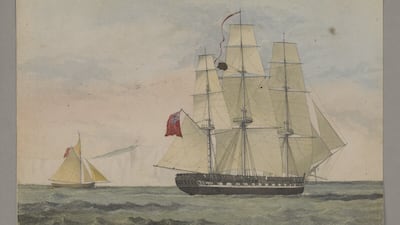
But the full story of flags in the UAE is much older than 50 years. It can be traced back hundreds of years when the sailing dhows of the Arabian Gulf often identified themselves with a red flag, usually in the form of a pennant fluttering from the mast.
How each emirate got its flag before the unification
For British naval ships that increasingly patrolled the Gulf in the early 19th century, though, red flags signalled a potential enemy.
A series of destructive raids by Britain along the coast of the Northern Emirates resulted in a series of enforced treaties, or truces, that effectively gave the British control over the Gulf, and the emirates the name “Trucial States”.
The 1819 General Treaty also established how Arab shipping along the Gulf should identify themselves as non-hostile.
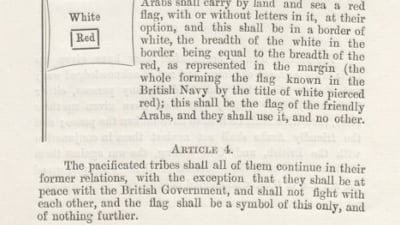
“The friendly Arabs shall carry by land and sea a red flag, with or without letters in it, at their option,” it specified.
“This shall be in a border of white, the breadth of the white in the border being equal to the breadth of the red, as represented in the margin (the whole forming the flag known in the British Navy by the title of white pierced red).”
It concluded “this shall be the flag of the friendly Arabs, and they shall use it, and no other”.
In practice, the designs varied between states, from Bahrain to Ras Al Khaimah. Among the seven Trucial States that now form the UAE, five distinct flags emerged, some with the ruler’s personal touch.
Much later, in the 1950s, the British established the Trucial States Council, a consultative body for the rulers of the seven emirates, and which, almost forgotten, was also given a flag that featured a green seven-point star and a white and red design.
These three shades, along with black, are generally known as the Pan Arab colours, and feature on the flags of nine Arab countries, including the UAE.
Here is the complete guide to the flags of the UAE, past and present.
The current UAE flag
Mr Al Maainah’s design is a green, white and black horizontal tricolour with a vertical red band nearest the flagpole.
To see if it had been chosen, he ran to Mushrif Palace and peeked through the fence as it was raised for the first time on the morning of December 2, 1971.
“There was no wind that day, so I waited until there was a draft to make sure that the flag up there at the pole was mine,” he told The National.
Green represented the Caliphate of the Fatimids, who ruled out of Egypt, while Red was the Ottoman flag and represented blood.
Finally, white symbolised the Prophet Mohammed’s first victory, at the Battle of Badr in 624 CE, but also peace.
Other variations of the Pan Arab colours attribute red to the Hashemite dynasty, but also a quote from the 14th century Iraqi poet Safi Al Din Al Hilli: “White are our acts, black our battles, green our fields, and red our swords”.
He is reported to have been presented with a number of alternatives created by a British diplomat, Sir Mark Sykes.
Ironically, Sykes, with the French diplomat François Picot, would that year also draw up the infamous Sykes-Picot Agreement, which created many of the divisions in the Middle East that still exist today.
Abu Dhabi's flag
The flag of Abu Dhabi is still occasionally seen today. It is red, with a white square in the top corner.
In fact, this is a relatively new version. Until the late 1950s, Abu Dhabi used a plain red flag, at least on land.
In 1958, the then Ruler of Abu Dhabi, Sheikh Shakbut bin Sultan Al Nahyan, announced to Britain that he would be adding a white square “on its upper side corner to take one third of the width and slightly more than one third of the length of the flag”.
It was flown for the first time on February 27, 1958, and was used for state occasions until December 1971, when the UAE flag was adopted.
Dubai and Ajman's flag
The flag of Dubai is red, with a white band next to the hoist, as the flag staff is technically known. In the early 1960s, oil companies also agreed to fly the Dubai flag when operating in the emirate. Ajman’s official flag also uses the same design.
Sharjah and Ras Al Khaimah's flag
The fact Sharjah and Ras Al Khaimah use the same design is also a reflection of their past, with both Emirates ruled by branches of the Al Qasimi family.
The flag is red with a white border, whose width is a quarter of the total and most closely resembles the design proposed by the British in the 1820, perhaps unsurprisingly, since the British military expeditions that led to the signing of the treaty were directed at the Al Qasimis.
Umm Al Quwain's flag
The flag of Umm Al Quwain is a design created in 1961 by the ruler, Sheikh Ahmad bin Rashid Al Mualla, who had ruled the Emirate since 1928 and was the oldest leader at the ceremony to create the UAE in 1971.
The flag features a white band next to the hoist, white crescent moon and a five-point star, both symbols of Islam.
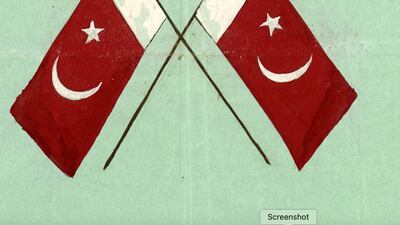
According to British diplomatic files, the ruler initially wished a plain red background, but added a white band after it was pointed out the original design might be confused with the flag of Turkey. Its official use was confirmed in May, 1961.
Before that date, Umm Al Quwain had adopted the same design as Dubai and Ajman.
Fujairah's flag
Fujairah’s flag reflects its history. At the time of the signing of the General Treaty with Britain in 1819, it was considered part of the Sultanate of Muscat, and adopted the plain red flag used there. Around 1850, it came under Sharjah, and was accepted as an emirate in 1902, although the UK government did not recognise it as a Trucial State until 1952.
The Ruler of Fujairah, Sheikh Mohammed bin Hamad Al Sharqi, at this point replaced the red flag with one that included the name of the emirate in white Arabic letters.
In 1961, Fujairah is understood to have reverted to the old red flag until 1975, when the current ruler, Sheikh Hamad bin Mohammed Al Sharqi, replaced it with the flag of the UAE.
The flag of the Trucial States Council
Established in 1952, the Trucial States Council was a consultative body set up by the UK and chaired by the political agent, Britain’s top administrative official who was replaced by an ambassador in 1971.
The council consisted of the rulers of the seven emirates, but lacked funding and met just twice a year. It did, however, have a flag. The design incorporated red stripes at the top and bottom, with white between, and a seven-point green star in the centre, each point presumably to represent an emirate.
The flag is almost identical with that of Lebanon, which features a cedar tree rather than a star, but there is no indication this in anything other than a coincidence.
It does not seem to have been widely used, but badges of the Trucial Oman Scouts, the paramilitary force established by Britain, sometimes use a similar colour scheme, with the crossed khanjar daggers of the regiment instead of a star.

THE SPECS
Aston Martin Rapide AMR
Engine: 6.0-litre V12
Transmission: Touchtronic III eight-speed automatic
Power: 595bhp
Torque: 630Nm
Price: Dh999,563
More from Rashmee Roshan Lall
The biog
Title: General Practitioner with a speciality in cardiology
Previous jobs: Worked in well-known hospitals Jaslok and Breach Candy in Mumbai, India
Education: Medical degree from the Government Medical College in Nagpur
How it all began: opened his first clinic in Ajman in 1993
Family: a 90-year-old mother, wife and two daughters
Remembers a time when medicines from India were purchased per kilo
THE NEW BATCH'S FOCUS SECTORS
AiFlux – renewables, oil and gas
DevisionX – manufacturing
Event Gates – security and manufacturing
Farmdar – agriculture
Farmin – smart cities
Greener Crop – agriculture
Ipera.ai – space digitisation
Lune Technologies – fibre-optics
Monak – delivery
NutzenTech – environment
Nybl – machine learning
Occicor – shelf management
Olymon Solutions – smart automation
Pivony – user-generated data
PowerDev – energy big data
Sav – finance
Searover – renewables
Swftbox – delivery
Trade Capital Partners – FinTech
Valorafutbol – sports and entertainment
Workfam – employee engagement
The White Lotus: Season three
Creator: Mike White
Starring: Walton Goggins, Jason Isaacs, Natasha Rothwell
Rating: 4.5/5
Final scores
18 under: Tyrrell Hatton (ENG)
- 14: Jason Scrivener (AUS)
-13: Rory McIlroy (NIR)
-12: Rafa Cabrera Bello (ESP)
-11: David Lipsky (USA), Marc Warren (SCO)
-10: Tommy Fleetwood (ENG), Chris Paisley (ENG), Matt Wallace (ENG), Fabrizio Zanotti (PAR)
GAC GS8 Specs
Engine: 2.0-litre 4cyl turbo
Power: 248hp at 5,200rpm
Torque: 400Nm at 1,750-4,000rpm
Transmission: 8-speed auto
Fuel consumption: 9.1L/100km
On sale: Now
Price: From Dh149,900
What is a robo-adviser?
Robo-advisers use an online sign-up process to gauge an investor’s risk tolerance by feeding information such as their age, income, saving goals and investment history into an algorithm, which then assigns them an investment portfolio, ranging from more conservative to higher risk ones.
These portfolios are made up of exchange traded funds (ETFs) with exposure to indices such as US and global equities, fixed-income products like bonds, though exposure to real estate, commodity ETFs or gold is also possible.
Investing in ETFs allows robo-advisers to offer fees far lower than traditional investments, such as actively managed mutual funds bought through a bank or broker. Investors can buy ETFs directly via a brokerage, but with robo-advisers they benefit from investment portfolios matched to their risk tolerance as well as being user friendly.
Many robo-advisers charge what are called wrap fees, meaning there are no additional fees such as subscription or withdrawal fees, success fees or fees for rebalancing.
Dust and sand storms compared
Sand storm
- Particle size: Larger, heavier sand grains
- Visibility: Often dramatic with thick "walls" of sand
- Duration: Short-lived, typically localised
- Travel distance: Limited
- Source: Open desert areas with strong winds
Dust storm
- Particle size: Much finer, lightweight particles
- Visibility: Hazy skies but less intense
- Duration: Can linger for days
- Travel distance: Long-range, up to thousands of kilometres
- Source: Can be carried from distant regions
AUSTRALIA SQUAD
Aaron Finch, Matt Renshaw, Brendan Doggett, Michael Neser, Usman Khawaja, Shaun Marsh, Mitchell Marsh, Tim Paine (captain), Travis Head, Marnus Labuschagne, Nathan Lyon, Jon Holland, Ashton Agar, Mitchell Starc, Peter Siddle
MATCH INFO
Manchester City 1 Chelsea 0
De Bruyne (70')
Man of the Match: Kevin de Bruyne (Manchester City)
New UK refugee system
- A new “core protection” for refugees moving from permanent to a more basic, temporary protection
- Shortened leave to remain - refugees will receive 30 months instead of five years
- A longer path to settlement with no indefinite settled status until a refugee has spent 20 years in Britain
- To encourage refugees to integrate the government will encourage them to out of the core protection route wherever possible.
- Under core protection there will be no automatic right to family reunion
- Refugees will have a reduced right to public funds
Ordinary Virtues: Moral Order in a Divided World by Michael Ignatieff
Harvard University Press
ALRAWABI%20SCHOOL%20FOR%20GIRLS
%3Cp%3ECreator%3A%20Tima%20Shomali%3C%2Fp%3E%0A%3Cp%3EStarring%3A%C2%A0Tara%20Abboud%2C%C2%A0Kira%20Yaghnam%2C%20Tara%20Atalla%3C%2Fp%3E%0A%3Cp%3ERating%3A%204%2F5%3C%2Fp%3E%0A
The Greatest Royal Rumble card as it stands
50-man Royal Rumble - names entered so far include Braun Strowman, Daniel Bryan, Kurt Angle, Big Show, Kane, Chris Jericho, The New Day and Elias
Universal Championship Brock Lesnar (champion) v Roman Reigns in a steel cage match
WWE World Heavyweight ChampionshipAJ Styles (champion) v Shinsuke Nakamura
Intercontinental Championship Seth Rollins (champion) v The Miz v Finn Balor v Samoa Joe
United States Championship Jeff Hardy (champion) v Jinder Mahal
SmackDown Tag Team Championship The Bludgeon Brothers (champions) v The Usos
Raw Tag Team Championship (currently vacant) Cesaro and Sheamus v Matt Hardy and Bray Wyatt
Casket match The Undertaker v Chris Jericho
Singles match John Cena v Triple H
Cruiserweight Championship Cedric Alexander v tba
Europe's top EV producers
- Norway (63% of cars registered in 2021)
- Iceland (33%)
- Netherlands (20%)
- Sweden (19%)
- Austria (14%)
- Germany (14%)
- Denmark (13%)
- Switzerland (13%)
- United Kingdom (12%)
- Luxembourg (10%)
Source: VCOe
Queen
Nicki Minaj
(Young Money/Cash Money)
ABU%20DHABI'S%20KEY%20TOURISM%20GOALS%3A%20BY%20THE%20NUMBERS
%3Cp%3EBy%202030%2C%20Abu%20Dhabi%20aims%20to%20achieve%3A%3C%2Fp%3E%0A%3Cp%3E%3Cstrong%3E%E2%80%A2%2039.3%20million%20visitors%2C%3C%2Fstrong%3E%20nearly%2064%25%20up%20from%202023%3C%2Fp%3E%0A%3Cp%3E%3Cstrong%3E%E2%80%A2%20Dh90%20billion%20contribution%20to%20GDP%2C%3C%2Fstrong%3E%20about%2084%25%20more%20than%20Dh49%20billion%20in%202023%3C%2Fp%3E%0A%3Cp%3E%3Cstrong%3E%E2%80%A2%20178%2C000%20new%20jobs%2C%3C%2Fstrong%3E%20bringing%20the%20total%20to%20about%20366%2C000%3C%2Fp%3E%0A%3Cp%3E%3Cstrong%3E%E2%80%A2%2052%2C000%20hotel%20rooms%2C%3C%2Fstrong%3E%20up%2053%25%20from%2034%2C000%20in%202023%3C%2Fp%3E%0A%3Cp%3E%3Cstrong%3E%E2%80%A2%207.2%20million%20international%20visitors%2C%3C%2Fstrong%3E%20almost%2090%25%20higher%20compared%20to%202023's%203.8%20million%3C%2Fp%3E%0A%3Cp%3E%3Cstrong%3E%E2%80%A2%203.9%20international%20overnight%20hotel%20stays%2C%3C%2Fstrong%3E%2022%25%20more%20from%203.2%20nights%20in%202023%3C%2Fp%3E%0A
The%20US%20Congress%20explained
%3Cp%3E-%20Congress%20is%20one%20of%20three%20branches%20of%20the%20US%20government%2C%20and%20the%20one%20that%20creates%20the%20nation's%20federal%20laws%3C%2Fp%3E%0A%3Cp%3E-%20Congress%20is%20divided%20into%20two%20chambers%3A%20The%20House%20of%20Representatives%20and%20the%20Senate%3C%2Fp%3E%0A%3Cp%3E-%C2%A0The%20House%20is%20made%20up%20of%20435%20members%20based%20on%20a%20state's%20population.%20House%20members%20are%20up%20for%20election%20every%20two%20years%3C%2Fp%3E%0A%3Cp%3E-%20A%20bill%20must%20be%20approved%20by%20both%20the%20House%20and%20Senate%20before%20it%20goes%20to%20the%20president's%20desk%20for%20signature%3C%2Fp%3E%0A%3Cp%3E-%20A%20political%20party%20needs%20218%20seats%20to%20be%20in%20control%20of%20the%20House%20of%20Representatives%3C%2Fp%3E%0A%3Cp%3E-%20The%20Senate%20is%20comprised%20of%20100%20members%2C%20with%20each%20state%20receiving%20two%20senators.%20Senate%20members%20serve%20six-year%20terms%3C%2Fp%3E%0A%3Cp%3E-%20A%20political%20party%20needs%2051%20seats%20to%20control%20the%20Senate.%20In%20the%20case%20of%20a%2050-50%20tie%2C%20the%20party%20of%20the%20president%20controls%20the%20Senate%3C%2Fp%3E%0A
MATCH INFO
Uefa Champions League, semi-final result:
Liverpool 4-0 Barcelona
Liverpool win 4-3 on aggregate
Champions Legaue final: June 1, Madrid
Our legal columnist
Name: Yousef Al Bahar
Advocate at Al Bahar & Associate Advocates and Legal Consultants, established in 1994
Education: Mr Al Bahar was born in 1979 and graduated in 2008 from the Judicial Institute. He took after his father, who was one of the first Emirati lawyers
THE TWIN BIO
Their favourite city: Dubai
Their favourite food: Khaleeji
Their favourite past-time : walking on the beach
Their favorite quote: ‘we rise by lifting others’ by Robert Ingersoll
Company profile
Name: Dukkantek
Started: January 2021
Founders: Sanad Yaghi, Ali Al Sayegh and Shadi Joulani
Based: UAE
Number of employees: 140
Sector: B2B Vertical SaaS(software as a service)
Investment: $5.2 million
Funding stage: Seed round
Investors: Global Founders Capital, Colle Capital Partners, Wamda Capital, Plug and Play, Comma Capital, Nowais Capital, Annex Investments and AMK Investment Office
Mercer, the investment consulting arm of US services company Marsh & McLennan, expects its wealth division to at least double its assets under management (AUM) in the Middle East as wealth in the region continues to grow despite economic headwinds, a company official said.
Mercer Wealth, which globally has $160 billion in AUM, plans to boost its AUM in the region to $2-$3bn in the next 2-3 years from the present $1bn, said Yasir AbuShaban, a Dubai-based principal with Mercer Wealth.
“Within the next two to three years, we are looking at reaching $2 to $3 billion as a conservative estimate and we do see an opportunity to do so,” said Mr AbuShaban.
Mercer does not directly make investments, but allocates clients’ money they have discretion to, to professional asset managers. They also provide advice to clients.
“We have buying power. We can negotiate on their (client’s) behalf with asset managers to provide them lower fees than they otherwise would have to get on their own,” he added.
Mercer Wealth’s clients include sovereign wealth funds, family offices, and insurance companies among others.
From its office in Dubai, Mercer also looks after Africa, India and Turkey, where they also see opportunity for growth.
Wealth creation in Middle East and Africa (MEA) grew 8.5 per cent to $8.1 trillion last year from $7.5tn in 2015, higher than last year’s global average of 6 per cent and the second-highest growth in a region after Asia-Pacific which grew 9.9 per cent, according to consultancy Boston Consulting Group (BCG). In the region, where wealth grew just 1.9 per cent in 2015 compared with 2014, a pickup in oil prices has helped in wealth generation.
BCG is forecasting MEA wealth will rise to $12tn by 2021, growing at an annual average of 8 per cent.
Drivers of wealth generation in the region will be split evenly between new wealth creation and growth of performance of existing assets, according to BCG.
Another general trend in the region is clients’ looking for a comprehensive approach to investing, according to Mr AbuShaban.
“Institutional investors or some of the families are seeing a slowdown in the available capital they have to invest and in that sense they are looking at optimizing the way they manage their portfolios and making sure they are not investing haphazardly and different parts of their investment are working together,” said Mr AbuShaban.
Some clients also have a higher appetite for risk, given the low interest-rate environment that does not provide enough yield for some institutional investors. These clients are keen to invest in illiquid assets, such as private equity and infrastructure.
“What we have seen is a desire for higher returns in what has been a low-return environment specifically in various fixed income or bonds,” he said.
“In this environment, we have seen a de facto increase in the risk that clients are taking in things like illiquid investments, private equity investments, infrastructure and private debt, those kind of investments were higher illiquidity results in incrementally higher returns.”
The Abu Dhabi Investment Authority, one of the largest sovereign wealth funds, said in its 2016 report that has gradually increased its exposure in direct private equity and private credit transactions, mainly in Asian markets and especially in China and India. The authority’s private equity department focused on structured equities owing to “their defensive characteristics.”