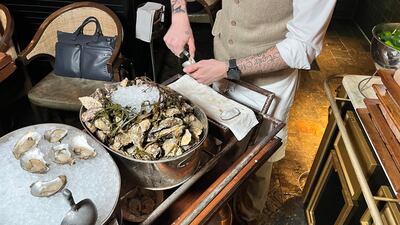
• Oysters are typically farmed close to shore but these oysters are farmed off shore to take advantage of the warmer climate. Chris Whiteoak / The National
    Oysters are typically farmed close to shore but these oysters are farmed off shore to take advantage of the warmer climate. Chris Whiteoak / The National
  • Dibba Bay Oysters farm in Fujairah, where millions of oysters are produced. Chris Whiteoak / The National
    Dibba Bay Oysters farm in Fujairah, where millions of oysters are produced. Chris Whiteoak / The National
  • Oysters grow in a series of graduated nets, known as lanterns, metres beneath the surface of the sea. ocean farm. Chris Whiteoak / The National
    Oysters grow in a series of graduated nets, known as lanterns, metres beneath the surface of the sea. ocean farm. Chris Whiteoak / The National
  • Oysters grow in a series of graduated nets, known as lanterns, metres beneath the surface of the sea. ocean farm. Chris Whiteoak / The National
    Oysters grow in a series of graduated nets, known as lanterns, metres beneath the surface of the sea. ocean farm. Chris Whiteoak / The National
  • The lanterns protect the oysters while allowing the water to flow through so they can feed. Chris Whiteoak / The National
    The lanterns protect the oysters while allowing the water to flow through so they can feed. Chris Whiteoak / The National
  • The lanterns are filled with oysters that take about eight months to grow before being harvested. Chris Whiteoak / The National
    The lanterns are filled with oysters that take about eight months to grow before being harvested. Chris Whiteoak / The National
  • Oysters are harvested from the aqua farm. They take about eight months to grow completely. Chris Whiteoak / The National
    Oysters are harvested from the aqua farm. They take about eight months to grow completely. Chris Whiteoak / The National
  • Workers pull lanterns full of oysters from the sea. Chris Whiteoak / The National
    Workers pull lanterns full of oysters from the sea. Chris Whiteoak / The National
  • Between 5,000 and 10,000 baby oysters fit in each lantern. Once fully grown, that reduces to about 400 to 500. Chris Whiteoak / The National
    Between 5,000 and 10,000 baby oysters fit in each lantern. Once fully grown, that reduces to about 400 to 500. Chris Whiteoak / The National
  • Ramie Murray, founder of Dibba Bay Oysters, is a Scottish expatriate who has lived in the UAE for more than two decades.. Chris Whiteoak / The National
    Ramie Murray, founder of Dibba Bay Oysters, is a Scottish expatriate who has lived in the UAE for more than two decades.. Chris Whiteoak / The National
  • Oysters are weighed in the weighing room back at the land processing area. Chris Whiteoak / The National
    Oysters are weighed in the weighing room back at the land processing area. Chris Whiteoak / The National
  • After passing through the offshore farm and processing platform, the oysters are washed down, cleaned and individually weighed at the on-shore sorting facility before being packed and shipped for local or international export. Chris Whiteoak / The National
    After passing through the offshore farm and processing platform, the oysters are washed down, cleaned and individually weighed at the on-shore sorting facility before being packed and shipped for local or international export. Chris Whiteoak / The National
  • Cleaned oysters are packaged so they can be sold. Chris Whiteoak / The National
    Cleaned oysters are packaged so they can be sold. Chris Whiteoak / The National
  • Cleaned, freshly harvested oysters are ready for packaging. Chris Whiteoak / The National
    Cleaned, freshly harvested oysters are ready for packaging. Chris Whiteoak / The National
  • Harvested oysters are cleaned before they are packaged and sold. Chris Whiteoak / The National
    Harvested oysters are cleaned before they are packaged and sold. Chris Whiteoak / The National
  • Oysters freshly pulled from the sea are taken for processing. Chris Whiteoak / The National
    Oysters freshly pulled from the sea are taken for processing. Chris Whiteoak / The National
  • A worker separates the oysters based on their size at the land processing platform. Chris Whiteoak / The National
    A worker separates the oysters based on their size at the land processing platform. Chris Whiteoak / The National
  • Ramie Murray, founder of Dibba Bay Oysters, buys baby oysters from the UK and France before growing them in the waters off Fujairah. Chris Whiteoak / The National
    Ramie Murray, founder of Dibba Bay Oysters, buys baby oysters from the UK and France before growing them in the waters off Fujairah. Chris Whiteoak / The National
  • Oysters pass through the land processing area where they are weighed, cleaned and packaged for sale. Chris Whiteoak / The National
    Oysters pass through the land processing area where they are weighed, cleaned and packaged for sale. Chris Whiteoak / The National
  • The processing platform, where the oysters are separated based on size and cleaned before packaging. Chris Whiteoak / The National
    The processing platform, where the oysters are separated based on size and cleaned before packaging. Chris Whiteoak / The National

How a UAE oyster farm is helping the environment off the Fujairah coast


Daniel Bardsley
  • English
  • Arabic

As a source of pearls, the oyster has for centuries been closely entwined with the history and traditional culture of the UAE.

Other industries have long since taken over from pearl diving, but the farming of oysters — for food — has in recent years been thriving off the Emirates' east coast.

Aquaculture in general has sometimes been associated with environmental harm, but the production of oysters, which are bivalve molluscs, is often cited as having a positive impact on the natural world.

Tying in with this, Dibba Bay Oysters farm in Fujairah recently secured Friend of the Sea Sustainable Aquaculture certification through a programme run by the Italian-based World Sustainability Organisation, after its aquaculture facilities were found to meet strict sustainable policies and waste management regulations.

Farming bivalves is very often a low-impact way of producing animal protein compared to the farming of fish in general
Paolo Bray,
Friend of the Sea programme

Paolo Bray, founder and director of the Friend of the Sea programme, said that oyster farms often improve biodiversity because they increase the surface area of a habitat as much as 50-fold.

He said this leads to greater numbers of sea creatures such as barnacles, anemones and hooked mussels, some of which provide food for predators.

“These oyster reefs are used as spawning areas,” Mr Bray said. “Farming bivalves is very often a low-impact way of producing animal protein compared to the farming of fish in general.”

Oysters filter the water and can sequester carbon, so have a positive impact in terms of carbon emissions, Mr Bray said.

Oysters' positive impact

Oysters do not have to be fed and while they do produce solid waste, this is not harmful to the surrounding waters. Chris Whiteoak / The National

Demand for seafood is growing globally, and aquaculture — the cultivation of fish, crustaceans, molluscs and other aquatic organisms — accounts for much of the increased output.

For the past 35 years, the amount of fish and other marine organisms captured from the wild has remained roughly stable at between about 75 and 86 million tonnes a year, according to figures published by the United Nations’ Food and Agriculture Organisation (FAO).

Harvests are not likely to grow because stocks are already under significant pressure.

Meanwhile, aquaculture in inland waters has increased its output from six million tonnes a year in 1987 to 54 million tonnes in 2020, while annual output from aquaculture in marine waters rose from four million tonnes to 33 million tonnes.

Aquaculture, particularly when it involves rearing fish, has sometimes been linked to environmental damage, such as through the build-up of nutrients from fish feed and waste, which can lead to algal blooms that deplete waters of oxygen.

However, oysters do not have to be fed and while they do produce solid waste, this is not harmful to the surrounding waters.

Welfare is much less of a factor than with finned fish, where concerns have been raised over, for example, lice infestations.

“The fact that no feed is needed and there’s no need to use additional chemical substances or growth hormones, as you’re finding with finned fish normally, [means] the impact on the environment is much less,” Mr Bray said.

“[Consumers] should have less concern as far as oyster welfare during the farming phase and transport phase compared with fish species.”

Environmental certification schemes for seafood can have a significant impact, Mr Bray indicated, citing a dolphin-safe tuna programme he has previously been involved with, which he said reduced the accidental catching of dolphins by more than 90 per cent in one area.

Friend of the Sea certification has been awarded to more than 1,500 companies in over 80 countries, and can assist farms by, for example, offering networking opportunities with potential buyers interested in sustainable products. Other oyster farms certified are in Australia, Italy, Monaco and the UK.

Criteria farms are assessed on include impact on important habitats, complying with water quality standards, not using harmful antifouling agents or growth hormones, and managing waste and energy use well.

Supplies the UAE market

Ramie Murray said the farm produces 300,000 to 400,000 oysters per month. Jordan Bickerstaffe / Liquorice Productions

Ramie Murray, chief executive of Dibba Bay Oysters farm, said that the company’s operations were “low intensity”, adding that the nets holding the oysters were “as a floating reef” that created habitats for other marine life.

“We’ve got them very spread out,” he said. “They’re feeding naturally from phytoplankton. They build their shells from the minerals they find in the water.”

Mr Murray said, however, that the farm’s biggest positive environmental impact was that it supplied the UAE market with oysters that would otherwise be flown in. The farm has approximately 35 per cent share of the oyster market in the Emirates.

It is the only oyster farm of its kind in the Middle East and cultivates Pacific oysters, which are originally from Japan.

The farm grew “quite slowly at the beginning” but has since expanded faster and now produces 300,000 to 400,000 oysters per month. Mr Murray said production could be increased to 800,000 per month.

Mr Murray said the farm applied for Friend of the Sea certification because it was a fully third-party, which he contrasted with some other certification programmes with roots in the industry.

He said the company was “very happy with the rigour” of the certification process, which involved having to document many procedures around how the company works.

As well as exports to other GCC countries, Dibba Bay sends its oysters to the Maldives, the Seychelles, Malaysia, Mauritius and Hong Kong, which Mr Murray said typically sources oysters from France or the United States.

“There’s the carbon emissions from us exporting [to Hong Kong], but it’s less than half from France of the USA,” he said. “China is an enormous producer, but it consumes them all.”

Dibba Bay’s environmental impact also includes efforts to support a coral nursery project to recreate coral reef ecosystems using oyster shells.

Discarded oyster shells used to help create artificial reefs in the UAE — in pictures

  • Hundreds of thousands of discarded oyster shells are being used to help create artificial reefs in the UAE. Photo: Dubai Oyster Project
    Hundreds of thousands of discarded oyster shells are being used to help create artificial reefs in the UAE. Photo: Dubai Oyster Project
  • The Dubai Oyster Project uses discarded oyster shells from The Maine restaurants. Photo: The Dubai Oyster Project
    The Dubai Oyster Project uses discarded oyster shells from The Maine restaurants. Photo: The Dubai Oyster Project
  • To date, more than 400,000 oyster shells have been donated to The Arbor School for the project. Photo: The Dubai Oyster Project
    To date, more than 400,000 oyster shells have been donated to The Arbor School for the project. Photo: The Dubai Oyster Project
  • More than 250,000 used oyster shells have been used to help create artifical reefs in the UAE so far. Photo: Dubai Oyster Project
    More than 250,000 used oyster shells have been used to help create artifical reefs in the UAE so far. Photo: Dubai Oyster Project
  • Joey Ghazal, pictured, co-founded the project with long-time friend and keen environmentalist Fadi Abu Ghali. Photo: Diala Shuhaiber
    Joey Ghazal, pictured, co-founded the project with long-time friend and keen environmentalist Fadi Abu Ghali. Photo: Diala Shuhaiber
THE SPECS – Honda CR-V Touring AWD

Engine: 2.4-litre 4-cylinder

Power: 184hp at 6,400rpm

Torque: 244Nm at 3,900rpm

Transmission: Continuously Variable Transmission (CVT)

0-100kmh in 9.4 seconds

Top speed: 202kmh

Fuel consumption: 6.8L/100km

Price: From Dh122,900

Ten tax points to be aware of in 2026

1. Domestic VAT refund amendments: request your refund within five years

If a business does not apply for the refund on time, they lose their credit.

2. E-invoicing in the UAE

Businesses should continue preparing for the implementation of e-invoicing in the UAE, with 2026 a preparation and transition period ahead of phased mandatory adoption. 

3. More tax audits

Tax authorities are increasingly using data already available across multiple filings to identify audit risks. 

4. More beneficial VAT and excise tax penalty regime

Tax disputes are expected to become more frequent and more structured, with clearer administrative objection and appeal processes. The UAE has adopted a new penalty regime for VAT and excise disputes, which now mirrors the penalty regime for corporate tax.

5. Greater emphasis on statutory audit

There is a greater need for the accuracy of financial statements. The International Financial Reporting Standards standards need to be strictly adhered to and, as a result, the quality of the audits will need to increase.

6. Further transfer pricing enforcement

Transfer pricing enforcement, which refers to the practice of establishing prices for internal transactions between related entities, is expected to broaden in scope. The UAE will shortly open the possibility to negotiate advance pricing agreements, or essentially rulings for transfer pricing purposes. 

7. Limited time periods for audits

Recent amendments also introduce a default five-year limitation period for tax audits and assessments, subject to specific statutory exceptions. While the standard audit and assessment period is five years, this may be extended to up to 15 years in cases involving fraud or tax evasion. 

8. Pillar 2 implementation 

Many multinational groups will begin to feel the practical effect of the Domestic Minimum Top-Up Tax (DMTT), the UAE's implementation of the OECD’s global minimum tax under Pillar 2. While the rules apply for financial years starting on or after January 1, 2025, it is 2026 that marks the transition to an operational phase.

9. Reduced compliance obligations for imported goods and services

Businesses that apply the reverse-charge mechanism for VAT purposes in the UAE may benefit from reduced compliance obligations. 

10. Substance and CbC reporting focus

Tax authorities are expected to continue strengthening the enforcement of economic substance and Country-by-Country (CbC) reporting frameworks. In the UAE, these regimes are increasingly being used as risk-assessment tools, providing tax authorities with a comprehensive view of multinational groups’ global footprints and enabling them to assess whether profits are aligned with real economic activity. 

Contributed by Thomas Vanhee and Hend Rashwan, Aurifer

Quick pearls of wisdom

Focus on gratitude: And do so deeply, he says. “Think of one to three things a day that you’re grateful for. It needs to be specific, too, don’t just say ‘air.’ Really think about it. If you’re grateful for, say, what your parents have done for you, that will motivate you to do more for the world.”

Know how to fight: Shetty married his wife, Radhi, three years ago (he met her in a meditation class before he went off and became a monk). He says they’ve had to learn to respect each other’s “fighting styles” – he’s a talk it-out-immediately person, while she needs space to think. “When you’re having an argument, remember, it’s not you against each other. It’s both of you against the problem. When you win, they lose. If you’re on a team you have to win together.” 

Her most famous song

Aghadan Alqak (Would I Ever Find You Again)?

Would I ever find you again
You, the heaven of my love, my yearning and madness;
You, the kiss to my soul, my cheer and
sadness?
Would your lights ever break the night of my eyes again?
Would I ever find you again?
This world is volume and you're the notion,
This world is night and you're the lifetime,
This world is eyes and you're the vision,
This world is sky and you're the moon time,
Have mercy on the heart that belongs to you.

Lyrics: Al Hadi Adam; Composer: Mohammed Abdel Wahab

PREMIER LEAGUE FIXTURES

Saturday (UAE kick-off times)

Watford v Leicester City (3.30pm)

Brighton v Arsenal (6pm)

West Ham v Wolves (8.30pm)

Bournemouth v Crystal Palace (10.45pm)

Sunday

Newcastle United v Sheffield United (5pm)

Aston Villa v Chelsea (7.15pm)

Everton v Liverpool (10pm)

Monday

Manchester City v Burnley (11pm)

It Was Just an Accident

Director: Jafar Panahi

Stars: Vahid Mobasseri, Mariam Afshari, Ebrahim Azizi, Hadis Pakbaten, Majid Panahi, Mohamad Ali Elyasmehr

Rating: 4/5

Suggested picnic spots

Abu Dhabi
Umm Al Emarat Park
Yas Gateway Park
Delma Park
Al Bateen beach
Saadiyaat beach
The Corniche
Zayed Sports City
 
Dubai
Kite Beach
Zabeel Park
Al Nahda Pond Park
Mushrif Park
Safa Park
Al Mamzar Beach Park
Al Qudrah Lakes 

Company%20Profile
%3Cp%3E%3Cstrong%3EName%3A%3C%2Fstrong%3E%20HyveGeo%3Cbr%3E%3Cstrong%3EStarted%3A%3C%2Fstrong%3E%202023%3Cbr%3E%3Cstrong%3EFounders%3A%3C%2Fstrong%3E%20Abdulaziz%20bin%20Redha%2C%20Dr%20Samsurin%20Welch%2C%20Eva%20Morales%20and%20Dr%20Harjit%20Singh%3Cbr%3E%3Cstrong%3EBased%3A%20%3C%2Fstrong%3ECambridge%20and%20Dubai%3Cbr%3E%3Cstrong%3ENumber%20of%20employees%3A%3C%2Fstrong%3E%208%3Cbr%3E%3Cstrong%3EIndustry%3A%20%3C%2Fstrong%3ESustainability%20%26amp%3B%20Environment%3Cbr%3E%3Cstrong%3EFunding%3A%20%3C%2Fstrong%3E%24200%2C000%20plus%20undisclosed%20grant%3Cbr%3E%3Cstrong%3EInvestors%3A%20%3C%2Fstrong%3EVenture%20capital%20and%20government%3C%2Fp%3E%0A
Related
How to protect yourself when air quality drops

Install an air filter in your home.

Close your windows and turn on the AC.

Shower or bath after being outside.

Wear a face mask.

Stay indoors when conditions are particularly poor.

If driving, turn your engine off when stationary.

Mane points for safe home colouring
  • Natural and grey hair takes colour differently than chemically treated hair
  • Taking hair from a dark to a light colour should involve a slow transition through warmer stages of colour
  • When choosing a colour (especially a lighter tone), allow for a natural lift of warmth
  • Most modern hair colours are technique-based, in that they require a confident hand and taught skills
  • If you decide to be brave and go for it, seek professional advice and use a semi-permanent colour
Fifa%20World%20Cup%20Qatar%202022%20
%3Cp%3E%3Cstrong%3EFirst%20match%3A%20%3C%2Fstrong%3ENovember%2020%0D%3Cbr%3E%3Cstrong%3EFinal%2016%20round%3A%20%3C%2Fstrong%3EDecember%203%20to%206%0D%3Cbr%3E%3Cstrong%3EQuarter-finals%3A%20%3C%2Fstrong%3EDecember%209%20and%2010%0D%3Cbr%3E%3Cstrong%3ESemi-finals%3A%20%3C%2Fstrong%3EDecember%2013%20and%2014%0D%3Cbr%3E%3Cstrong%3EFinal%3A%20%3C%2Fstrong%3EDecember%2018%3C%2Fp%3E%0A
UAE currency: the story behind the money in your pockets


Coal Black Mornings

Brett Anderson

Little Brown Book Group 

The specs

Price, base / as tested Dh1,470,000 (est)
Engine 6.9-litre twin-turbo W12
Gearbox eight-speed automatic
Power 626bhp @ 6,000rpm
Torque: 900Nm @ 1,350rpm
Fuel economy, combined 14.0L / 100km

COMPANY%20PROFILE
%3Cp%3E%3Cstrong%3EName%3A%3C%2Fstrong%3E%20Carzaty%2C%20now%20Kavak%3Cbr%3E%3Cstrong%3EBased%3A%3C%2Fstrong%3E%20Dubai%3Cbr%3E%3Cstrong%3ELaunch%20year%3A%20%3C%2Fstrong%3ECarzaty%20launched%20in%202018%2C%20Kavak%20in%20the%20GCC%20launched%20in%202022%3Cbr%3E%3Cstrong%3ENumber%20of%20employees%3A%3C%2Fstrong%3E%20140%3Cbr%3E%3Cstrong%3ESector%3A%3C%2Fstrong%3E%20Automotive%3Cbr%3E%3Cstrong%3EFunding%3A%20%3C%2Fstrong%3ECarzaty%20raised%20%246m%20in%20equity%20and%20%244m%20in%20debt%3B%20Kavak%20plans%20%24130m%20investment%20in%20the%20GCC%3C%2Fp%3E%0A
What to watch out for:

Algae, waste coffee grounds and orange peels will be used in the pavilion's walls and gangways

The hulls of three ships will be used for the roof

The hulls will painted to make the largest Italian tricolour in the country’s history

Several pillars more than 20 metres high will support the structure

Roughly 15 tonnes of steel will be used

What is Folia?

Prince Khaled bin Alwaleed bin Talal's new plant-based menu will launch at Four Seasons hotels in Dubai this November. A desire to cater to people looking for clean, healthy meals beyond green salad is what inspired Prince Khaled and American celebrity chef Matthew Kenney to create Folia. The word means "from the leaves" in Latin, and the exclusive menu offers fine plant-based cuisine across Four Seasons properties in Los Angeles, Bahrain and, soon, Dubai.

Kenney specialises in vegan cuisine and is the founder of Plant Food Wine and 20 other restaurants worldwide. "I’ve always appreciated Matthew’s work," says the Saudi royal. "He has a singular culinary talent and his approach to plant-based dining is prescient and unrivalled. I was a fan of his long before we established our professional relationship."

Folia first launched at The Four Seasons Hotel Los Angeles at Beverly Hills in July 2018. It is available at the poolside Cabana Restaurant and for in-room dining across the property, as well as in its private event space. The food is vibrant and colourful, full of fresh dishes such as the hearts of palm ceviche with California fruit, vegetables and edible flowers; green hearb tacos filled with roasted squash and king oyster barbacoa; and a savoury coconut cream pie with macadamia crust.

In March 2019, the Folia menu reached Gulf shores, as it was introduced at the Four Seasons Hotel Bahrain Bay, where it is served at the Bay View Lounge. Next, on Tuesday, November 1 – also known as World Vegan Day – it will come to the UAE, to the Four Seasons Resort Dubai at Jumeirah Beach and the Four Seasons DIFC, both properties Prince Khaled has spent "considerable time at and love". 

There are also plans to take Folia to several more locations throughout the Middle East and Europe.

While health-conscious diners will be attracted to the concept, Prince Khaled is careful to stress Folia is "not meant for a specific subset of customers. It is meant for everyone who wants a culinary experience without the negative impact that eating out so often comes with."

Updated: November 02, 2022, 8:48 AM