


Dr Anwar Gargash, diplomatic adviser to the UAE President, has called for a political solution to the war in Ukraine.
Speaking on Wednesday at the Arab Media Forum in Dubai, Dr Gargash said the effects of the war have been felt around the world.
“There is no political solution yet, unfortunately,” he said. “There are attempts to have countries with or against. Many are being negatively affected.”
Dr Gargash stressed that many countries, including the UAE, were careful not to take sides in a complex war, while saying the “law of the jungle” should not prevail in any dispute.
“Many countries … don't want to be with or against [Ukraine or Russia] but with the rules. We live in a region with lots of difficulties [so we] cannot [have the] laws of the jungle. There must be clear rules.”
The wide-ranging talk on the second day of the forum also touched on Yemen, the UAE’s plans for the next several decades, and complex relations with countries such as Turkey and Iran.
On Iran, Dr Gargash, a former minister of state for foreign affairs, said it was important to avoid judging other political systems in the region and instead build on opportunities for growth.
_____________________________
War in Ukraine latest: in pictures
-
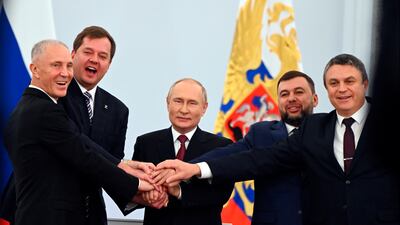
From left, Moscow-appointed head of Kherson region Vladimir Saldo, Moscow-appointed head of Zaporizhzhia region Yevgeny Balitsky, Russian President Vladimir Putin, leader of the Donetsk People's Republic Denis Pushilin, and leader of the Luhansk People's Republic Leonid Pasechnik during a ceremony to sign an annexation agreement with Russia in Moscow. AP -
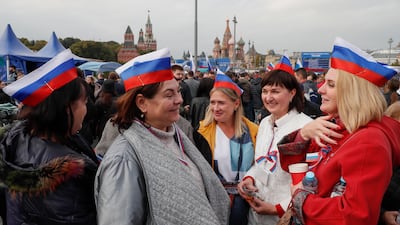
Russians gather for a celebration after the ceremony in central Moscow. EPA -
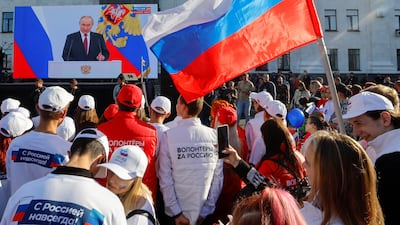
People gather near a screen showing Mr Putin during a broadcast of the ceremony. Reuters -
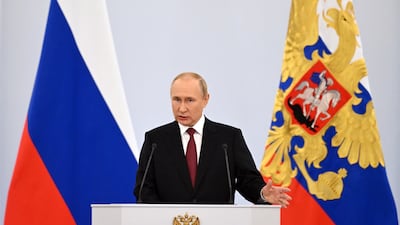
Mr Putin speaks during the ceremony to sign the treaties for the new territories' accession to Russia at the Grand Kremlin Palace in Moscow. EPA -
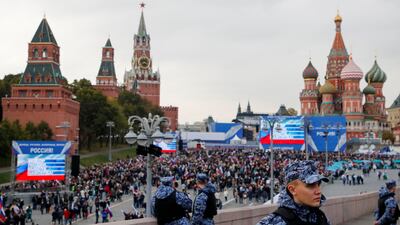
Law enforcement officers stand guard as people walk towards Red Square to attend the ceremony marking the annexation of the Russian-controlled territories. Reuters -

Participants listen to Mr Putin at the ceremony in the Georgievsky Hall of the Great Kremlin Palace in Moscow. Reuters -
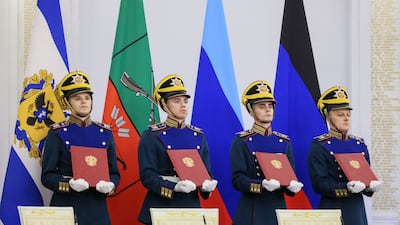
Honour guards attend the ceremony. Reuters -
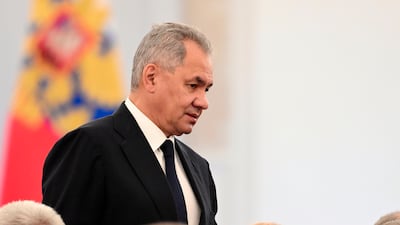
Russian Defence Minister Sergey Shoigu arrives at the ceremony. AP -

People walk towards Red Square in Moscow. Reuters -
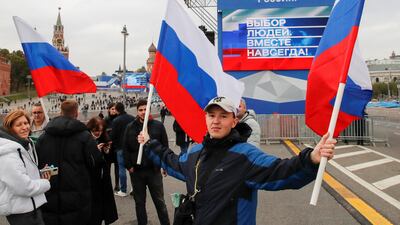
People gather in front of screens located near the Kremlin before the live broadcast of the ceremony. Reuters


_____________________________
“We cannot say this system doesn’t suit us and don't like it,” he said.
Dr Gargash said there were “issues” with Iran but the UAE is striving for good relations. He cautioned against the “illusion” of a military situation that would only mean the region would lose.
“The solution with Iran is to have good bilateral relations and continue dialogue,” he said.
“To hold each other accountable and find partnerships. [This is the case] not only with Iran but with other countries.”
Dr Gargash said the last decades in the region had been very difficult, with wars, crises and the Arab uprisings of 2011.
“We do not want to spend 20 to 30 years in wars. No one who is rational will accept a repeat,” he said.
Dr Gargash pointed to strengthening ties with Turkey and talks between Egypt and Turkey that suggested a more positive future.
But he said the fact that Yemen was still without a ceasefire was a “disaster”. He said a ceasefire was a paramount objective and conditions for a political solution were needed.
'Without growth this region will be forgotten'
Looking ahead to the UAE’s path for the next few decades, Dr Gargash said it had passed through an “exceptional decade” of challenges, problems, coronavirus, unrest and the Arab uprisings in other countries.
Now the plan was to work on the economy, but not just the traditional economy.
“We have to change the work environment. This is an ecosystem and not just about economic transactions,” Dr Gargash said.
He said it was important to also strengthen bridges built in the past 15 years and he pointed to the signing of the Abraham Accords, talks with Iran and Turkey and efforts to find new partnerships.
“We are not naïve,” Dr Gargash said. “Every country has its own interests. The UAE is working on sorting out problems. We have succeeded to a certain extent. There is competition and we accept legitimate competition.
“The region is slowly getting out of the Arab spring crises. It took a lot of effort to put out those fires. This region will be forgotten if we do not focus on putting prosperity and growth on the agenda.
“Look at Saudi Arabia. This shows the fact [there was a] previous approach for a previous period. [But now] new challenges need a new approach to creating jobs and a new economy.”

