



The Kingdom of Bahrain will host the annual Arab Space Co-operation meeting, a gathering that aims to help Arab countries promote and increase their activities in the cosmos.
This year’s event will be held on November 8 on the sidelines of the Bahrain International Airshow.
It will be the first time the annual meeting will be held outside the Emirates since the Arab Space Co-operation Group was formed by the UAE Space Agency in 2019.
As well as the UAE and Bahrain, the group comprises Saudi Arabia, Bahrain, Oman, Kuwait, Jordan, Algeria, Tunisia, Sudan, Egypt, Lebanon, Morocco, Iraq and Mauritania.
The purpose is for members to share the successes and challenges of their respective space programmes and offer advice.
Dr Mohammed Ibrahim Al Asiri, chief executive of Bahrain’s National Space Science Authority (NSSA), said the meeting would help the kingdom highlight its progress in the space industry.
"The holding of the meeting of the Arab Group for Space Co-operation in the Kingdom of Bahrain is an important step in the path of the National Space Science Authority and its contribution to highlighting the name of the Kingdom of Bahrain in the space sector at the Arab and international levels,” he said.
Arab Space Agency
Shortly after the Arab Space Co-operation Group was formed, it was announced that it would make way for the Arab Space Agency, which aims to replicate the format of the European Space Agency.
The ESA has helped Europe create a strong exploration programme and contribute to major projects, such as a partner on the International Space Station and the $10 billion James Webb Telescope.
There has, however, been no update on the Arab Space Agency since the announcement.
It was also revealed in 2019 that the Arab Space Co-operation Group would build the 813 satellite to monitor climate change with engineers from all 14 member countries involved in its development.
But the project was paused a while ago and is being reassessed by the UAE Space Agency.
Bahrain’s progress in space
Bahrain is gradually making its name in the Arab world with its space activities, having established the NSSA in 2014.
“The objective of NSSA is to enhance space-based technology services for governance and development, and work on exciting potential new space missions to advance research and development in space sciences,” Bahrain’s government website says.
The country plans to launch its first entirely domestically-built satellite next year.
Bahrain signed the US-led Artemis Accords in March, an agreement that outlines plans to explore the Moon and beyond.
Two Bahraini aerospace engineers helped design and build the UAE’s DhabiSat satellite, which was launched last year, while Light-1, a UAE-Bahraini satellite, was sent into space this year.
A satellite laboratory was set up at the University of Bahrain, which aims to help students complete postgraduate studies in space science engineering.
NSSA also established a lab for processing space data and satellite images.
Other Arab countries making progress
Saudi Arabia set up its Space Commission in 2018 with the aim of driving growth in the sector.
The commission has held meetings with a number of space agency partners to increase co-operation, including the US, China and the UK.
In 2020, Saudi Arabia allocated $2.1 billion for its space programme under its economic diversification plan called Vision 2030.
It has increased its investment in space over the past three years, with plans to explore the Moon and Mars.
The kingdom signed the Artemis Accords this year, becoming the fourth in the Middle East to do so, after the UAE, Bahrain and Israel.
Saudi Arabia has a rich history in space exploration, with Prince Sultan bin Salman becoming the first Arab in space in 1985.
He was part of a seven-member international crew aboard Nasa's Discovery space shuttle.
UAE is leading the way
The UAE is leading the way in the Arab world with its successful space programme.
In only a few years, the country reached the orbit of Mars with its Hope probe, sent the first Emirati astronaut to the International Space Station and built domestic satellites.
Next year is set to be the Emirates' busiest in space, with the Rashid rover expected to land on the lunar surface, an Emirati astronaut embarking on the Arab world's longest space mission to the ISS and the launch of MBZ-Sat, the region's most powerful imaging satellite.
-
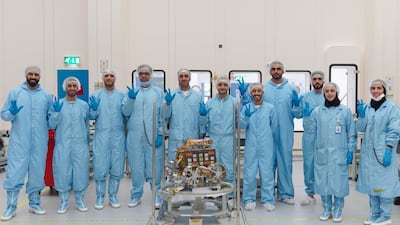
A team of Emirati engineers have developed the UAE's lunar mission. They are pictured with the Rashid rover at the Mohammed bin Rashid Space Centre. Photo: MBRSC -
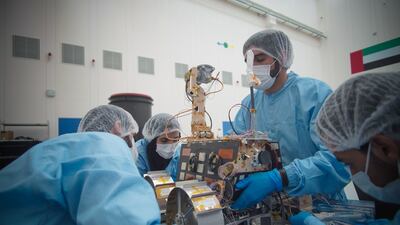
Emirati engineers carry the Rashid rover inside a clean room at the space centre. Photo: MBRSC -
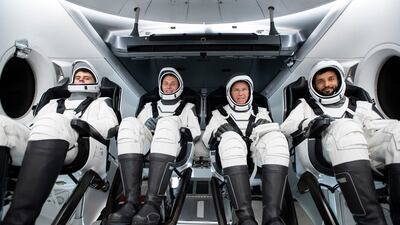
Emirati astronaut Sultan Al Neyadi, right, wears a SpaceX suit as he sits with fellow astronauts in a Dragon Crew Capsule during training for the Crew-6 mission next spring. Photo: Nasa / SpaceX -
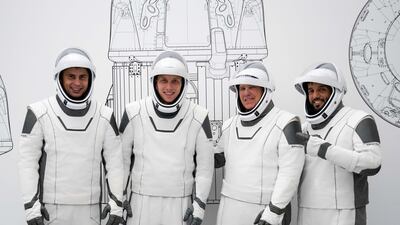
UAE astronaut Sultan Al Neyadi, right, in his SpaceX astronaut suit with fellow crew members, from left, Andrey Fedyaev, William Hoburg and Stephen Bowen. Photo: Nasa / SpaceX -
The UAE's first two astronauts Hazza Al Mansouri and Sultan Al Neyadi after they graduated from Nasa's basic training programme. Photo: MBRSC -
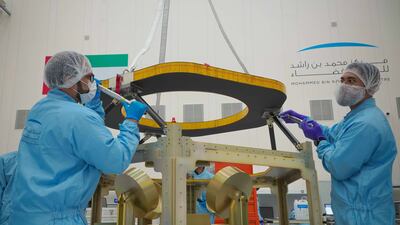
Engineers at the Mohammed Bin Rashid Space Centre work on the MBZ-Sat, the most advanced satellite in the region in the field of high-resolution imagery, which is due to be launched in 2023. Photo: Dubai Media Office -
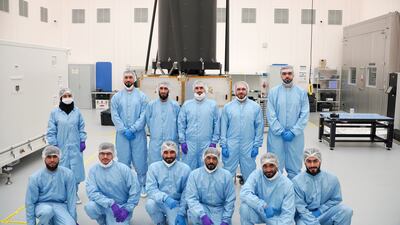
Mohammed bin Rashid Space Centre engineers with the MBZ-Sat satellite. Photo: Dubai Media Office -
The PHI-Demo satellite developed at the space centre. Photo: MBRSC



