

The UAE will receive supplies of wheat under an agreement with India.
The Ministry of Finance said the shipments are for domestic use only, with re-exports banned for four months.
The deal comes against a backdrop of global shortages linked to the war in Ukraine and a heatwave in India. The ministry decision means any wheat brought into the Emirates is for local consumption and not for resale abroad.
All varieties of buckwheat ― hard, regular and fine ― as well as wheat and spelt flour are affected, commencing retroactively from May 13. The decision was announced in a Ministry of Economy statement to the news agency Wam.
Motilal Oswal Securities
A heatwave in India that has badly affected crops, prompted the government in New Delhi on May 13 to enforce a ban on wheat exports as local prices of the commodity rose to record levels.
In recent weeks, however, India has given assurances that it can help other countries to meet their needs despite the shortages.
Since then, a number of countries, including the UAE, have requested that India resume shipping wheat to them.
The Wam statement said the recent trade deal between the UAE and India included "the Indian government's approval to export wheat to the UAE for domestic consumption".
This is the third time India may allow international shipments of wheat since it imposed the ban on exports in May.
The Ministry of Economy said that companies wishing to export or re-export wheat and wheat flour varieties of Indian origin brought into the country before May 13 must apply for a permit.
Strong ties
Analysts said India’s decision to allow wheat exports to the UAE was based on strong diplomatic ties.
“India deals with the UAE as a privileged trade partner. The relationship is strong so the government has taken a special decision,” Kishore Narne, director of Motilal Oswal Securities told The National.
“The basic understanding is that if the wheat is not going to be used for commercial purposes - that is companies in the UAE buy wheat and re-export for profit, then India is willing to relax the ban on wheat exports to the UAE.
“This is being done with Bangladesh, UAE and a few countries where India has strong diplomatic relations and those that are in need.”
Indian media had reported that the UAE was among five countries including Oman and Bangladesh that New Delhi was considering relaxing the export ban.
After China, India is the world’s second largest wheat producer but due to large domestic consumption, the country exports only a small portion.
India produced 108 million tonnes of wheat last year and exported about seven million tonnes.
Scorching summer leaves India struggling
A scorching summer is expected to reduce this year’s crop and the need to keep reserves for its own population is the main reason for India’s export ban.
“Right now India is hand-to-mouth, last year there was a 4-5 per cent drop in crop. This year because the summer has been too hot, the expectation is 98 million tonnes so it means the crop will already be 10 per cent down,” Mr Narne said.
“India normally maintains seven-and-half million to eight million tonnes in basic reserves for the food security programme so it genuinely does not have too much wheat to export.
“This is the bare minimum inventory because domestic consumption is so high.
“That is why when the prices went up and there was a huge export demand, the government banned export of wheat.”
Trade data shows that the UAE primarily imports wheat from countries including Russia, Canada, Ukraine, Australia and India.
Russia and Ukraine together account for 29 per cent of global wheat export. Russia's war in Ukraine has led to global shortages of wheat, grains and fertiliser, among other goods.
A Russian blockade on Ukraine's Black Sea ports and sanctions placed on Russia mean that food production in the two countries, known as the world's breadbasket, has decreased significantly since February.
Egypt to boost wheat production as Ukraine exports dry up: in pictures
-
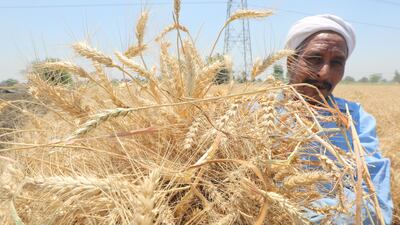
An man works in a wheat field in Banha, Egypt. All photos: EPA -
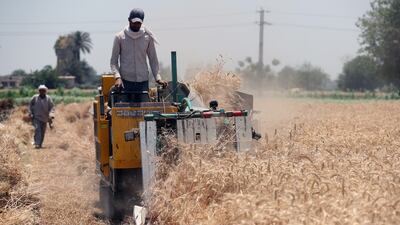
Egypt, the largest importer of wheat in the world, has been forced by the war in Ukraine to rethink its strategy and says it will now rely more on local production of the cereal as a way to reduce its reliance on international purchases in the coming years. -
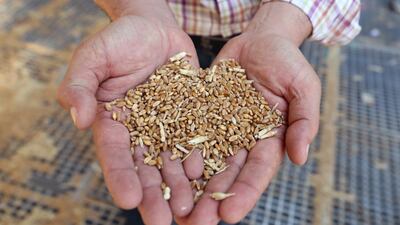
A man holds grains of wheat at the Banha grain silos, in Qalyubia Governorate. -
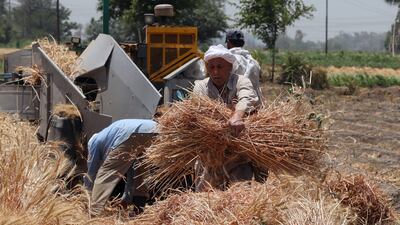
Bread is a staple for most of Egypt's 103 million people. -
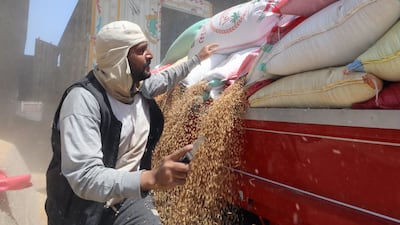
Workers unload wheat at the Banha grain silos. -

Local growers have been barred from selling wheat to anyone other than the government until August. -
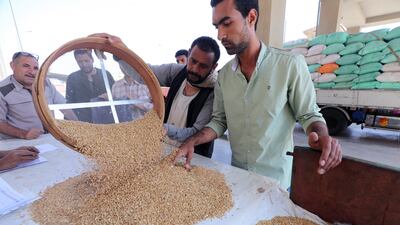
Previously, growers who failed to deliver 60 per cent of their wheat harvest to authorities faced penalties. -

Workers collect wheat at the Banha silos. -
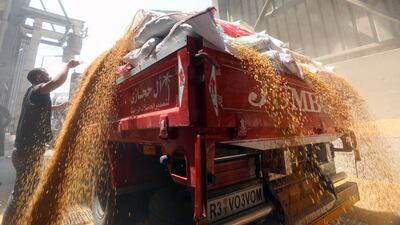
About 71 million people in the country rely on cheap bread under a state subsidised food card system. -
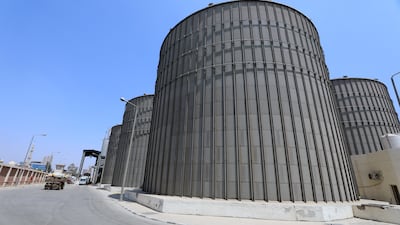
Egypt has 44 silos with a total capacity of 3. 1 million tonnes, across its governorates



