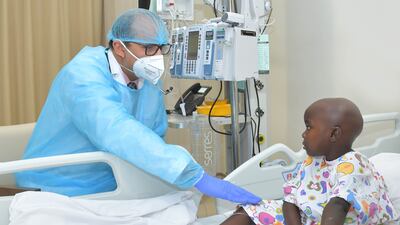
Doctors said Jordana, 5, has responded well to the treatment and is due to be discharged from Burjeel Medical City within a few days. Photo: Burjeel Medical City

Abu Dhabi hospital performs UAE's first paediatric bone marrow transplant


  • English
  • Arabic

In another milestone for the UAE, a 5-year-old Abu Dhabi resident had the first paediatric bone marrow transplant from a donor in the UAE last week.

Burjeel Medical City’s bone marrow transplant unit, which was inaugurated in September, performed the complex and specialised procedure using a matched sibling transplant treatment that involved Jordana from Uganda receiving healthy stem cells from her sister Jolina, 10.

Doctors said Jordana has responded well to the treatment and is due to be discharged from Burjeel Medical City in the coming days, following a five-week stay in hospital.

Jordana was diagnosed with sickle cell disease since birth, a genetic disorder that results in an abnormality in the haemoglobin found in red blood cells, which can lead to several complications including anaemia, swelling in the hands and feet, frequent pain, acute chest syndrome, and sometimes stroke.

She endured a lot of pain and was regularly admitted to hospital before the treatment, said Dr Zainul Aabideen, head of paediatric haematology and oncology at BMC.

Burjeel Medical City’s bone marrow transplant unit performed the complex and specialised procedure using a matched sibling transplant treatment that involved Jordana, 5, from Uganda receiving healthy stem cells from her sister Jolina, 10. Photo: Burjeel Medical City

“The only curative option for this life-threatening condition is bone marrow transplantation," Dr Aabideen said.

"Prior to this procedure, there would have been immense suffering for the patient. The entire care team here at the hospital, as well as the child’s parents, are delighted that the transplant will relieve this pain from her life.”

The allogeneic stem cell transplant involves transferring healthy blood stem cells from a donor to replace a patient’s diseased or damaged bone marrow.

The complex procedure requires collecting stem cells from the donor's blood, bone marrow within a donor's hipbone, or from the blood of a donated umbilical cord, before transferring them to the patient.

The transplant takes place only after the patient has undergone an intense series of chemotherapy or radiation — also known as the “conditioning” process — to fully kill their diseased cells and prepare their body to receive the healthy donor stem cells.

Once ​​infused into the bloodstream, the donor cells begin creating new blood cells within the patient’s bone marrow.

The treatment is followed by several weeks of close medical care, as well as blood test check-ups to monitor the body’s response to the new cells.

Burjeel Medical City is currently performing bone marrow transplantation for another child from Iraq diagnosed with thalassemia.

Professor Humaid Alshamsi, director of VPS Oncology at BMC, said patients previously had to travel abroad for the highly specialised treatment.

"The recent success of the stem cell transplants at our institution will provide new hope to the many patients who will benefit from similar care,” he said.

Burjeel Medical City plans to expand its bone marrow transplant capabilities across the region in the near future.


MEDIEVIL%20(1998)
%3Cp%3E%3Cstrong%3EDeveloper%3A%3C%2Fstrong%3E%20SCE%20Studio%20Cambridge%3Cbr%3E%3Cstrong%3EPublisher%3A%3C%2Fstrong%3E%20Sony%20Computer%20Entertainment%3Cbr%3E%3Cstrong%3EConsole%3A%3C%2Fstrong%3E%20PlayStation%2C%20PlayStation%204%20and%205%3Cbr%3E%3Cstrong%3ERating%3A%3C%2Fstrong%3E%203.5%2F5%3C%2Fp%3E%0A
How Islam's view of posthumous transplant surgery changed

Transplants from the deceased have been carried out in hospitals across the globe for decades, but in some countries in the Middle East, including the UAE, the practise was banned until relatively recently.

Opinion has been divided as to whether organ donations from a deceased person is permissible in Islam.

The body is viewed as sacred, during and after death, thus prohibiting cremation and tattoos.

One school of thought viewed the removal of organs after death as equally impermissible.

That view has largely changed, and among scholars and indeed many in society, to be seen as permissible to save another life.

A%20MAN%20FROM%20MOTIHARI
%3Cp%3E%3Cstrong%3EAuthor%3A%20%3C%2Fstrong%3EAbdullah%20Khan%0D%3Cbr%3E%3Cstrong%3EPublisher%3A%20%3C%2Fstrong%3EPenguin%20Random%20House%3Cbr%3E%3Cstrong%3EPages%3A%20%3C%2Fstrong%3E304%0D%3Cbr%3E%3Cstrong%3EAvailable%3A%20%3C%2Fstrong%3ENow%0D%3Cbr%3E%3C%2Fp%3E%0A
Squad

Ali Kasheif, Salim Rashid, Khalifa Al Hammadi, Khalfan Mubarak, Ali Mabkhout, Omar Abdulrahman, Mohammed Al Attas, Abdullah Ramadan, Zayed Al Ameri (Al Jazira), Mohammed Al Shamsi, Hamdan Al Kamali, Mohammed Barghash, Khalil Al Hammadi (Al Wahda), Khalid Essa, Mohammed Shaker, Ahmed Barman, Bandar Al Ahbabi (Al Ain), Al Hassan Saleh, Majid Suroor (Sharjah) Walid Abbas, Ahmed Khalil (Shabab Al Ahli), Tariq Ahmed, Jasim Yaqoub (Al Nasr), Ali Saleh, Ali Salmeen (Al Wasl), Hassan Al Muharami (Baniyas) 

Updated: April 21, 2022, 2:34 AM