• Dr Dimitra Atri, a research scientist at New York University Abu Dhabi, has created an atlas of Mars using data from the UAE’s Hope probe. The full map will be published later this month, but he gave 'The National' a preview. All photos by Dr Atri / Emirates Mars Mission and infographic by Roy Cooper / The National
    Dr Dimitra Atri, a research scientist at New York University Abu Dhabi, has created an atlas of Mars using data from the UAE’s Hope probe. The full map will be published later this month, but he gave 'The National' a preview. All photos by Dr Atri / Emirates Mars Mission and infographic by Roy Cooper / The National
  • The Arabia Quadrangle region on Mars.
    The Arabia Quadrangle region on Mars.
  • The Syrtis Major Planum region on Mars.
    The Syrtis Major Planum region on Mars.
  • The Elsyium region on Mars.
    The Elsyium region on Mars.

UAE’s Hope probe tracks enormous dust storm on Mars


Sarwat Nasir
  • English
  • Arabic

The UAE’s Hope probe tracked a massive dust storm on Mars for more than two weeks, helping to show how quickly they can spread across the planet.

Hope started monitoring a rapidly evolving regional dust storm in late December, as it expanded to a size of several thousand kilometres.

Dust storms on Mars cause extremely turbulent weather. They can be up to 30 kilometres high and cover the entire planet.

The storms can be seen from space, making the planet appear as a bright ball of red.

Scientists hope that by studying them they can gain further insight into how they are drying out the planet by helping Martian water escape the planet's atmosphere.

Hope, which reached orbit in February 2021, used a high-resolution camera and an infrared spectrometer to document the storm’s growth and dissipation.

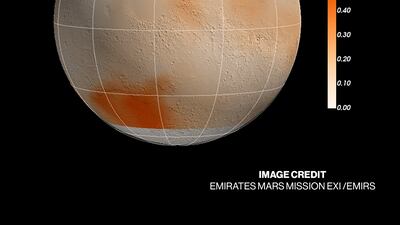
  • Observations late December confirmed thick dust clouds only in Hellas, an impact crater on the southern hemisphere, but showed low amounts of suspended dust elsewhere – indicating that a dust storm was forming. Photo: Hope Mars Mission
    Observations late December confirmed thick dust clouds only in Hellas, an impact crater on the southern hemisphere, but showed low amounts of suspended dust elsewhere – indicating that a dust storm was forming. Photo: Hope Mars Mission
  • By January 5, the storm had grown massively, stretching 2,500 km across, as it approached from the east. It partially covered Syrtis Major, with greyish water-ice clouds also visible in the storm. Meanwhile, Hellas was completely covered by dust clouds. Photo: Hope Mars Mission
    By January 5, the storm had grown massively, stretching 2,500 km across, as it approached from the east. It partially covered Syrtis Major, with greyish water-ice clouds also visible in the storm. Meanwhile, Hellas was completely covered by dust clouds. Photo: Hope Mars Mission
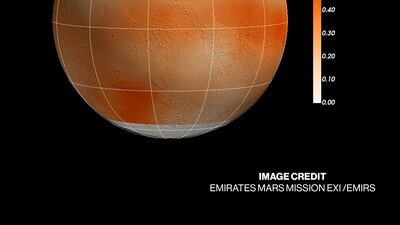
  • By January 7, dust haze and greyish water-ice clouds spread to the east of Syrtis Major and north of Hellas. Photo: Hope Mars Mission
    By January 7, dust haze and greyish water-ice clouds spread to the east of Syrtis Major and north of Hellas. Photo: Hope Mars Mission
  • By January 9, the storm shrunk in size and moved over to northwestern Syrtis, measuring 1,200 km across. The dust haze, however, is still covering the plains east of Syrtis, with Hope probe data showing how it spread so far, spanning about one-third of the circumference of Mars. Photo: Hope Mars Mission
    By January 9, the storm shrunk in size and moved over to northwestern Syrtis, measuring 1,200 km across. The dust haze, however, is still covering the plains east of Syrtis, with Hope probe data showing how it spread so far, spanning about one-third of the circumference of Mars. Photo: Hope Mars Mission
  • The haze started to thin by January 14 and no dust storms were visible by then. Photo: Hope Mars Mission
    The haze started to thin by January 14 and no dust storms were visible by then. Photo: Hope Mars Mission

The instruments revealed the thermal conditions of the planet’s surface and lower atmosphere, giving details about the geographic distribution of dust, water vapour, water and carbon dioxide ice clouds.

Hope’s unique orbital placement has helped to measure these elements over timescales of minutes to days — data that was difficult to capture by all other previous missions because their observations were limited to only certain places and times of day.

Dust storm begins to form

On December 29, Hope captured a fully illuminated disk of Mars, nearly centred on Syrtis Major — a Martian feature that appears as a distinctive dark spot from space and is home to basaltic volcanic rock, stretching about 1,500km north from the planet’s equator.

The atmosphere was relatively clear, with only thin water-ice clouds visible over the plains to the east of Syrtis.

The observations during this time confirmed thick dust clouds only in Hellas, an impact crater in the planet's southern hemisphere, but showed low amounts of suspended dust elsewhere, indicating that a dust storm was forming.

Enormous storm and dust haze

By January 5, the storm had grown massively, stretching 2,500km across, as it approached from the east.

It partially covered Syrtis Major, with greyish water-ice clouds also visible in the storm.

Meanwhile, Hellas was completely covered by dust clouds.

Data from Hope shows that there were high concentrations of dust in Syrtis and Hellas, with haze extending far to the east.

By January 7, dust haze and greyish water-ice clouds spread to the east of Syrtis Major and north of Hellas.

Hope’s data shows that the thickness of the haze increased, lifting the dust from the surface and causing it to extend at least 4,000km east from Syrtis Major.

Starts to dissipate

By January 9, the storm had shrunk in size and moved to north-western Syrtis. It now measured 1,200km across.

The high-resolution camera on the Hope probe was able to capture a fully illuminated hemisphere centred on Syrtis Major again. It had been partially covered by the storm only days earlier.

The dust haze, however, was still covering the plains east of Syrtis, with Hope probe data showing it had spread to span about a third of the circumference of Mars.

The haze started to thin by January 14 and no dust storms were visible by then.

UAE's Moon rover Rashid - in pictures

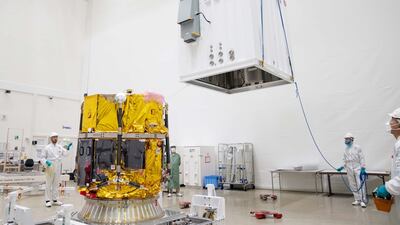
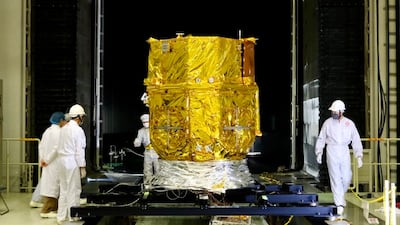
  • The Hakuto-R Mission 1 lunar lander is delivered to Florida's Cape Canaveral from where it will carry the UAE's Rashid rover to the Moon. Photo: ispace
    The Hakuto-R Mission 1 lunar lander is delivered to Florida's Cape Canaveral from where it will carry the UAE's Rashid rover to the Moon. Photo: ispace
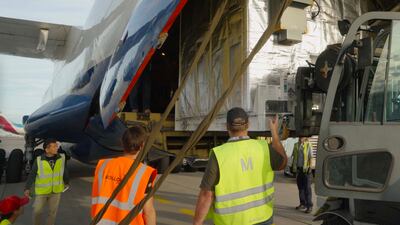
  • The Hakuto lander with the Rashid rover stored inside, ready to be shipped to Florida. Photo: ispace
    The Hakuto lander with the Rashid rover stored inside, ready to be shipped to Florida. Photo: ispace
  • Rashid lunar rover's final prototype. Photo: Mohammed bin Rashid Space Centre
    Rashid lunar rover's final prototype. Photo: Mohammed bin Rashid Space Centre
  • An Emirati engineer tested the Moon rover in remote desert areas of Dubai. Photo: Mohammed bin Rashid Space Centre
    An Emirati engineer tested the Moon rover in remote desert areas of Dubai. Photo: Mohammed bin Rashid Space Centre
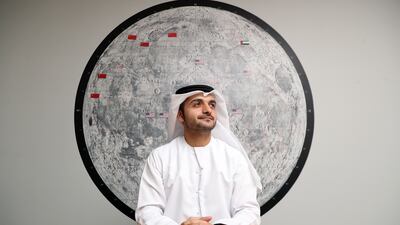
  • Dr Hamad Al Marzooqi, project manager of the Emirates lunar mission. Chris Whiteoak / The National
    Dr Hamad Al Marzooqi, project manager of the Emirates lunar mission. Chris Whiteoak / The National
  • Development of the lander nears completion. Photo: ispace
    Development of the lander nears completion. Photo: ispace
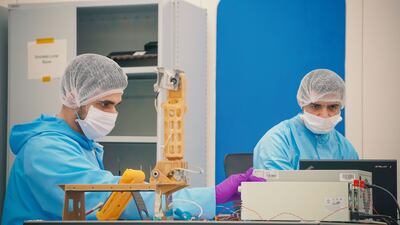
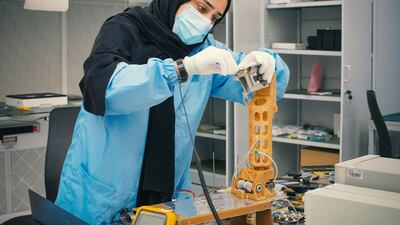
  • Emirati engineers test parts of the Rashid rover. Photo: Mohammed Bin Rashid Space Centre
    Emirati engineers test parts of the Rashid rover. Photo: Mohammed Bin Rashid Space Centre
  • Emirati engineers test parts of the Rashid rover. Photo: Mohammed Bin Rashid Space Centre
    Emirati engineers test parts of the Rashid rover. Photo: Mohammed Bin Rashid Space Centre
  • A full Moon gleams above Buenos Aires. AFP
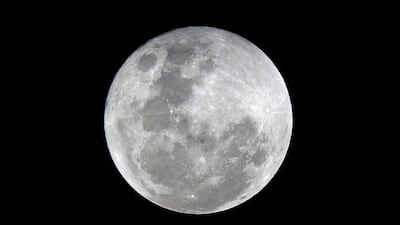
    A full Moon gleams above Buenos Aires. AFP
THE BIO:

Sabri Razouk, 74

Athlete and fitness trainer 

Married, father of six

Favourite exercise: Bench press

Must-eat weekly meal: Steak with beans, carrots, broccoli, crust and corn

Power drink: A glass of yoghurt

Role model: Any good man

ESSENTIALS

The flights

Emirates flies direct from Dubai to Rio de Janeiro from Dh7,000 return including taxes. Avianca fliles from Rio to Cusco via Lima from $399 (Dhxx) return including taxes. 

The trip

From US$1,830 per deluxe cabin, twin share, for the one-night Spirit of the Water itinerary and US$4,630 per deluxe cabin for the Peruvian Highlands itinerary, inclusive of meals, and beverages. Surcharges apply for some excursions.

The biog

Hobby: Playing piano and drawing patterns

Best book: Awaken the Giant Within by Tony Robbins

Food of choice: Sushi  

Favourite colour: Orange

How to watch Ireland v Pakistan in UAE

When: The one-off Test starts on Friday, May 11
What time: Each day’s play is scheduled to start at 2pm UAE time.
TV: The match will be broadcast on OSN Sports Cricket HD. Subscribers to the channel can also stream the action live on OSN Play.

How it works

Booklava works on a subscription model. On signing up you receive a free book as part of a 30-day-trial period, after which you pay US$9.99 (Dh36.70) per month to gain access to a library of books and discounts of up to 30 per cent on selected titles. You can cancel your subscription at any time. For more details go to www.booklava.com

The burning issue

The internal combustion engine is facing a watershed moment – major manufacturer Volvo is to stop producing petroleum-powered vehicles by 2021 and countries in Europe, including the UK, have vowed to ban their sale before 2040. The National takes a look at the story of one of the most successful technologies of the last 100 years and how it has impacted life in the UAE.

Read part three: the age of the electric vehicle begins

Read part two: how climate change drove the race for an alternative 

Read part one: how cars came to the UAE

Quick facts on cancer
  • Cancer is the second-leading cause of death worldwide, after cardiovascular diseases 
  •  About one in five men and one in six women will develop cancer in their lifetime 
  • By 2040, global cancer cases are on track to reach 30 million 
  • 70 per cent of cancer deaths occur in low and middle-income countries 
  • This rate is expected to increase to 75 per cent by 2030 
  • At least one third of common cancers are preventable 
  • Genetic mutations play a role in 5 per cent to 10 per cent of cancers 
  • Up to 3.7 million lives could be saved annually by implementing the right health
    strategies 
  • The total annual economic cost of cancer is $1.16 trillion


Updated: March 07, 2022, 3:46 PM