

The future of military drones was unveiled in Abu Dhabi on Monday with home-grown companies displaying the latest technology.
On the first day of the Unmanned Systems Exhibition and Conference (Umex), manufacturers set out the latest in "swarming" aerial drones and unmanned fighting ground vehicles.
The Ministry of Defence signed three deals worth more than Dh650 million, the vast bulk of it with Edge-owned Global Aerospace Logistics, which repairs and overhauls aerial vehicles.
Abu Dhabi-based International Golden Group won a contract worth Dh10m for drone systems and South Africa’s Denel Dynamics won a deal worth Dh5.6m to provide support services for aircraft systems.
Ministry of Defence
Although the exhibition at Abu Dhabi National Exhibition Centre is largely devoted to the latest military applications, there was much discussion about the future of civilian drones.
Col Staff Pilot Abdulnasir Mohammed Saif Al Hameedi, from the Ministry of Defence, said effective regulation of drones was a top priority for the authorities.
As with many nations, the country wants to see drones utilised for e-commerce and retail, but risks remain. On Monday, the Ministry of Interior extended a ban imposed in January on all aerial drones, in addition to light aircraft flights, following the attempted Houthi attacks on Abu Dhabi in January and February.
“Due to its rapid emergence, it is important for us to start regulating these systems," Col Al Hameedi told The National.
-
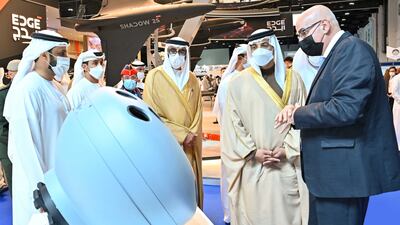
Sheikh Mansour bin Zayed, Deputy Prime Minister and Minister of Presidential Affairs opens Umex. All photos: Wam -
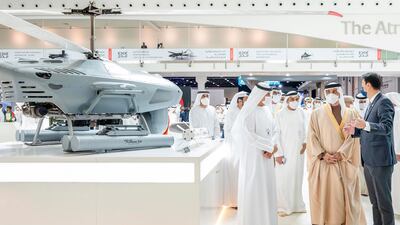
Sheikh Mansour bin Zayed, Deputy Prime Minister and Minister of Presidential Affairs opens Umex. All photos: Wam -

Sheikh Mansour bin Zayed, Deputy Prime Minister and Minister of Presidential Affairs opens Umex. All photos: Wam -

Sheikh Mansour bin Zayed, Deputy Prime Minister and Minister of Presidential Affairs opens Umex. All photos: Wam -
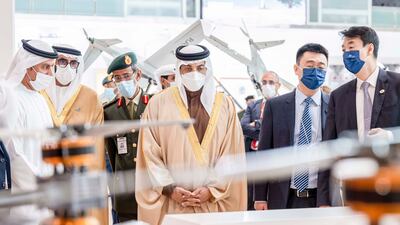
Sheikh Mansour bin Zayed, Deputy Prime Minister and Minister of Presidential Affairs today opens Umex on Monday. All photos: Wam -

Sheikh Mansour bin Zayed, Deputy Prime Minister and Minister of Presidential Affairs opens Umex. All photos: Wam -
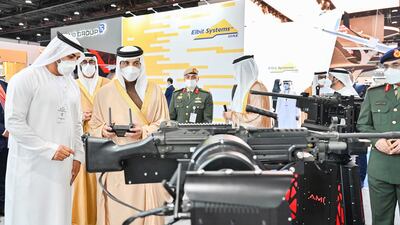
Sheikh Mansour bin Zayed, Deputy Prime Minister and Minister of Presidential Affairs opens Umex. All photos: Wam


"I think the solution is to bring both civil and defence under one centralised regulatory body that governs its use. I think if we reach that stage, we would be much safer.”
“We will see more emerging technologies but there will also be more challenges so we need to accelerate the process of regulating and controlling this growth.”
The exhibition is held in cooperation with the Ministry of Defence and has 25 local and international exhibitors.
Among the main exhibitors is Abu Dhabi-based Edge, a conglomerate of two dozen defence companies.
Halcon, which makes swarming drones and other aircraft for Edge, said the new technology had created incredible opportunities and threats as well.
“Hostile drones present security authorities with a serious challenge all over the world, and this requires a comprehensive and end-to-end approach from defence leaders," said Saeed Al Mansoori, chief executive of Halcon.
"Following a detailed and extensive roadmap, we are working to deliver a multilayered and scalable solution to meet the ever-evolving security challenges from a broad spectrum of threats."
He said the industry here was already seeing far greater emphasis placed defensive drone technology — and not just offensive technology.
-

The Scorpio-B can be equipped with remote weapon systems, twin 40mm grenade launchers, pan-tilt-zoom cameras and intelligence, surveillance, and reconnaissance sensors with the possibility to mount various payloads of up to 200kg. All photos: Victor Besa / The National -
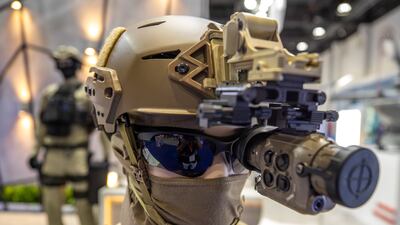
The VooDoo-M Multi-Mission Thermal Sight by Pixels. -
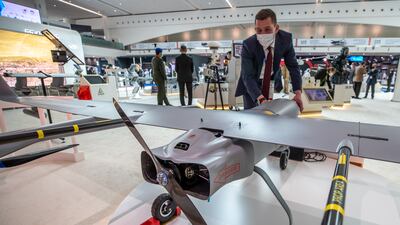
The UKRSPEC Systems drone. -
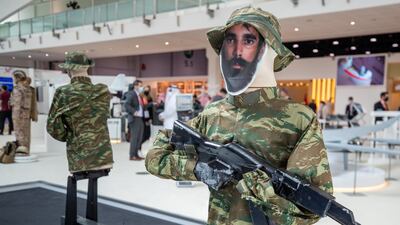
Robotic Targets by Marathon Target Australia. -

Abu Dhabi Police smart Police Car. -
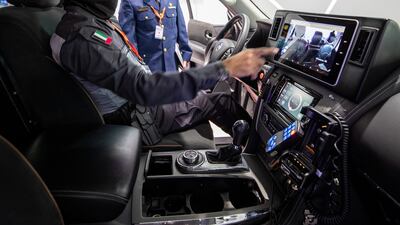
AUH Police Smart Police Car. -
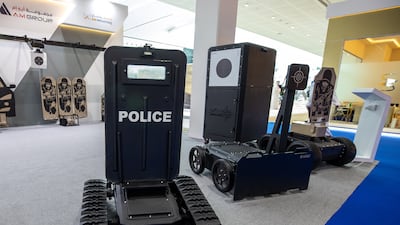
AM Industries stall. -
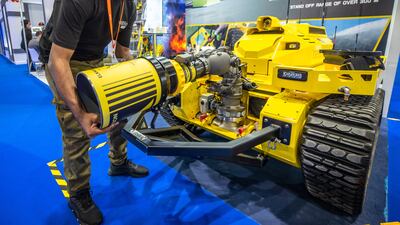
Mahgoub Omer attaches the foam mixer of the RS3 firefighting robot by Thermite. -

The Abu Dhabi Police VR Rowing Machine. -

Cristanini CBRN decontamination system. -

Schiebel Camcopter S-100. -

The Kaman Kargo drone. Victor Besa / The National -

Emirati aeronautical engineers test the Interdata system at UMEX. -
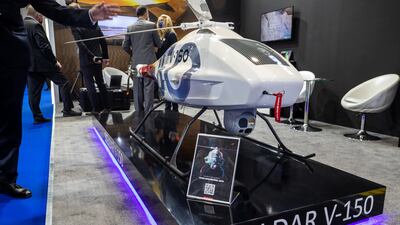
The Skeldar V-150. -
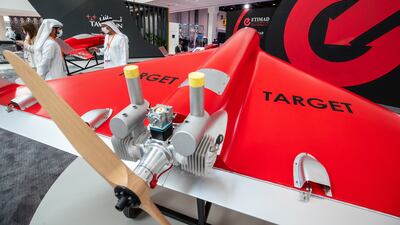
The PE-04 by Etimad. -
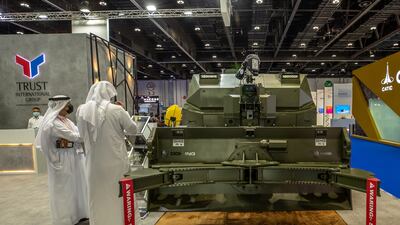
DOK-ING presented Komodo, an innovative remote-controlled robotic system for operations in extreme nuclear, biological and chemical (NBC) conditions at its headquarters in Zagreb. It is a unique machine that can operate in conditions of an open fire, explosion, collapse, high concentrations of explosive and toxic substances, as well as in terrorist threats. -

Edge's Shadow series drone is displayed on the opening day of Umex at Abu Dhabi National Exhibition Centre. -
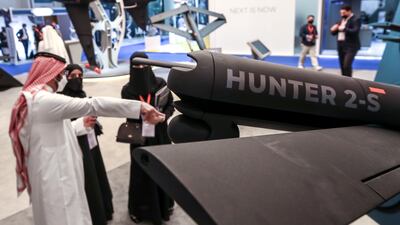
A Hunter 2-S drone, which can be used in 'swarming' air-to-ground attacks. -

The Edge stand at Umex. -
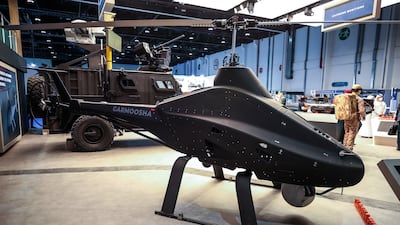
The Garmoosha by Edge is displayed on the opening day of Umex. -
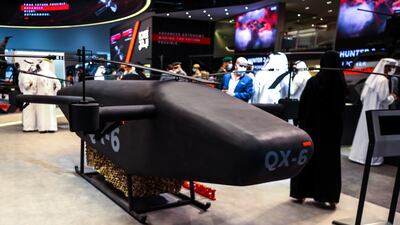
The QX-6, another Edge product. -
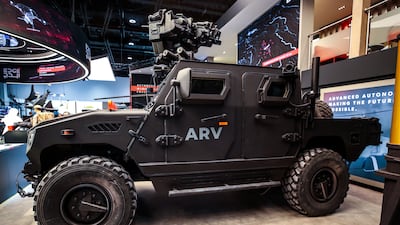
An unmanned Amed Robotic Vehicle. -

The 71S by Edge. -

The QX-3 by Edge. -
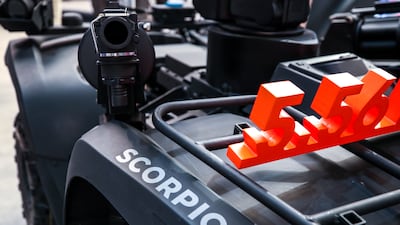
The Scorpio-B by Edge. -
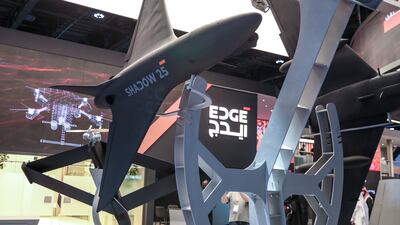
The Edge Shadow series.



