



Hundreds, probably thousands, of years before the late Sheikh Zayed made the first state visit to India by a UAE President in 1975 there was trade between the two countries.
Goods like spices and cloth were shipped in dhows across the Arabian Sea in one direction, while coveted pearls sailed in exchange from the emirates of the Arabian Gulf.
Today, those trading links continue to thrive, although the ranges of goods - and services - and the way they are moved, are infinitely greater and more diverse.
The Indian government calculates trade between the two countries, which stood at US$180 million annually in the 1970s, is now worth a staggering $59 billion. And the recent Comprehensive Economic Partnership Agreement between the two is only going to enhance that more.
The UAE is now India’s third-largest trading partner, behind only the economic giants of China and the United States.
In the opposite direction, India is the second-largest trading partner for the UAE, worth US$41 billion, excluding oil.
Those enormous sums only tell part of the story. Over many centuries this exchange can be measured not just in the value of goods but in the cultural and social impact it brought.

Older Emiratis will remember the Gulf rupee, the currency of the Gulf and the seven emirates until the mid 1960s, which replaced the even older Indian rupee for all transactions in the region.
Today, more than three million Indians live and work in the UAE, by far the largest group of foreign residents. Some have lived here for several generations, building business and families.
They are bankers, accountants and doctors, but also engineers, electricians and carpenters. Their labour has helped build many, if not most, of the country's great infrastructure projects, from the Dubai Metro to Louvre Abu Dhabi.
Indians came to Abu Dhabi and Dubai in growing numbers from the 1960s onwards, drawn by the economic boom that followed the discovery of oil.
Companies founded by Indian entrepreneurs in the UAE include Lulu, Jumbo Electronics, Jashanmal, Ajmal Perfumes and Joyalukkas Jewellery. It has made several of their creators billionaires.
This is a relationship that can also be measured in terms of human as well as economic capital. There is the example of Dr Zulekha Daud, the daughter of a construction worker, who built a network of hospitals, clinics and pharmacies in a 50-year relationship with the UAE.
To an estimated 10,000 Emiratis, though, she is known simply as “Mama Zulekha” for delivering them as babies in her role as a midwife.
Then there is Sunny Varkey, born in Kerala but largely raised in Dubai, who founded the hugely successful GEMS education network of schools in the UAE and abroad, and whose Varkey foundation supports the US$1m Global Teacher Prize.
They are just two examples of many of the thriving relationships between the UAE and India. But not everything needs to be measured in household names or millions of dollars.
Taxi drivers, waiters and labourers alike come to work in the UAE knowing their hard work can create a better life for families back home in India.

Both governments recognise the value and depth of these ties.
In addition to the 1975 visit, Sheikh Zayed travelled to India in 1992, while Indian presidents have come to the UAE in 1976, 2003 and 2010.
Indian prime minister Narendra Modi has visited the UAE three times, most recently in August 2019, while other senior politicians and leaders have regularly travelled between the two countries,
Recent years have seen a strengthening of the bilateral relationship between the UAE and India, with a series of deals on everything from cyber security and agriculture to human trafficking and energy.
Again, these ties are more than just economic. When Mr Modi addressed the Indian community and Dubai Opera House during his visit in 2018, he was able to announce the first Hindu temple in Abu Dhabi.
When Kerala was hit by disastrous floods in 2018, Emiratis and the UAE government were quick to support with aid. “The people of Kerala have always been and are still part of our success story in the UAE. We have a special responsibility to help and support those affected,” Sheikh Mohammed bin Rashid, Vice President and Ruler of Dubai, wrote on Twitter.
In reply, Mr Modi wrote that Sheikh Mohammed’s concern “reflects the special ties between governments and people of India and UAE".
In the future, the ties between the two countries can only draw them closer - perhaps literally. One concept under consideration is a 2,000-kilometre undersea rail tunnel linking Mumbai and the UAE with high-speed trains that will make the journey in just two hours.
UAE and India's trade deal - in pictures
-
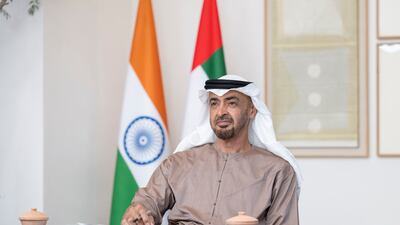
Sheikh Mohamed bin Zayed, Crown Prince of Abu Dhabi and Deputy Supreme Commander of the Armed Forces, takes part in a virtual summit with India's Prime Minister Narendra Modi. Photo: Hamad Al Kaabi / Ministry of Presidential Affairs -
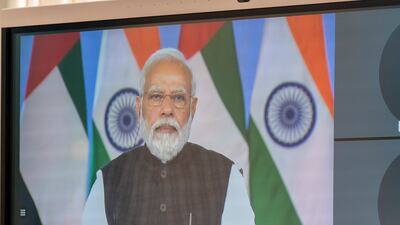
The virtual summit between Sheikh Mohamed bin Zayed, Crown Prince of Abu Dhabi and Deputy Supreme Commander of the Armed Forces, and India's Prime Minister Narendra Modi. Photo: Abdullah Al Neyadi / Ministry of Presidential Affairs -
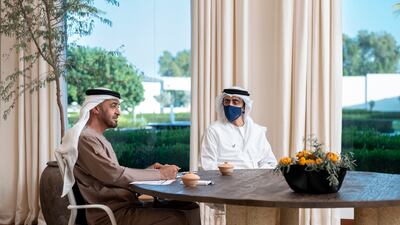
Sheikh Mohamed bin Zayed, Crown Prince of Abu Dhabi and Deputy Supreme Commander of the Armed Forces, and Sheikh Abdullah bin Zayed, Minister of Foreign Affairs and International Co-operation, take part in the virtual summit. Photo: Abdullah Al Neyadi / Ministry of Presidential Affairs -
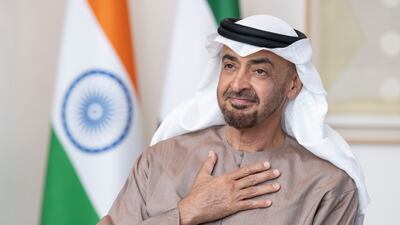
Sheikh Mohamed bin Zayed, Crown Prince of Abu Dhabi and Deputy Supreme Commander of the Armed Forces, at the summit in which the UAE and India signed a Comprehensive Economic Partnership Agreement. Photo: Hamad Al Kaabi / Ministry of Presidential Affairs -
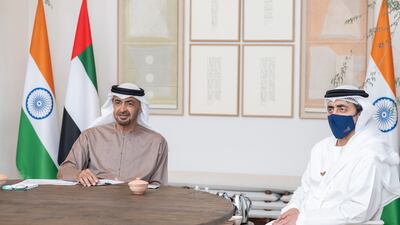
Sheikh Mohamed bin Zayed, Crown Prince of Abu Dhabi and Deputy Supreme Commander of the Armed Forces, and Sheikh Abdullah bin Zayed, Minister of Foreign Affairs and International Co-operation, at the summit. The agreement is expected to boost non-oil trade between the UAE and India from $60 billion at present to $100 billion within five years. Photo: Hamad Al Kaabi / Ministry of Presidential Affairs -
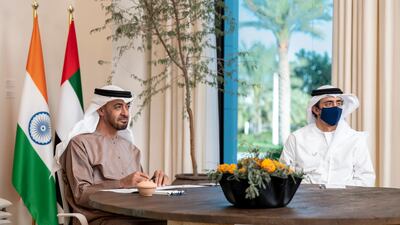
Sheikh Mohamed bin Zayed, Crown Prince of Abu Dhabi and Deputy Supreme Commander of the Armed Forces, and Sheikh Abdullah bin Zayed, Minister of Foreign Affairs and International Co-operation, at the virtual summit with India's Prime Minister Narendra Modi. Photo: Abdullah Al Neyadi / Ministry of Presidential Affairs



