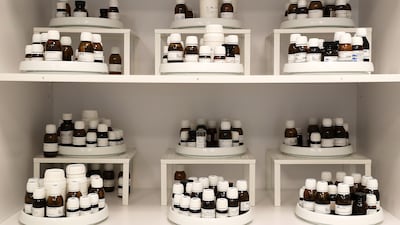
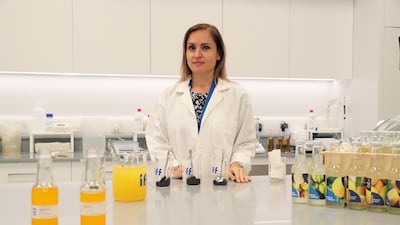
At a laboratory in Dubai Science Park, taste experts are trying to crack the code for the perfect flavour of the Middle East.
They aim to convert some of the region's most popular food and drink into laboratory-made flavours.
It is then hoped manufacturers will use these in their beverages, confectionery and food.
The 1,400-square metre plant was launched last year by US corporation International Flavours and Fragrances (IFF).
If you look at a market such as the GCC, people like their snacks a bit spicier and tangier
Sahar Razmkhah
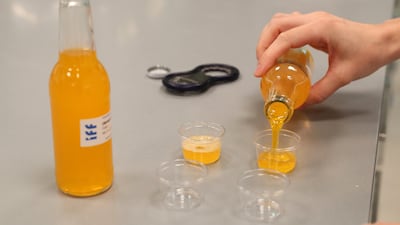
Confidentiality is paramount but for one of the company's recent projects, farms and markets in the GCC were scoured for popular versions of oranges. The flavour created was then used to make a carbonated drink.
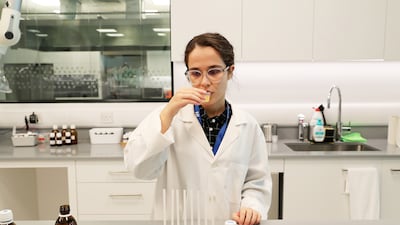
The National went inside the laboratory to see the flavour experts at work.
“Each region has its own particular tastes and preferences. For example, there are typical spices used in the Middle East that people want to have in their seasoning mixes or in their dishes,” said Sahar Razmkhah, technical manager at the lab.
“We are looking into the typical foods and beverages traditionally used in the region and see if those can be converted into flavours.”
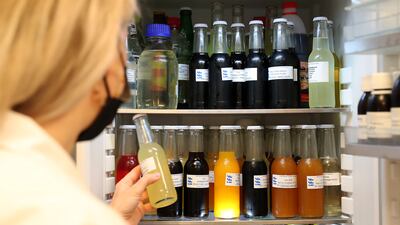
The centre is run by a team of flavourists and compounders who can create up to 30 flavours a day.
They decide on the ingredients for everything – potato chips, snacks, carbonated beverages, juices, dairy, ice cream, bakery, chocolate and other food items. The flavourists have more than 15 years of experience in tasting.
“If you look at a market such as the GCC, people like their snacks a bit spicier and tangier. So, for example, a chilli lemon-type of taste is well preferred. But if you look at a market such as North Africa, or the Levant, we can say most people prefer milder tastes,” Ms Razmkhah said.
“For beverages, we find that people in the GCC have a sweet tooth.”
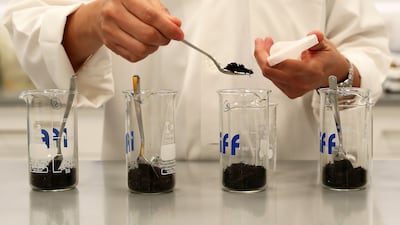
The laboratory is divided into various sections, such as one for cooking and tasting food items and another for mixing or seasoning.
The centre also has state-of-the-art equipment such as highly sensitive scales, carbonation machines and homogenisers. The instruments help in measuring the parameters necessary to create flavours and finished products.
Ms Razmkhah said the creation of a flavour was an elaborate process.
“Most of the time, we derive flavours based on what is already existing in nature. Let's say, for example, a strawberry flavour," she said.
"It might sound like one fruit but there are many varieties of strawberries: there are small strawberries, we have the sweet ones and more aromatic ones. They can be cooked in the form of a jam or a candy. So first of all, we need to define the kind of strawberry flavour we want to create.”
“After that we look at a variety of raw materials needed to compose the flavour. We have instruments that can analyse the fruit and we know scientifically what raw materials are required to reach different tonalities, such as for jams, sweets, candies and so on.”
Flavours are not used solely to bring a certain taste, they are also sometimes used to mask a taste or enhance elements such as sweetness or saltiness. As plant-based products gain popularity in the region, Ms Razmkhah said a good example is soy milk.
“People really don't like the strong taste of soy. So, some flavours help to suppress certain tastes so that other more pleasant tastes can be enhanced.”
Another example for the Middle East is mango, she said.
“People in Pakistan are used to a different taste of mango than those in Egypt. So we taste various types of fruits with different levels of ripeness," said Ms Razmkhah.
"Then we try to create flavours according to the local tastes. The samples of flavours are then presented to the manufacturers and they choose what works best for them.”

THE DETAILS
Kaala
Dir: Pa. Ranjith
Starring: Rajinikanth, Huma Qureshi, Easwari Rao, Nana Patekar
Rating: 1.5/5
Timeline
2012-2015
The company offers payments/bribes to win key contracts in the Middle East
May 2017
The UK SFO officially opens investigation into Petrofac’s use of agents, corruption, and potential bribery to secure contracts
September 2021
Petrofac pleads guilty to seven counts of failing to prevent bribery under the UK Bribery Act
October 2021
Court fines Petrofac £77 million for bribery. Former executive receives a two-year suspended sentence
December 2024
Petrofac enters into comprehensive restructuring to strengthen the financial position of the group
May 2025
The High Court of England and Wales approves the company’s restructuring plan
July 2025
The Court of Appeal issues a judgment challenging parts of the restructuring plan
August 2025
Petrofac issues a business update to execute the restructuring and confirms it will appeal the Court of Appeal decision
October 2025
Petrofac loses a major TenneT offshore wind contract worth €13 billion. Holding company files for administration in the UK. Petrofac delisted from the London Stock Exchange
November 2025
180 Petrofac employees laid off in the UAE
Basquiat in Abu Dhabi
One of Basquiat’s paintings, the vibrant Cabra (1981–82), now hangs in Louvre Abu Dhabi temporarily, on loan from the Guggenheim Abu Dhabi.
The latter museum is not open physically, but has assembled a collection and puts together a series of events called Talking Art, such as this discussion, moderated by writer Chaedria LaBouvier.
It's something of a Basquiat season in Abu Dhabi at the moment. Last week, The Radiant Child, a documentary on Basquiat was shown at Manarat Al Saadiyat, and tonight (April 18) the Guggenheim Abu Dhabi is throwing the re-creation of a party tonight, of the legendary Canal Zone party thrown in 1979, which epitomised the collaborative scene of the time. It was at Canal Zone that Basquiat met prominent members of the art world and moved from unknown graffiti artist into someone in the spotlight.
“We’ve invited local resident arists, we’ll have spray cans at the ready,” says curator Maisa Al Qassemi of the Guggenheim Abu Dhabi.
Guggenheim Abu Dhabi's Canal Zone Remix is at Manarat Al Saadiyat, Thursday April 18, from 8pm. Free entry to all. Basquiat's Cabra is on view at Louvre Abu Dhabi until October
Seven tips from Emirates NBD
1. Never respond to e-mails, calls or messages asking for account, card or internet banking details
2. Never store a card PIN (personal identification number) in your mobile or in your wallet
3. Ensure online shopping websites are secure and verified before providing card details
4. Change passwords periodically as a precautionary measure
5. Never share authentication data such as passwords, card PINs and OTPs (one-time passwords) with third parties
6. Track bank notifications regarding transaction discrepancies
7. Report lost or stolen debit and credit cards immediately
Who's who in Yemen conflict
Houthis: Iran-backed rebels who occupy Sanaa and run unrecognised government
Yemeni government: Exiled government in Aden led by eight-member Presidential Leadership Council
Southern Transitional Council: Faction in Yemeni government that seeks autonomy for the south
Habrish 'rebels': Tribal-backed forces feuding with STC over control of oil in government territory
How to protect yourself when air quality drops
Install an air filter in your home.
Close your windows and turn on the AC.
Shower or bath after being outside.
Wear a face mask.
Stay indoors when conditions are particularly poor.
If driving, turn your engine off when stationary.
UAE currency: the story behind the money in your pockets
The bio
Favourite book: Peter Rabbit. I used to read it to my three children and still read it myself. If I am feeling down it brings back good memories.
Best thing about your job: Getting to help people. My mum always told me never to pass up an opportunity to do a good deed.
Best part of life in the UAE: The weather. The constant sunshine is amazing and there is always something to do, you have so many options when it comes to how to spend your day.
Favourite holiday destination: Malaysia. I went there for my honeymoon and ended up volunteering to teach local children for a few hours each day. It is such a special place and I plan to retire there one day.
RESULTS
6pm: Al Maktoum Challenge Round-2 – Group 1 (PA) $55,000 (Dirt) 1,900m
Winner: Rajeh, Antonio Fresu (jockey), Musabah Al Muhairi (trainer)
6.35pm: Oud Metha Stakes – Rated Conditions (TB) $60,000 (D) 1,200m
Winner: Get Back Goldie, William Buick, Doug O’Neill
7.10pm: Jumeirah Classic – Listed (TB) $150,000 (Turf) 1,600m
Winner: Sovereign Prince, James Doyle, Charlie Appleby
7.45pm: Firebreak Stakes – Group 3 (TB) $150,000 (D) 1,600m
Winner: Hypothetical, Mickael Barzalona, Salem bin Ghadayer
8.20pm: Al Maktoum Challenge Round-2 – Group 2 (TB) $350,000 (D) 1,900m
Winner: Hot Rod Charlie, William Buick, Doug O’Neill
8.55pm: Al Bastakiya Trial – Conditions (TB) $60,000 (D) 1,900m
Winner: Withering, Adrie de Vries, Fawzi Nass
9.30pm: Balanchine – Group 2 (TB) $180,000 (T) 1,800m
Winner: Creative Flair, William Buick, Charlie Appleby
A timeline of the Historical Dictionary of the Arabic Language
- 2018: Formal work begins
- November 2021: First 17 volumes launched
- November 2022: Additional 19 volumes released
- October 2023: Another 31 volumes released
- November 2024: All 127 volumes completed
The%20Mother%20
%3Cp%3E%3Cstrong%3EDirector%3A%3C%2Fstrong%3E%20Niki%20Caro%26nbsp%3B%3C%2Fp%3E%0A%3Cp%3E%3Cstrong%3EStars%3A%3C%2Fstrong%3E%20Jennifer%20Lopez%2C%20Joseph%20Fiennes%2C%20Gael%20Garcia%20Bernal%2C%20Omari%20Hardwick%20and%20Lucy%20Paez%3C%2Fp%3E%0A%3Cp%3E%3Cstrong%3ERating%3A%3C%2Fstrong%3E%203%2F5%3C%2Fp%3E%0A