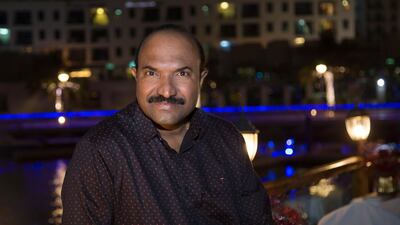
Shahed Mahmood won Dh15 million from Abu Dhabi's Big Ticket draw on Wednesday. Photo: Mr Mahmood

Abu Dhabi’s Big Ticket: Pakistani who won Dh15 million grand prize says ‘never give up’


  • English
  • Arabic

A Pakistani national who won Dh15 million in the Abu Dhabi Big Ticket draw says the money will help him to build a better future for his family.

The draw’s organisers announced Shahed Mahmood as the latest winner of "The Fantastic 15 Million" on Wednesday.

The 35-year-old, who works for a glass installation company in the capital, bought the ticket with a friend and will split the winnings with him equally.

Mr Mahmood moved to the UAE in 2007 and earns about Dh6,000 a month. He sends most of his salary back to Kashmir to support his four children and wife.

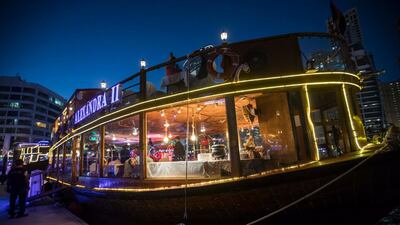
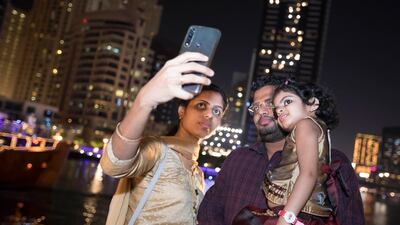
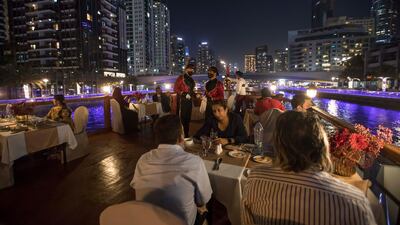
  • UAE residents who struck lucky with Abu Dhabi's Big Ticket draw attended a gala dinner. Organisers of the draw celebrated the winners' good luck at the Alexandra Dhow Cruise in Dubai Marina. All photos by Leslie Pableo / The National
    UAE residents who struck lucky with Abu Dhabi's Big Ticket draw attended a gala dinner. Organisers of the draw celebrated the winners' good luck at the Alexandra Dhow Cruise in Dubai Marina. All photos by Leslie Pableo / The National
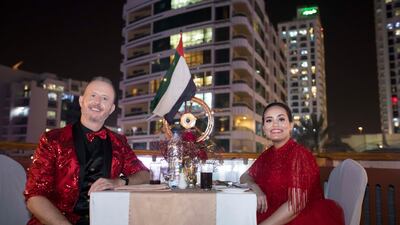
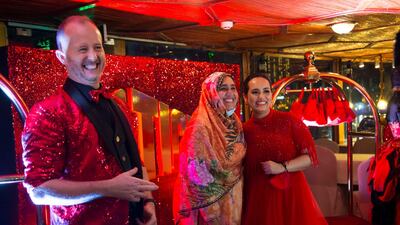
  • Richard Isaac and Bouchra Yamani, the two presenters who pick out the raffle tickets and call the winners, interacted with the winners. Some of attendees had won jackpots of between Dh1 million to Dh15 million, while others won Dh90,000
    Richard Isaac and Bouchra Yamani, the two presenters who pick out the raffle tickets and call the winners, interacted with the winners. Some of attendees had won jackpots of between Dh1 million to Dh15 million, while others won Dh90,000
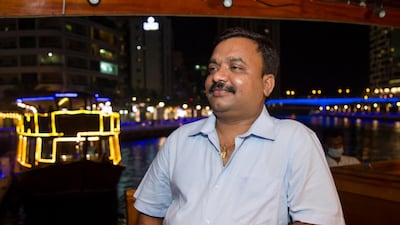
  • 'The National' spoke to winners about how they have spent their grand prize. Shivamurthy Gali Krishnappa won Dh12 million last month. He said he wants to save for his children's future. For now, he is still working as a mechanical engineer for a stainless steel production company
    'The National' spoke to winners about how they have spent their grand prize. Shivamurthy Gali Krishnappa won Dh12 million last month. He said he wants to save for his children's future. For now, he is still working as a mechanical engineer for a stainless steel production company
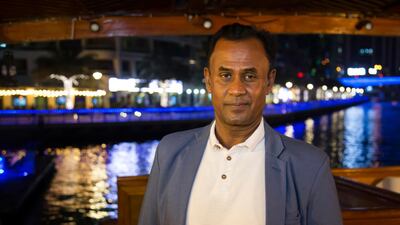
  • Shahed Ahmed Moulvifaiz, a Bangladeshi car garage owner in Al Ain, won Dh10 million less than a week ago. He wants to bring his family to the UAE, expand his business and spend on his youngest son's education
    Shahed Ahmed Moulvifaiz, a Bangladeshi car garage owner in Al Ain, won Dh10 million less than a week ago. He wants to bring his family to the UAE, expand his business and spend on his youngest son's education
  • Jayaprakash Mariyan Philip had won the Dh1 million prize with nine other people. The funds were split equally, leaving him with Dh100,000. He said he has paid off part of his bank loans
    Jayaprakash Mariyan Philip had won the Dh1 million prize with nine other people. The funds were split equally, leaving him with Dh100,000. He said he has paid off part of his bank loans
  • Zaheenn Kausar was visiting her husband in Abu Dhabi from Pakistan, when he bought a ticket under her name. She proved lucky for her family after winning Dh90,000. She wants to pay for her daughter's university tuition and buy a car for herself
    Zaheenn Kausar was visiting her husband in Abu Dhabi from Pakistan, when he bought a ticket under her name. She proved lucky for her family after winning Dh90,000. She wants to pay for her daughter's university tuition and buy a car for herself
  • Before the Covid-19 pandemic, more than 5,000 people would gather during a live event in Abu Dhabi to watch the draw take place. Since 2020, the draw streams live on social media channels, bringing in even larger crowds
    Before the Covid-19 pandemic, more than 5,000 people would gather during a live event in Abu Dhabi to watch the draw take place. Since 2020, the draw streams live on social media channels, bringing in even larger crowds
  • Many people buy multiple tickets together and then split the prize equally. There are also those who win after buying a ticket alone, allowing them to keep the entire jackpot
    Many people buy multiple tickets together and then split the prize equally. There are also those who win after buying a ticket alone, allowing them to keep the entire jackpot
  • The Abu Dhabi Big Draw has been changing lives since 1992
    The Abu Dhabi Big Draw has been changing lives since 1992
  • The ticket for the grand prize costs Dh500
    The ticket for the grand prize costs Dh500

“I still can’t believe that I’m a millionaire. It’s going to change our lives and help create a better future for me and my family,” he said.

“This really shows that you shouldn’t give up on your dreams and that you should keep trying. I’m really still in shock, but also feeling excited about the future.”

Mr Mahmood said he has not made any concrete plans on how he will spend the money, but hopes to save for his children’s education.

“I won the money last night and I’m still processing the news, so I don’t know what I’m going to do with the money. It’s a big amount and we’re going to be smart about how to spend or invest it,” he said.

This month, the Big Ticket draw boasts a Dh10 million grand prize and Dh1 million second prize.

Big Ticket has been in operation since 1992 and has grown in popularity since.

Before the Covid-19 pandemic, more than 5,000 people would gather during a live event in Abu Dhabi to watch the draw take place. It is now streamed live on social media channels, attracting an even bigger audience.


Company Profile

Name: Thndr
Started: 2019
Co-founders: Ahmad Hammouda and Seif Amr
Sector: FinTech
Headquarters: Egypt
UAE base: Hub71, Abu Dhabi
Current number of staff: More than 150
Funds raised: $22 million

Results
%3Cp%3E%3Cstrong%3EStage%203%3A%3C%2Fstrong%3E%3Cbr%3E1.%20Einer%20Rubio%20(COL)%20Movistar%20Team%20-%204h51%E2%80%9924%E2%80%9D%3Cbr%3E2.%20Remco%20Evenepoel%20(BEL)%20Soudal%20Quick-Step%20-%2014%22%3Cbr%3E3.%20Adam%20Yates%20(GBR)%20UAE%20Team%20Emirates%20-%2015%22%3Cbr%3E%3Cstrong%3EGeneral%20classifications%3A%3C%2Fstrong%3E%3Cbr%3E1.%20Remco%20Evenepoel%20(BEL)%20Soudal%20Quick-Step%3Cbr%3E2.%20Lucas%20Plapp%20(AUS)%20Ineos%20Grenaders)%20-%207%22%3Cbr%3E3.%20Pello%20Bilbao%20(ESP)%20Bahrain%20Victorious%20-%2011%22%3C%2Fp%3E%0A
WOMAN AND CHILD

Director: Saeed Roustaee

Starring: Parinaz Izadyar, Payman Maadi

Rating: 4/5

How will Gen Alpha invest?

Mark Chahwan, co-founder and chief executive of robo-advisory firm Sarwa, forecasts that Generation Alpha (born between 2010 and 2024) will start investing in their teenage years and therefore benefit from compound interest.

“Technology and education should be the main drivers to make this happen, whether it’s investing in a few clicks or their schools/parents stepping up their personal finance education skills,” he adds.

Mr Chahwan says younger generations have a higher capacity to take on risk, but for some their appetite can be more cautious because they are investing for the first time. “Schools still do not teach personal finance and stock market investing, so a lot of the learning journey can feel daunting and intimidating,” he says.

He advises millennials to not always start with an aggressive portfolio even if they can afford to take risks. “We always advise to work your way up to your risk capacity, that way you experience volatility and get used to it. Given the higher risk capacity for the younger generations, stocks are a favourite,” says Mr Chahwan.

Highlighting the role technology has played in encouraging millennials and Gen Z to invest, he says: “They were often excluded, but with lower account minimums ... a customer with $1,000 [Dh3,672] in their account has their money working for them just as hard as the portfolio of a high get-worth individual.”

Ten tax points to be aware of in 2026

1. Domestic VAT refund amendments: request your refund within five years

If a business does not apply for the refund on time, they lose their credit.

2. E-invoicing in the UAE

Businesses should continue preparing for the implementation of e-invoicing in the UAE, with 2026 a preparation and transition period ahead of phased mandatory adoption. 

3. More tax audits

Tax authorities are increasingly using data already available across multiple filings to identify audit risks. 

4. More beneficial VAT and excise tax penalty regime

Tax disputes are expected to become more frequent and more structured, with clearer administrative objection and appeal processes. The UAE has adopted a new penalty regime for VAT and excise disputes, which now mirrors the penalty regime for corporate tax.

5. Greater emphasis on statutory audit

There is a greater need for the accuracy of financial statements. The International Financial Reporting Standards standards need to be strictly adhered to and, as a result, the quality of the audits will need to increase.

6. Further transfer pricing enforcement

Transfer pricing enforcement, which refers to the practice of establishing prices for internal transactions between related entities, is expected to broaden in scope. The UAE will shortly open the possibility to negotiate advance pricing agreements, or essentially rulings for transfer pricing purposes. 

7. Limited time periods for audits

Recent amendments also introduce a default five-year limitation period for tax audits and assessments, subject to specific statutory exceptions. While the standard audit and assessment period is five years, this may be extended to up to 15 years in cases involving fraud or tax evasion. 

8. Pillar 2 implementation 

Many multinational groups will begin to feel the practical effect of the Domestic Minimum Top-Up Tax (DMTT), the UAE's implementation of the OECD’s global minimum tax under Pillar 2. While the rules apply for financial years starting on or after January 1, 2025, it is 2026 that marks the transition to an operational phase.

9. Reduced compliance obligations for imported goods and services

Businesses that apply the reverse-charge mechanism for VAT purposes in the UAE may benefit from reduced compliance obligations. 

10. Substance and CbC reporting focus

Tax authorities are expected to continue strengthening the enforcement of economic substance and Country-by-Country (CbC) reporting frameworks. In the UAE, these regimes are increasingly being used as risk-assessment tools, providing tax authorities with a comprehensive view of multinational groups’ global footprints and enabling them to assess whether profits are aligned with real economic activity. 

Contributed by Thomas Vanhee and Hend Rashwan, Aurifer

Mercer, the investment consulting arm of US services company Marsh & McLennan, expects its wealth division to at least double its assets under management (AUM) in the Middle East as wealth in the region continues to grow despite economic headwinds, a company official said.

Mercer Wealth, which globally has $160 billion in AUM, plans to boost its AUM in the region to $2-$3bn in the next 2-3 years from the present $1bn, said Yasir AbuShaban, a Dubai-based principal with Mercer Wealth.

Within the next two to three years, we are looking at reaching $2 to $3 billion as a conservative estimate and we do see an opportunity to do so,” said Mr AbuShaban.

Mercer does not directly make investments, but allocates clients’ money they have discretion to, to professional asset managers. They also provide advice to clients.

“We have buying power. We can negotiate on their (client’s) behalf with asset managers to provide them lower fees than they otherwise would have to get on their own,” he added.

Mercer Wealth’s clients include sovereign wealth funds, family offices, and insurance companies among others.

From its office in Dubai, Mercer also looks after Africa, India and Turkey, where they also see opportunity for growth.

Wealth creation in Middle East and Africa (MEA) grew 8.5 per cent to $8.1 trillion last year from $7.5tn in 2015, higher than last year’s global average of 6 per cent and the second-highest growth in a region after Asia-Pacific which grew 9.9 per cent, according to consultancy Boston Consulting Group (BCG). In the region, where wealth grew just 1.9 per cent in 2015 compared with 2014, a pickup in oil prices has helped in wealth generation.

BCG is forecasting MEA wealth will rise to $12tn by 2021, growing at an annual average of 8 per cent.

Drivers of wealth generation in the region will be split evenly between new wealth creation and growth of performance of existing assets, according to BCG.

Another general trend in the region is clients’ looking for a comprehensive approach to investing, according to Mr AbuShaban.

“Institutional investors or some of the families are seeing a slowdown in the available capital they have to invest and in that sense they are looking at optimizing the way they manage their portfolios and making sure they are not investing haphazardly and different parts of their investment are working together,” said Mr AbuShaban.

Some clients also have a higher appetite for risk, given the low interest-rate environment that does not provide enough yield for some institutional investors. These clients are keen to invest in illiquid assets, such as private equity and infrastructure.

“What we have seen is a desire for higher returns in what has been a low-return environment specifically in various fixed income or bonds,” he said.

“In this environment, we have seen a de facto increase in the risk that clients are taking in things like illiquid investments, private equity investments, infrastructure and private debt, those kind of investments were higher illiquidity results in incrementally higher returns.”

The Abu Dhabi Investment Authority, one of the largest sovereign wealth funds, said in its 2016 report that has gradually increased its exposure in direct private equity and private credit transactions, mainly in Asian markets and especially in China and India. The authority’s private equity department focused on structured equities owing to “their defensive characteristics.”

Top investing tips for UAE residents in 2021

Build an emergency fund: Make sure you have enough cash to cover six months of expenses as a buffer against unexpected problems before you begin investing, advises Steve Cronin, the founder of DeadSimpleSaving.com.

Think long-term: When you invest, you need to have a long-term mindset, so don’t worry about momentary ups and downs in the stock market.

Invest worldwide: Diversify your investments globally, ideally by way of a global stock index fund.

Is your money tied up: Avoid anything where you cannot get your money back in full within a month at any time without any penalty.

Skip past the promises: “If an investment product is offering more than 10 per cent return per year, it is either extremely risky or a scam,” Mr Cronin says.

Choose plans with low fees: Make sure that any funds you buy do not charge more than 1 per cent in fees, Mr Cronin says. “If you invest by yourself, you can easily stay below this figure.” Managed funds and commissionable investments often come with higher fees.

Be sceptical about recommendations: If someone suggests an investment to you, ask if they stand to gain, advises Mr Cronin. “If they are receiving commission, they are unlikely to recommend an investment that’s best for you.”

Get financially independent: Mr Cronin advises UAE residents to pursue financial independence. Start with a Google search and improve your knowledge via expat investing websites or Facebook groups such as SimplyFI. 

UAE squad

Esha Oza (captain), Al Maseera Jahangir, Emily Thomas, Heena Hotchandani, Indhuja Nandakumar, Katie Thompson, Lavanya Keny, Mehak Thakur, Michelle Botha, Rinitha Rajith, Samaira Dharnidharka, Siya Gokhale, Sashikala Silva, Suraksha Kotte, Theertha Satish (wicketkeeper) Udeni Kuruppuarachchige, Vaishnave Mahesh.

UAE tour of Zimbabwe

All matches in Bulawayo
Friday, Sept 26 – First ODI
Sunday, Sept 28 – Second ODI
Tuesday, Sept 30 – Third ODI
Thursday, Oct 2 – Fourth ODI
Sunday, Oct 5 – First T20I
Monday, Oct 6 – Second T20I

Day 5, Abu Dhabi Test: At a glance

Moment of the day When Dilruwan Perera dismissed Yasir Shah to end Pakistan’s limp resistance, the Sri Lankans charged around the field with the fevered delirium of a side not used to winning. Trouble was, they had not. The delivery was deemed a no ball. Sri Lanka had a nervy wait, but it was merely a stay of execution for the beleaguered hosts.

Stat of the day – 5 Pakistan have lost all 10 wickets on the fifth day of a Test five times since the start of 2016. It is an alarming departure for a side who had apparently erased regular collapses from their resume. “The only thing I can say, it’s not a mitigating excuse at all, but that’s a young batting line up, obviously trying to find their way,” said Mickey Arthur, Pakistan’s coach.

The verdict Test matches in the UAE are known for speeding up on the last two days, but this was extreme. The first two innings of this Test took 11 sessions to complete. The remaining two were done in less than four. The nature of Pakistan’s capitulation at the end showed just how difficult the transition is going to be in the post Misbah-ul-Haq era.

RESULTS

5pm: Maiden (PA) Dh80,000 2,200m
Winner: Arjan, Fabrice Veron (jockey), Eric Lemartinel (trainer).

5.30pm: Maiden (PA) Dh80,000 1,400m​​​​​​​
Winner: Jap Nazaa, Royston Ffrench, Irfan Ellahi.

6pm: Al Ruwais Group 3 (PA) Dh300,000 1,200m​​​​​​​
Winner: RB Lam Tara, Fabrice Veron, Eric Lemartinal.

6.30pm: Shadwell Gold Cup Prestige Dh125,000 1,600m​​​​​​​
Winner: AF Sanad, Bernardo Pinheiro, Khalifa Al Neyadi.

7pm: Shadwell Farm Stallions Handicap (PA) Dh70,000 1,600m​​​​​​​
Winner: Jawal Al Reef, Patrick Cosgrave, Abdallah Al Hammadi.

7.30pm: Maiden (TB) Dh80,000 1,600m​​​​​​​
Winner: Dubai Canal, Harry Bentley, Satish Seemar.

Updated: November 04, 2021, 3:18 PM