
LIVE BLOG: Latest on Expo 2020 Dubai here
Sheikh Mohammed bin Rashid, Vice President and Ruler of Dubai, on Friday met Seychelles President Wavel Ramkalawan at the country’s pavilion at Expo 2020 Dubai.
Sheikh Mohammed discussed with Mr Ramkalawan ways to enhance ties between the countries, especially in the economy, trade and tourism, Dubai Media Office reported.
-
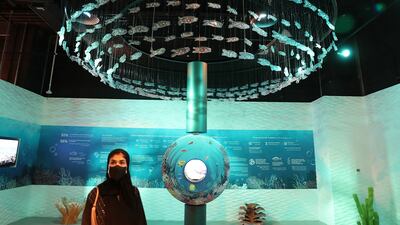
The 'blue' economy is the focus of one of the exhibits at the Seychelles pavilion at Expo 2020 Dubai. All pictures: Pawan Singh / The National -

Visitors to the pavilion learn about the Seychelles' unique ecosystem and the efforts being made to protect it. -

The coco de mer palm tree is endemic to the Seychelles and is an endangered species. It has the biggest seeds of any plant in the world. -

Visitors to the Seychelles pavilion are first taken on a 'treasure hunt'. -

Exhibits in the pavilion encourage visitors to learn about the work undertaken by local and international organisations to protect the treasures of Seychelles. -

Terence Crea is one of the pavilion guides at the Seychelles pavilion at Expo 2020 Dubai. -

Outside view of the Seychelles pavilion at Expo 2020 Dubai.
During a tour of the Seychelles pavilion, Sheikh Mohammed and Mr Ramkalawan saw exhibits that showcase the natural beauty and history of the nation’s islands and the steps being taken to safeguard them.
The pavilion highlights the country’s “blue economy initiatives”, which champions conservation and sustainable development of the coast and ocean areas.
A popular global tourism destination, Seychelles comprises of 115 islands, 50 per cent of which are protected areas.
Sheikh Mohammed expressed his appreciation for the efforts being undertaken by Seychelles to strengthen environmental conservation and sustainability in the country.
Expo 2020 Dubai runs until the end of March 2022.
Sheikh Mohammed's previous visit to the Seychelles Pavilion - in pictures
-
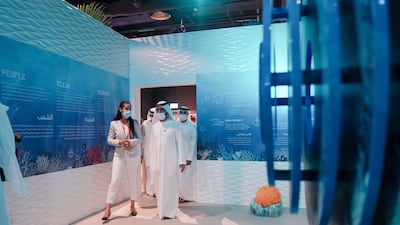
Sheikh Mohammed bin Rashid, Vice President and Ruler of Dubai, visits the Sustainability District at Expo 2020 Dubai, including the Seychelles pavilion. All photos: Wam -
Sheikh Mohammed has said conserving resources is one of the main challenges facing humanity. -
The Seychelles pavilion shines a light on the efforts being made to protect the natural beauty of the islands. -
Passport stamp for the pavilion of Seychelles on the 5th day of Expo 2020, Dubai.
The%20specs
Our commentary on Brexit
- Alistair Burt: Despite Brexit, Britain can remain a world power
- Sam Williams: Departure is influenced by its sense of place
FFP EXPLAINED
What is Financial Fair Play?
Introduced in 2011 by Uefa, European football’s governing body, it demands that clubs live within their means. Chiefly, spend within their income and not make substantial losses.
What the rules dictate?
The second phase of its implementation limits losses to €30 million (Dh136m) over three seasons. Extra expenditure is permitted for investment in sustainable areas (youth academies, stadium development, etc). Money provided by owners is not viewed as income. Revenue from “related parties” to those owners is assessed by Uefa's “financial control body” to be sure it is a fair value, or in line with market prices.
What are the penalties?
There are a number of punishments, including fines, a loss of prize money or having to reduce squad size for European competition – as happened to PSG in 2014. There is even the threat of a competition ban, which could in theory lead to PSG’s suspension from the Uefa Champions League.
2.0
Director: S Shankar
Producer: Lyca Productions; presented by Dharma Films
Cast: Rajnikanth, Akshay Kumar, Amy Jackson, Sudhanshu Pandey
Rating: 3.5/5 stars
PETER%20PAN%20%26%20WENDY
More from Neighbourhood Watch:
MATCH INFO
Red Star Belgrade v Tottenham Hotspur, midnight (Thursday), UAE
Ten tax points to be aware of in 2026
1. Domestic VAT refund amendments: request your refund within five years
If a business does not apply for the refund on time, they lose their credit.
2. E-invoicing in the UAE
Businesses should continue preparing for the implementation of e-invoicing in the UAE, with 2026 a preparation and transition period ahead of phased mandatory adoption.
3. More tax audits
Tax authorities are increasingly using data already available across multiple filings to identify audit risks.
4. More beneficial VAT and excise tax penalty regime
Tax disputes are expected to become more frequent and more structured, with clearer administrative objection and appeal processes. The UAE has adopted a new penalty regime for VAT and excise disputes, which now mirrors the penalty regime for corporate tax.
5. Greater emphasis on statutory audit
There is a greater need for the accuracy of financial statements. The International Financial Reporting Standards standards need to be strictly adhered to and, as a result, the quality of the audits will need to increase.
6. Further transfer pricing enforcement
Transfer pricing enforcement, which refers to the practice of establishing prices for internal transactions between related entities, is expected to broaden in scope. The UAE will shortly open the possibility to negotiate advance pricing agreements, or essentially rulings for transfer pricing purposes.
7. Limited time periods for audits
Recent amendments also introduce a default five-year limitation period for tax audits and assessments, subject to specific statutory exceptions. While the standard audit and assessment period is five years, this may be extended to up to 15 years in cases involving fraud or tax evasion.
8. Pillar 2 implementation
Many multinational groups will begin to feel the practical effect of the Domestic Minimum Top-Up Tax (DMTT), the UAE's implementation of the OECD’s global minimum tax under Pillar 2. While the rules apply for financial years starting on or after January 1, 2025, it is 2026 that marks the transition to an operational phase.
9. Reduced compliance obligations for imported goods and services
Businesses that apply the reverse-charge mechanism for VAT purposes in the UAE may benefit from reduced compliance obligations.
10. Substance and CbC reporting focus
Tax authorities are expected to continue strengthening the enforcement of economic substance and Country-by-Country (CbC) reporting frameworks. In the UAE, these regimes are increasingly being used as risk-assessment tools, providing tax authorities with a comprehensive view of multinational groups’ global footprints and enabling them to assess whether profits are aligned with real economic activity.
Contributed by Thomas Vanhee and Hend Rashwan, Aurifer
How to invest in gold
Investors can tap into the gold price by purchasing physical jewellery, coins and even gold bars, but these need to be stored safely and possibly insured.
A cheaper and more straightforward way to benefit from gold price growth is to buy an exchange-traded fund (ETF).
Most advisers suggest sticking to “physical” ETFs. These hold actual gold bullion, bars and coins in a vault on investors’ behalf. Others do not hold gold but use derivatives to track the price instead, adding an extra layer of risk. The two biggest physical gold ETFs are SPDR Gold Trust and iShares Gold Trust.
Another way to invest in gold’s success is to buy gold mining stocks, but Mr Gravier says this brings added risks and can be more volatile. “They have a serious downside potential should the price consolidate.”
Mr Kyprianou says gold and gold miners are two different asset classes. “One is a commodity and the other is a company stock, which means they behave differently.”
Mining companies are a business, susceptible to other market forces, such as worker availability, health and safety, strikes, debt levels, and so on. “These have nothing to do with gold at all. It means that some companies will survive, others won’t.”
By contrast, when gold is mined, it just sits in a vault. “It doesn’t even rust, which means it retains its value,” Mr Kyprianou says.
You may already have exposure to gold miners in your portfolio, say, through an international ETF or actively managed mutual fund.
You could spread this risk with an actively managed fund that invests in a spread of gold miners, with the best known being BlackRock Gold & General. It is up an incredible 55 per cent over the past year, and 240 per cent over five years. As always, past performance is no guide to the future.


