


Scientists are puzzled by unknown radio signals coming from the direction of the Milky Way’s centre.
Several signals have been received in the past year but astronomers have been unable to find the source.
It is now believed it suggests a new class of stellar object, meaning a newly formed star or planet.
An international team of scientists used a specialised telescope known as the Australian Square Kilometre Array Pathfinder (ASKAP) in Western Australia to research the object emitting the radio signals. And a study published in the Astrophysical Journal on Sunday has revealed its findings.
-
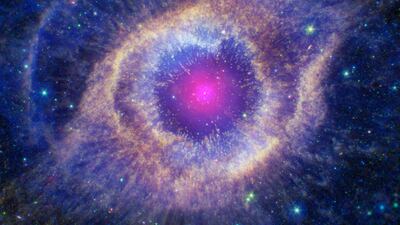
Helix Nebula is a phase when a star like the Sun runs out of fuel, it expands and its outer layers puff off, and then the core of the star shrinks. All photos: Nasa -
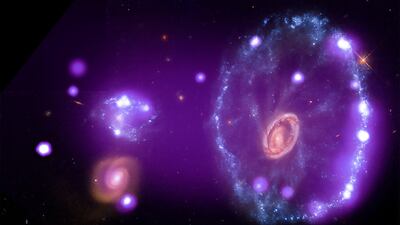
This Cartwheel Galaxy resembles a bull's eye, which is appropriate because its appearance is partly due to a smaller galaxy that passed through the middle of this object. -
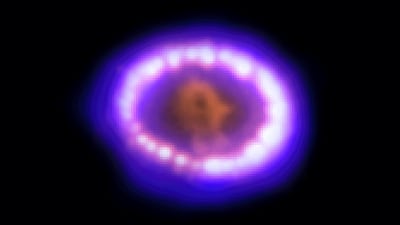
On February 24, 1987, observers in the southern hemisphere saw a new object in a nearby galaxy called the Large Magellanic Cloud. This was one of the brightest supernova explosions in centuries and soon became known as Supernova 1987A. -
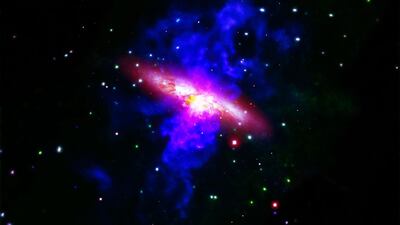
Messier 82, or M82, is a galaxy that is oriented edge-on to Earth. This gives astronomers an interesting view of what happens as this galaxy undergoes bursts of star formations. -
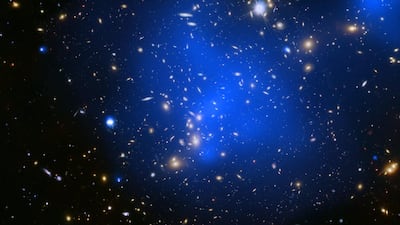
Galaxy clusters are the largest objects in the universe held together by gravity. They contain enormous amounts of superheated gas, with temperatures of tens of millions of degrees, which glow brightly in X-rays and can be observed across millions of light years between galaxies. -

What will be the next star in our Milky Way galaxy to explode as a supernova? Astronomers aren't certain, but one candidate is in Eta Carinae, a volatile system containing two massive stars that closely orbit each other.


“We have been surveying the sky with ASKAP to find unusual new objects ... throughout 2020 and 2021,” said Tara Murphy, a professor at the Sydney Institute for Astronomy and the School of Physics.
“Looking towards the centre of the galaxy, we found ASKAP J173608.2-321635, named after its coordinates. This object was unique in that it started out invisible, became bright, faded away and then reappeared. This behaviour was extraordinary.”
Astronomers routinely study radio waves from space objects to unlock secrets of the universe, such as flaring stars, pulsars - a very dense type of spinning dead star - and fast radio bursts.
Researchers with the study also used the MeerKAT radio telescope in South Africa to observe the radio signals every 15 minutes every few weeks and found its behaviour to be dramatically different than any other space object.
They received six radio signals from the same direction over a period of nine months in 2020.
“At first we thought it could be a pulsar – a very dense type of spinning dead star – or else a type of star that emits huge solar flares. But the signals from this new source don’t match what we expect from these types of celestial objects,” said Ziteng Wang, lead author of the study.
Another study published in the Nature Astronomy journal on Monday suggests the radio waves are coming from hidden planets.
Researchers used the Low Frequency Array, a powerful radio telescope based in the Netherlands, to search for planets and discovered stars unexpectedly blasting out radio waves. This possibly indicates the existence of hidden planets.
“We’ve discovered signals from 19 distant red dwarf stars, four of which are best explained by the existence of planets orbiting them,” said Dr Benjamin Pope, a professor at University of Queensland and a co-author of the study.
“We’ve long known that the planets of our own solar system emit powerful radio waves as their magnetic fields interact with the solar wind but radio signals from planets outside our solar system had yet to be picked up.
“This discovery is an important step for radio astronomy and could potentially lead to the discovery of planets throughout the galaxy.”
The team was confident the signals are coming from a magnetic connection of stars and unseen planets orbiting them – similar to the interaction between Jupiter and its moon, Io.
The researchers have developed a model for the radio emission that shows a planet enveloped in the magnetic field of a star, feeding material into a vast current that could possibly be causing the signals.
“We can’t be 100 per cent sure that the four stars we think have planets are indeed planet hosts, but we can say that a planet-star interaction is the best explanation for what we’re seeing,” Dr Pope said.
“Follow-up observations have ruled out planets more massive than Earth but there’s nothing to say that a smaller planet wouldn’t do this.”
Striking images of natural disasters captured from space - in pictures
-
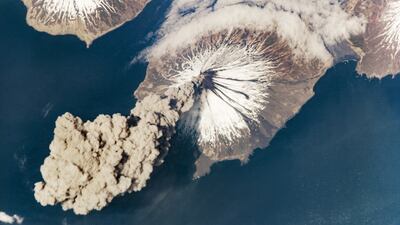
1. An enormous plume of ash rises from the Cleveland Volcano on May 23, 2006. The image was captured from the International Space Station by astronaut Jeff Williams. The ash cloud rose as high as 6,000 metres above sea level. Photo: Nasa Earth Observatory -
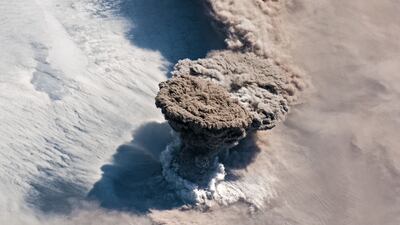
2. The Raikoke Volcano on the Kamchatka Peninsula erupts on June 22, 2019. The last time it exploded was in 1924. Photo: Nasa Earth Observatory -
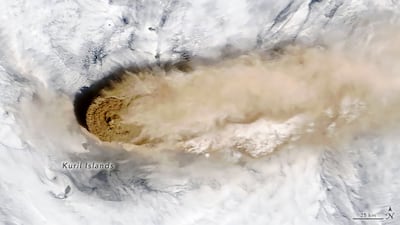
3. Another image of the Raikoke eruption was captured on the same morning by the Suomi NPP satellite. Photo: Nasa Earth Observatory -
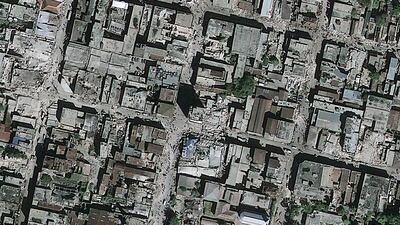
4. One of the deadliest earthquakes struck Haiti in 2010. This GeoEye-1 satellite image shows rubble on the streets of Port-au-Prince on January 13. About 250,000 people were killed in the 7.0 magnitude earthquake. Photo: Nasa Earth Observatory -
5. A huge sandstorm rolls across the Sahara Desert on August 1, 2018. Astronaut Ricky Arnold captured this image from the ISS. Photo: Ricky Arnold Twitter -
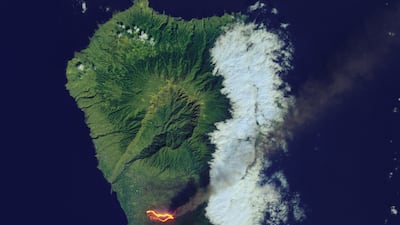
6. Satellite images show an active volcano on the Spanish island of La Palma on September 26, 2021. Photo: Nasa Earth Observatory -

7. The La Palma volcanic eruption has destroyed hundreds of homes. Photo: Nasa Earth Observatory -
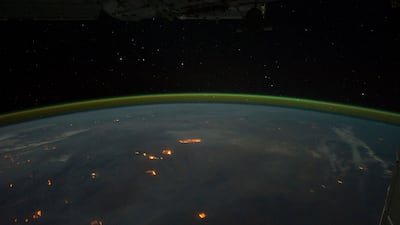
8. Astronauts on the space station captured images of auroras australis, or southern lights, while flying over the Indian Ocean. Light created by the wildfires in Australia can also be seen. Photo: Nasa Earth Observatory -
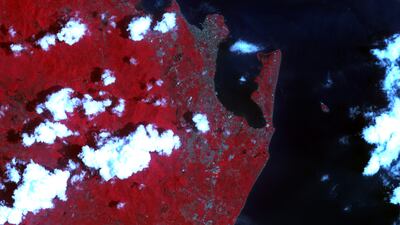
9. This Terra satellite image shows how green (represented in red in this photo) the island of Leyte was before the deadly super typhoon Haiyan hit Philippines in 2013. Photo: Nasa Earth Observatory -
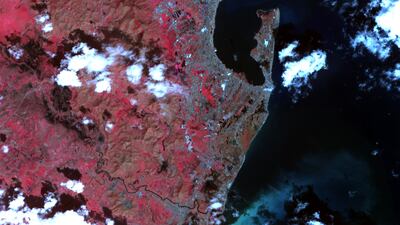
10. Much of the vegetation and properties on the island was destroyed after the typhoon struck with winds of near 315 kilometres per hour. Photo: Nasa Earth Observatory -

11. A view of super typhoon Haiyan from space taken by Nasa’s Aqua satellite. Photo: Nasa Earth Observatory -
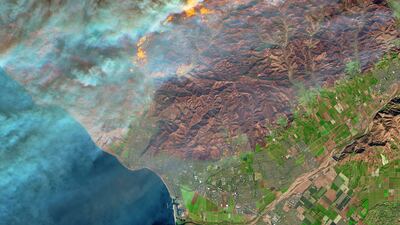
12. The European Space Agency’s Sentinel-2 satellite captured an image of the fires in southern California on December 5, 2017. This photo shows the largest of the blazes in Ventura County, which destroyed more than 65,000 acres. Photo: Nasa Earth Observatory -
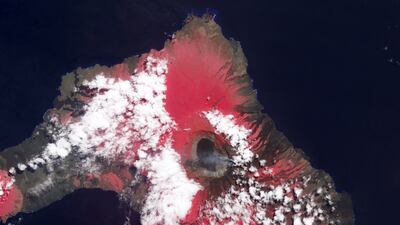
13. The highest volcano in the Galapagos Islands erupted for the first time in 33 years in 2015. An image captured by the Terra satellite shows volcanic ash and gases about 15 km high. Photo: Nasa Earth Observatory -
14. An image of the Hurricane Dorian taken by US astronaut Christina Koch in 2019. The natural disaster struck the Bahamas and killed more than 70 people. Photo: Nasa Earth Observatory -

15. Astronaut Christina Koch shared an image of smoke pluming over the Australian continent. The 2019-2020 bushfires destroyed thousands of homes and killed more than 30 people. Photo: Christina Koch Twitter -
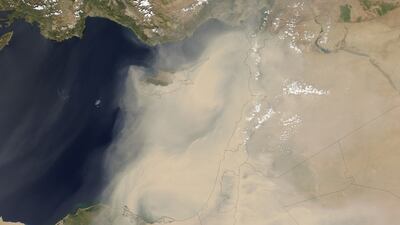
16. Satellite images show a dust storm sweeping over the Middle East in 2015. The storm hit Lebanon, Israel, Jordan, Cyprus and Palestine, causing many cancelled flights and the closure of seaports. Photo: Nasa Earth Observatory -
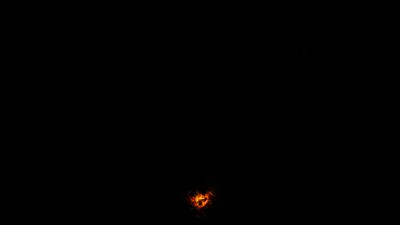
17. A shield volcano erupts on Iceland’s Reykjanes peninsula on March 22, 2021. Photo: Nasa Earth Observatory -
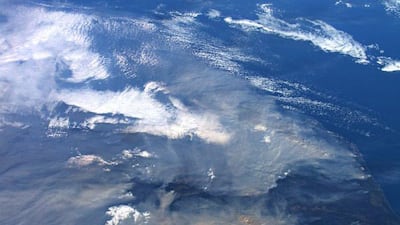
18. Astronaut Luca Parmitano shared an image of the wildfires in Australia on January 13, 2020. Photo: European Space Agency -
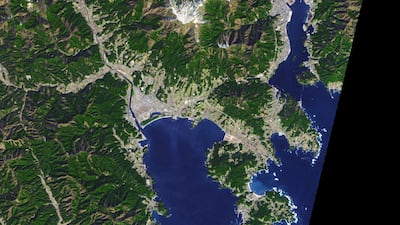
19. A 2007 view of Japan’s Tohoku region before one of the world’s deadliest earthquake destroyed most of the area in 2011. Photo: Nasa Earth Observatory -
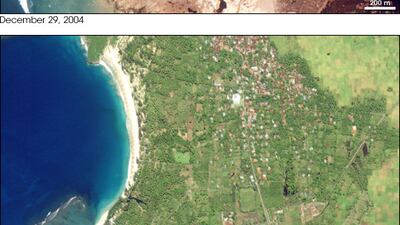
20. The 2004 Indian Ocean earthquake and tsunamis killed nearly 230,000 people. A satellite image shows the Indonesian town of Lhoknga destroyed by the natural disaster on December 26. All properties were destroyed, except for a white mosque that is visible in the image. Photo: Nasa -
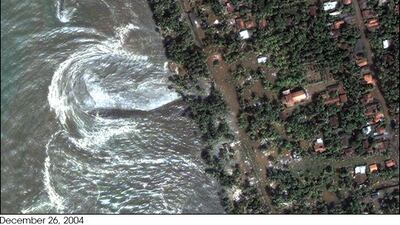
21. The tsunamis, caused by a 9.0 magnitude earthquake, also struck Sri Lanka. Photo: Nasa -
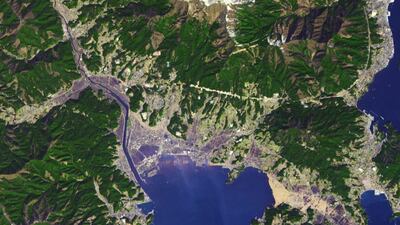
22. A satellite image taken after a 9.1 magnitude earthquake struck the Tohoku region in Japan, with tsunami waves destroying most of the coastal area. About five to 10 metre waves flooded into the town. The photo shows flooding, a destroyed seawall and debris. Photo: Nasa Earth Observatory -
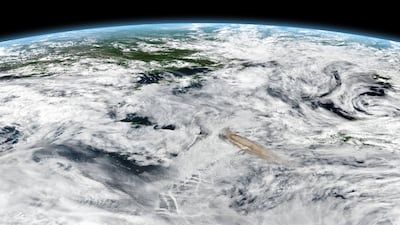
23. The Raikoke Volcano eruption seen from space on June 22, 2019. Photo: Nasa Earth Observatory -
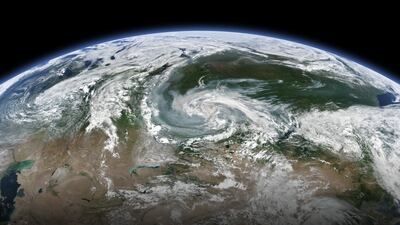
24. A Suomi NPP satellite image shows smoke over Russia, as wildfires burned across 11 regions of the country in July 2019. Photo: Nasa Earth Observatory -
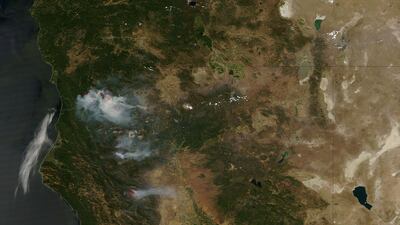
25. Satellite image of forest fires in Northern California captured in August 2008. Photo: Nasa Earth Observatory -
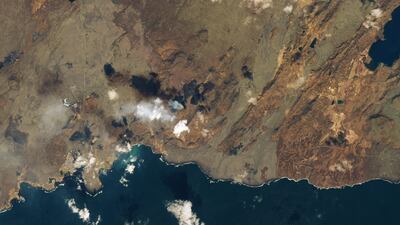
26. The Fagradalsfjall volcano in southwestern Iceland erupted on May 9, 2021. Photo: Nasa Earth Observatory -
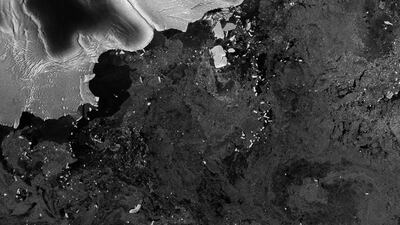
27. The 2011 tsunami in Japan was so intense, it caused calving of large icebergs from the Sulzberger Ice Shelf on the Antarctic coast, as shown in this image captured by European Space Agency’s Envisat satellite. Photo: Nasa Earth Observatory -
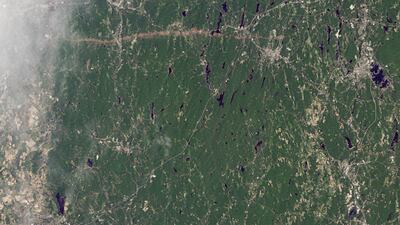
28. Satellite image shows a powerful tornado (brown horizontal line in the middle of image) sweeping across Massachusetts on June 2011. It wreaked havoc for 63 kilometres, killing three people and destroying property. Photo: Nasa Earth Observatory -
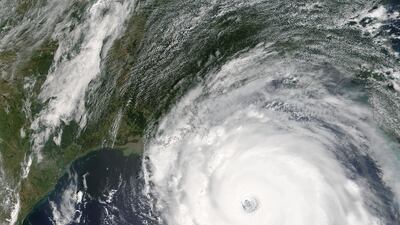
29. A satellite image of the Hurricane Katrina over the US in 2005. It struck the state of Louisiana, killing 1,833 people and destroying thousands of homes. Photo: Nasa Earth Observatory -

30. The Caldor fire reached Lake Tahoe on the California and Nevada border on September 15, 2021, as seen in this Landsat 8 satellite image. The fire had been burning for 10 weeks. Photo: Nasa Earth Observatory



