



Space exploration is the ignition that can boost the economy and help diversification, the UAE’s space chief has said.
Sarah Al Amiri, Minister of State for Advanced Technology and chairwoman of the UAE Space Agency, said the programme can not only create a private sector within the space field but also lead to many more economic opportunities.
Speaking on Wednesday, she said space missions were assessed according to many criteria and commercial viability was an important one.
“Our mission today at the space agency is marrying exploration missions together with commercially viable data sets, products and services, developing smaller satellites that have commercial value and are able to provide us with data that feeds into different sectors and creates this necessary ripple effect,” she said, at the US-based Centre for Strategic and International Studies.

“An interesting lesson learned is that exploration is that ignition that you give towards your economic diversification and the stimulation of your space economy and the private sector within the space sector, and then everything else then is able to indirectly feed off of that."
The UAE does have satellites in low-Earth orbit that produce data commercially for private companies all over the world.
KhalifaSat, the first Emirati-built satellite, is partly being used to boost the commercial space sector.
The UAE is also looking to have commercial payloads on its second Moon rover.
Salem Al Marri, the deputy director-general of the Mohammed bin Rashid Space Centre, said some companies and research institutions are willing to contribute financially to the country’s second lunar mission.
“In the next mission, we do see interest from commercial players and from start-up companies in the UAE that we want to support and endorse,” he said.
“We want our next and future rovers to be used as platforms by start-up companies, universities [and] commercial players to test their ideas, to implement them.”
During the first lunar mission, the UAE is carrying a few payloads from foreign space agencies, but they are non-commercial.
In an earlier exclusive interview with The National, Ms Al Amiri highlighted the agency’s efforts in increasing private sector investment in the country’s growing space industry.
She said the aim is to make the UAE a regional hub for the development of spacecraft systems.
“Most of the current space sector within the Emirates is focused on government spending and programmes across both local and federal governments,” she said.
"Today, we're talking about a space sector that has an indirect impact on the economy. In five years, we want to see a space sector that has both an indirect impact on the economy, society, and also a direct impact on the economy."
UAE's lunar mission - in pictures
-
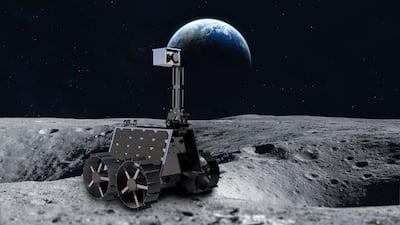
An artist's impression of the UAE's lunar rover called Rashid. -

Dr Hamad Al Marzooqi, project manager of the Emirates Lunar Mission at the Mohammed bin Rashid Space Centre. Chris Whiteoak / The National -
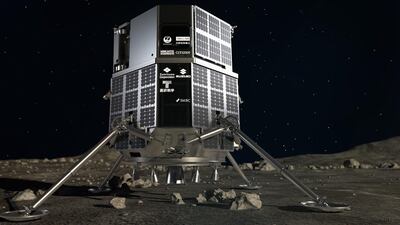
An artist's impression of iSpace's Hakuto-Reboot lunar lander. It will carry UAE's Rashid rover to the surface of the Moon in 2022. -
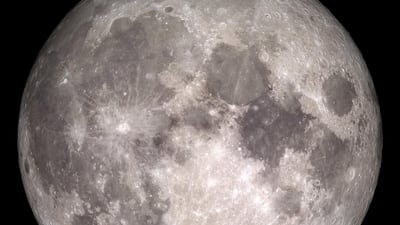
The UAE aims to land the Rashid rover on the near side of the Moon due to its smoother surface. -
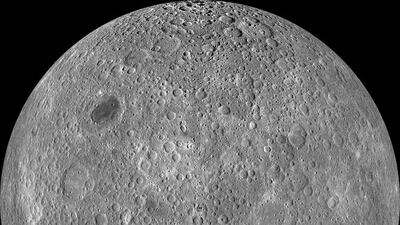
The far side of the Moon remains largely unexplored, but Nasa is turning its focus back to the lunar surface. -
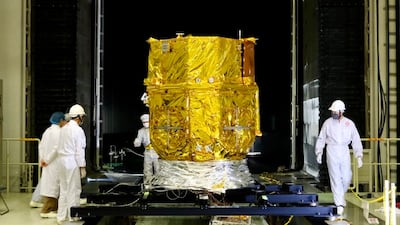
The HAKUTO-R lander, which will deliver the UAE's Rashid rover to the lunar surface in 2022, is now in final stages of assembly. -
The ispace team completed the assembly of the lander's structure thermal model in April. Courtesy: ispace -
The final assembly of the lander is being carried out in co-operation with the Ariane Group GmbH at the Ariane Group facility in Lampoldshausen, Germany. Courtesy: ispace -
Using a lander and rocket that is already available helps Emirati engineers and scientists get quicker and easier access to space. Courtesy: ispace -
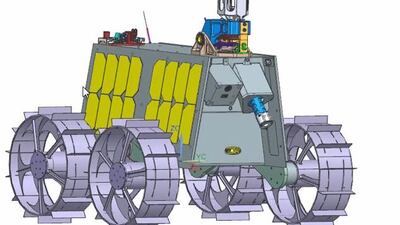
The initial concept design of the Rashid rover. Courtesy: MBRSC -
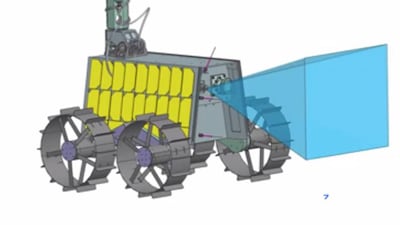
Rashid rover's thermal imager will analyse the Moon's properties through thermal energy. Courtesy: MBRSC -
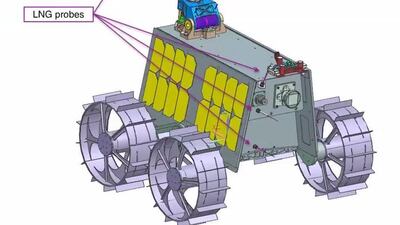
The Langmuir probes on the rover will analyse the lunar surface charge and electric fields. Courtesy: MBRSC -
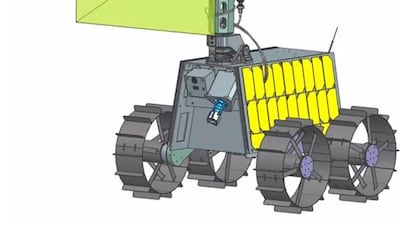
One of the rover's two high-resolution optical imagers that will take photos of the Moon. Courtesy: MBRSC



