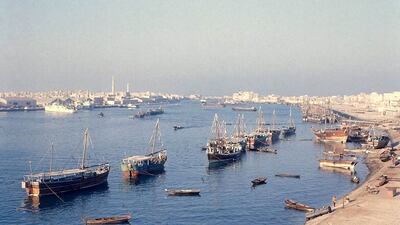
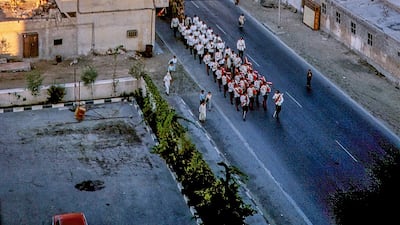
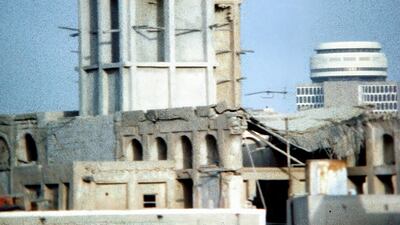
Today, life in the Emirates moves in the fast lane. In a regular series to mark the 50th anniversary of the UAE we take a little trip back in time to see just how much the country has changed.
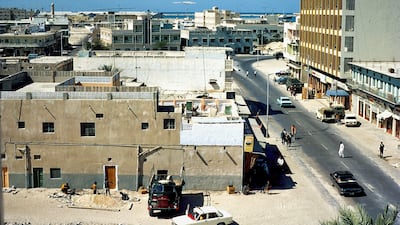
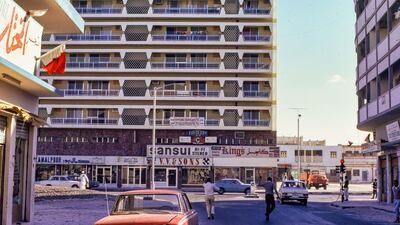
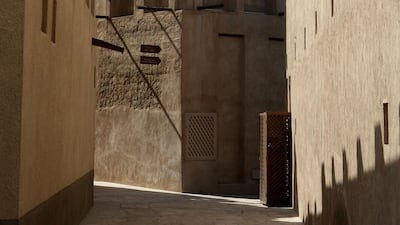
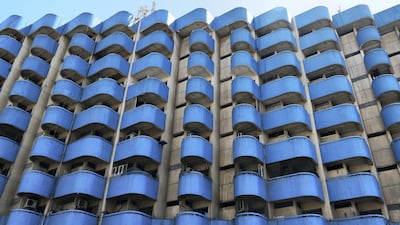
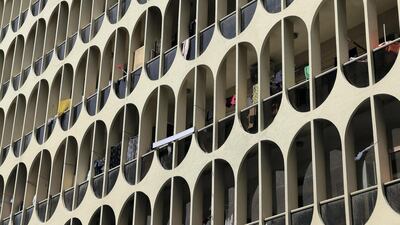
Half a century separates these two photographs of Bur Dubai, yet it is still recognisably the same place.
What is old in 2021 was new in 1971. There is the apartment block, since rebuilt, which is the central focus of the photo, but also something else, easily overlooked at first glance, now a part of everyday life.
These are traffic lights, the first in Dubai, despite the seeming absence of traffic back in the 1970s.
The photograph was taken by Len Chapman, who runs the Dubai As It Used To Be website.
Mr Chapman moved to Dubai with his young family in 1971, making their home at Al Owais building on Al Fahidi Street, one of the city’s earliest high-rise apartment blocks.
The traffic lights were switched off at midnight, he recalls, and became a source of irritation for drivers, who furiously honked horns if it was felt they stayed too long on red.
“When the traffic lights switched on at 6am, drivers started pressing their horn buttons. Apartment residents did not need alarm clocks.”
Mr Chapman has other memories of those days. On the ground floor of Al Owais building was V V & Sons, then the city’s go-to place for electrical and hi-fi goods. Founded in 1958, the company is still in business.
In the absence of supermarkets, shopping was at K M Brothers grocery (also still going strong), while bread was sold from the back of a van that arrived every evening.
The building on the corner on the right of the photo is another survivor from the 1970s, but pedestrians now walk on pavement rather than the sand sidewalks of those earlier years. On the left, the flag of Dubai can be seen hanging from a shop front.
Mr Chapman lived on Al Fahidi Street for only four months before moving to Jumeirah, but his stay in Dubai lasted more than 30 years. He now lives in Australia but keeps memories of those days alive through his website.

The Melbourne Mercer Global Pension Index
Mazen Abukhater, principal and actuary at global consultancy Mercer, Middle East, says the company’s Melbourne Mercer Global Pension Index - which benchmarks 34 pension schemes across the globe to assess their adequacy, sustainability and integrity - included Saudi Arabia for the first time this year to offer a glimpse into the region.
The index highlighted fundamental issues for all 34 countries, such as a rapid ageing population and a low growth / low interest environment putting pressure on expected returns. It also highlighted the increasing popularity around the world of defined contribution schemes.
“Average life expectancy has been increasing by about three years every 10 years. Someone born in 1947 is expected to live until 85 whereas someone born in 2007 is expected to live to 103,” Mr Abukhater told the Mena Pensions Conference.
“Are our systems equipped to handle these kind of life expectancies in the future? If so many people retire at 60, they are going to be in retirement for 43 years – so we need to adapt our retirement age to our changing life expectancy.”
Saudi Arabia came in the middle of Mercer’s ranking with a score of 58.9. The report said the country's index could be raised by improving the minimum level of support for the poorest aged individuals and increasing the labour force participation rate at older ages as life expectancies rise.
Mr Abukhater said the challenges of an ageing population, increased life expectancy and some individuals relying solely on their government for financial support in their retirement years will put the system under strain.
“To relieve that pressure, governments need to consider whether it is time to switch to a defined contribution scheme so that individuals can supplement their own future with the help of government support,” he said.
Ten tax points to be aware of in 2026
1. Domestic VAT refund amendments: request your refund within five years
If a business does not apply for the refund on time, they lose their credit.
2. E-invoicing in the UAE
Businesses should continue preparing for the implementation of e-invoicing in the UAE, with 2026 a preparation and transition period ahead of phased mandatory adoption.
3. More tax audits
Tax authorities are increasingly using data already available across multiple filings to identify audit risks.
4. More beneficial VAT and excise tax penalty regime
Tax disputes are expected to become more frequent and more structured, with clearer administrative objection and appeal processes. The UAE has adopted a new penalty regime for VAT and excise disputes, which now mirrors the penalty regime for corporate tax.
5. Greater emphasis on statutory audit
There is a greater need for the accuracy of financial statements. The International Financial Reporting Standards standards need to be strictly adhered to and, as a result, the quality of the audits will need to increase.
6. Further transfer pricing enforcement
Transfer pricing enforcement, which refers to the practice of establishing prices for internal transactions between related entities, is expected to broaden in scope. The UAE will shortly open the possibility to negotiate advance pricing agreements, or essentially rulings for transfer pricing purposes.
7. Limited time periods for audits
Recent amendments also introduce a default five-year limitation period for tax audits and assessments, subject to specific statutory exceptions. While the standard audit and assessment period is five years, this may be extended to up to 15 years in cases involving fraud or tax evasion.
8. Pillar 2 implementation
Many multinational groups will begin to feel the practical effect of the Domestic Minimum Top-Up Tax (DMTT), the UAE's implementation of the OECD’s global minimum tax under Pillar 2. While the rules apply for financial years starting on or after January 1, 2025, it is 2026 that marks the transition to an operational phase.
9. Reduced compliance obligations for imported goods and services
Businesses that apply the reverse-charge mechanism for VAT purposes in the UAE may benefit from reduced compliance obligations.
10. Substance and CbC reporting focus
Tax authorities are expected to continue strengthening the enforcement of economic substance and Country-by-Country (CbC) reporting frameworks. In the UAE, these regimes are increasingly being used as risk-assessment tools, providing tax authorities with a comprehensive view of multinational groups’ global footprints and enabling them to assess whether profits are aligned with real economic activity.
Contributed by Thomas Vanhee and Hend Rashwan, Aurifer
Ferrari 12Cilindri specs
Engine: naturally aspirated 6.5-liter V12
Power: 819hp
Torque: 678Nm at 7,250rpm
Price: From Dh1,700,000
Available: Now
THE%20HOLDOVERS
%3Cp%3E%3Cstrong%3EDirector%3A%20%3C%2Fstrong%3EAlexander%20Payne%3C%2Fp%3E%0A%3Cp%3E%3Cstrong%3EStarring%3A%3C%2Fstrong%3E%20Paul%20Giamatti%2C%20Da'Vine%20Joy%20Randolph%2C%20Dominic%20Sessa%3C%2Fp%3E%0A%3Cp%3E%3Cstrong%3ERating%3A%3C%2Fstrong%3E%204.5%2F5%3C%2Fp%3E%0A
GIANT REVIEW
Starring: Amir El-Masry, Pierce Brosnan
Director: Athale
Rating: 4/5
Teams
Punjabi Legends Owners: Inzamam-ul-Haq and Intizar-ul-Haq; Key player: Misbah-ul-Haq
Pakhtoons Owners: Habib Khan and Tajuddin Khan; Key player: Shahid Afridi
Maratha Arabians Owners: Sohail Khan, Ali Tumbi, Parvez Khan; Key player: Virender Sehwag
Bangla Tigers Owners: Shirajuddin Alam, Yasin Choudhary, Neelesh Bhatnager, Anis and Rizwan Sajan; Key player: TBC
Colombo Lions Owners: Sri Lanka Cricket; Key player: TBC
Kerala Kings Owners: Hussain Adam Ali and Shafi Ul Mulk; Key player: Eoin Morgan
Venue Sharjah Cricket Stadium
Format 10 overs per side, matches last for 90 minutes
Timeline October 25: Around 120 players to be entered into a draft, to be held in Dubai; December 21: Matches start; December 24: Finals
More from Neighbourhood Watch
If you go
The flights
Emirates and Etihad fly direct to Nairobi, with fares starting from Dh1,695. The resort can be reached from Nairobi via a 35-minute flight from Wilson Airport or Jomo Kenyatta International Airport, or by road, which takes at least three hours.
The rooms
Rooms at Fairmont Mount Kenya range from Dh1,870 per night for a deluxe room to Dh11,000 per night for the William Holden Cottage.
RACE CARD
6.30pm Mazrat Al Ruwayah – Group 2 (PA) $36,000 (Dirt) 1,600m
7.05pm Handicap (TB) $68,000 (Turf) 2,410m
7.40pm Meydan Trophy – Conditions (TB) $50,000 (T) 1,900m
8.15pm Al Maktoum Challenge Round 2 - Group 2 (TB) $293,000 (D) 1,900m
8.50pm Al Rashidiya – Group 2 (TB) $163,000 (T) 1,800m
9.25pm Handicap (TB) $65,000 (T) 1,000m