
Today, life in the Emirates moves in the fast lane. In a new regular series to mark the 50th anniversary of the UAE we take a little trip back in time and see just how much the country has changed.
The brief was simple: deliver a building that would introduce Dubai to the world. Just as Sydney had its Opera House and New York the Empire State Building, Dubai needed a structure that would become synonymous with the city. That was the task handed to British architect Tom Wright in the early 1990s.
The site chosen for the new building was about 20 kilometres out of town and far from the action. The area had been informally known as Chicago Beach, named after the Chicago Bridge and Iron Company, which built oil storage tanks there. It was also home to the 1970s-era Chicago Beach Hotel. While still popular, it had become jaded by the 1990s.

Wright, then in his 30s and working for the Atkins design firm, delivered a sail-inspired structure that reflected Dubai′s maritime heritage. It was approved in 1993 and dredging work to create the man-made island it would sit on started almost immediately. By 1996 the hotel was starting to rise. The entire project was a complex feat of engineering. Scores of concrete piles were driven into the sand to support the hotel, while a honeycomb collection of rocks ring-fenced it against sea intrusion.
The pace of construction was staggering. In the older photograph from 1997, the hotel is already almost complete, while some workers take a rest on the beach. A mere two years later Burj Al Arab – Tower of the Arabs – opened its doors in time for the new millennium. People from across the UAE came to view the new attraction.
The 321-metre high hotel has 202 rooms and one of the world's tallest atriums. The Burj Al Arab's architectural height is taller than the Eiffel Tower. The interiors are gilded in 24-carat gold, while its helipad has also been put to good use. In 2004, Tiger Woods teed off from there, while a year later, Andre Agassi and Roger Federer faced off on a makeshift tennis court. Along with Jumeirah Beach Hotel, it has become synonymous with Dubai.
As for the Chicago Beach Hotel, it was finally demolished in 1997 and the Wild Wadi Waterpark stands on the spot today. In the years since, Dubai has built the world's tallest building and a host of other super structures but the hotel remains a modern symbol of Dubai's ambition.
Burj Al Arab: the global landmark of Dubai – in pictures
-
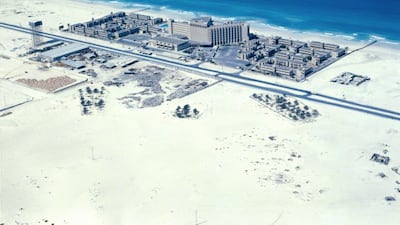
Dubai's Chicago Beach Hotel taken at around 1979. Today the Wild Wadi water park sits on this spot. Photo: Omar Salam -
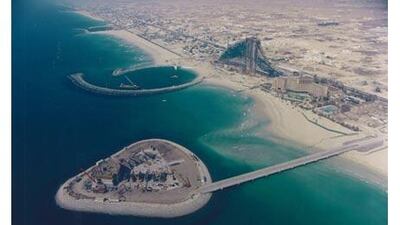
By January 1996, the area had been transformed. The artificial island that Burj Al Arab would sit on was complete and construction on the hotel well advanced. -

A sketch by British architect, Tom Wright, showing his concept for the Burj Al Arab design. -

Architect Tom Wright with his original model of the Burj Al Arab. Stephen Lock for The National -
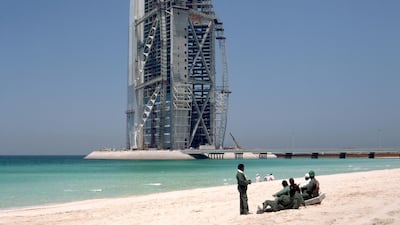
The Burj Al Arab in 1997, as it edges towards completion. James Davis / Eye Ubiquitous / Corbis -

The Burj Al Arab opened in 1999 and drew people from across the UAE to see the new building. Here Abu Dhabi residents Omeir Nasir, left, and Owais Nasir, right, visit the Burj Al Arab between 1999 and 2002. Photo: Sarwat Nasir -
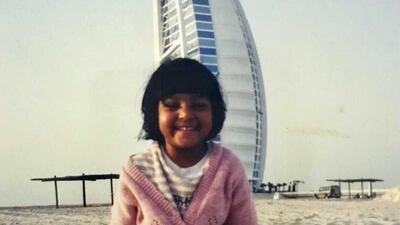
Madiha Naz Nasir visits in 1999 or 2000. Photo: Sarwat Nasir -
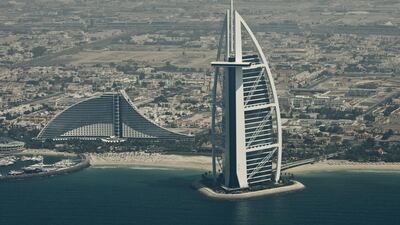
The Burj Al Arab and Jumeirah Beach Hotel in 2009. -
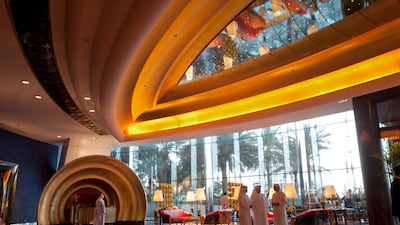
The lobby of the Burj Al Arab hotel taken in 2011. Jeff Topping / The National -
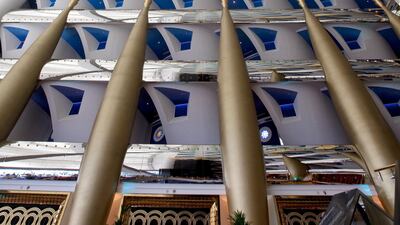
The hotel has one of the world's tallest atriums. Jeff Topping / The National -
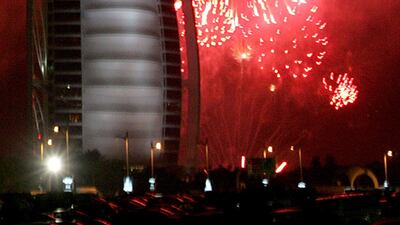
The hotel has become synonymous with Dubai. Pawan Singh / The National -

Its helipad has also staged events, such as between Roger Federer and Andre Agassi in February 2005. Getty -
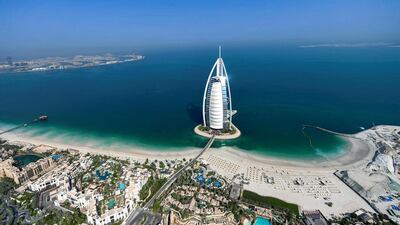
The Burj Al Arab in Dubai, a symbol of Dubai's enduring ambition. AFP



