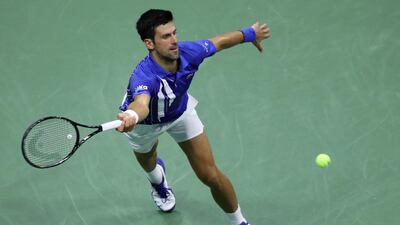
Novak Djokovic returns a volley during his match against Jan-Lennard Struff at the US Open. AFP

Novak Djokovic through to last 16 as bizarre delay shrouds US Open


  • English
  • Arabic

Novak Djokovic sailed into the last 16 of the US Open on Friday as off-court intrigue forced the delay of a men's singles match over issues linked to coronavirus.

Djokovic outclassed Germany's Jan-Lennard Struff 6-3, 6-3, 6-1 in a routine victory for the world No 1, who is chasing an 18th Grand Slam singles title.

Far from routine was a last-minute attempt by New York health officials to prevent France's Adrian Mannarino from playing his last-32 encounter against German fifth seed Alexander Zverev.

The intervention led to a back and forth between tournament organisers and the state government and resulted in the match, which Zverev won in four sets, starting over three hours late.

"It was a weird situation for me," said Mannarino, one of 11 players put under enhanced safety protocols earlier this week after compatriot Benoit Paire was withdrawn from the tournament after testing positive for coronavirus.

"I was just laying on the sofa still trying to be focused just in case I would go on court," he said, following Zverev's 6-7, 6-4, 6-2 victory.

Zverev will now play unseeded Spaniard Alejandro Davidovich Fokina in the last 16 while Djokovic will play Spain's Pablo Carreno Busta for a place in the quarter-finals.

Osaka struggles

Earlier, Japan's Naomi Osaka battled into the last 16 of the women's draw.

The two-time Grand Slam winner required three sets to dislodge 18-year-old Ukrainian Marta Kostyuk in an early game at Arthur Ashe Stadium.

The Japanese fourth seed, who threw her racquet in frustration after losing the second set on tie-break, prevailed 6-3, 6-7, 6-2 against the world No 137.

"I just felt like I had so many points that I didn't capitalise on. I think when I went up, I became a bit passive and then she came in because she has no fear," said Osaka, 22.

Her experience came to the fore in the deciding set as she held her serve and broke Kostyuk twice to set up a match against 14th seed Anett Kontaveit of Estonia for a place in the quarter-finals.

Elsewhere, sixth seed Petra Kvitova breezed past American Jessica Pegula 6-4, 6-3 to set up a last-16 encounter with Shelby Rogers, also of the United States.

Eighth seed Petra Martic of Croatia swept aside unseeded Russian Varvara Gracheva 6-3, 6-3.

Martic will play Yulia Putintseva of Kazakhstan in the last 16 after the 23rd seed powered past Vera Lapko of Belarus 6-3, 6-3.

Germany's 17th seed Angelique Kerber also progressed to the fourth round, making light work of American Ann Li 6-3, 6-4.

Kerber, the 2016 US Open champion, will go up against Jennifer Brady for a quarter-final spot after the American 28th seed knocked out France's Caroline Garcia 6-3, 6-3.

Garcia had provided the biggest upset of the tournament on Wednesday when she eliminated top seed Karolina Pliskova.

Tsitsipas stunned

In the men's draw, Croatia's 27th seed Borna Coric staged a remarkable Houdini act to stun fourth seed Stefanos Tsitsipas in a 4 hour, 36 minute late-night thriller.

Coric appeared to be heading for certain defeat after Tsitsipas, leading by two sets to one, opened up a 5-1 lead in the fourth.

But Coric rallied superbly, saving six match points and fighting back to take the set 7-5 to force a decider.

Tsitsipas went a break up once more in the fifth but couldn't press home the advantage as Coric forced a tie break before clinching a 6-7, 6-4, 4-6, 7-5, 7-6 win.

Twelfth seed Denis Shapovalov recovered from 5-2 down in the fourth set to pip American number 19 seed Taylor Fritz 3-6, 6-3, 4-6, 7-6, 6-2

Fritz, 22 was within two points of victory before the 21-year-old Shapovalov completed a remarkable comeback.

"I think we both deserved to win," said Shapovalov. "It was great tennis and I think I just got a little bit lucky."

The Canadian will do battle with seventh seed David Goffin for a place in the quarter-finals after the Belgian brushed aside Serbia's 26th seed Filip Krajinovic 6-1, 7-6, 6-4.

Britain's involvement in the singles ended on Friday with both Dan Evans and Cameron Norrie exiting.

France's Corentin Moutet knocked out Evans 4-6, 6-3, 7-6, 7-6 as they resumed their second round match that was postponed Thursday because of rain.

The specs
  • Engine: 3.9-litre twin-turbo V8
  • Power: 640hp
  • Torque: 760nm
  • On sale: 2026
  • Price: Not announced yet

Mercer, the investment consulting arm of US services company Marsh & McLennan, expects its wealth division to at least double its assets under management (AUM) in the Middle East as wealth in the region continues to grow despite economic headwinds, a company official said.

Mercer Wealth, which globally has $160 billion in AUM, plans to boost its AUM in the region to $2-$3bn in the next 2-3 years from the present $1bn, said Yasir AbuShaban, a Dubai-based principal with Mercer Wealth.

Within the next two to three years, we are looking at reaching $2 to $3 billion as a conservative estimate and we do see an opportunity to do so,” said Mr AbuShaban.

Mercer does not directly make investments, but allocates clients’ money they have discretion to, to professional asset managers. They also provide advice to clients.

“We have buying power. We can negotiate on their (client’s) behalf with asset managers to provide them lower fees than they otherwise would have to get on their own,” he added.

Mercer Wealth’s clients include sovereign wealth funds, family offices, and insurance companies among others.

From its office in Dubai, Mercer also looks after Africa, India and Turkey, where they also see opportunity for growth.

Wealth creation in Middle East and Africa (MEA) grew 8.5 per cent to $8.1 trillion last year from $7.5tn in 2015, higher than last year’s global average of 6 per cent and the second-highest growth in a region after Asia-Pacific which grew 9.9 per cent, according to consultancy Boston Consulting Group (BCG). In the region, where wealth grew just 1.9 per cent in 2015 compared with 2014, a pickup in oil prices has helped in wealth generation.

BCG is forecasting MEA wealth will rise to $12tn by 2021, growing at an annual average of 8 per cent.

Drivers of wealth generation in the region will be split evenly between new wealth creation and growth of performance of existing assets, according to BCG.

Another general trend in the region is clients’ looking for a comprehensive approach to investing, according to Mr AbuShaban.

“Institutional investors or some of the families are seeing a slowdown in the available capital they have to invest and in that sense they are looking at optimizing the way they manage their portfolios and making sure they are not investing haphazardly and different parts of their investment are working together,” said Mr AbuShaban.

Some clients also have a higher appetite for risk, given the low interest-rate environment that does not provide enough yield for some institutional investors. These clients are keen to invest in illiquid assets, such as private equity and infrastructure.

“What we have seen is a desire for higher returns in what has been a low-return environment specifically in various fixed income or bonds,” he said.

“In this environment, we have seen a de facto increase in the risk that clients are taking in things like illiquid investments, private equity investments, infrastructure and private debt, those kind of investments were higher illiquidity results in incrementally higher returns.”

The Abu Dhabi Investment Authority, one of the largest sovereign wealth funds, said in its 2016 report that has gradually increased its exposure in direct private equity and private credit transactions, mainly in Asian markets and especially in China and India. The authority’s private equity department focused on structured equities owing to “their defensive characteristics.”

RESULTS

1.45pm: Maiden Dh75,000 1,400m
Winner: Dirilis Ertugrul, Fabrice Veron (jockey), Ismail Mohammed (trainer)
2.15pm: Handicap Dh90,000 1,400m
Winner: Kidd Malibu, Sandro Paiva, Musabah Al Muhairi
2.45pm: Maiden Dh75,000 1,000m
Winner: Raakezz, Tadhg O’Shea, Nicholas Bachalard
3.15pm: Handicap Dh105,000 1,200m
Winner: Au Couer, Sean Kirrane, Satish Seemar
3.45pm: Maiden Dh75,000 1,600m
Winner: Rayig, Pat Dobbs, Doug Watson
4.15pm: Handicap Dh105,000 1,600m
Winner: Chiefdom, Royston Ffrench, Salem bin Ghadayer
4.45pm: Handicap Dh80,000 1,800m
Winner: King’s Shadow, Richard Mullen, Satish Seemar

Desert Warrior

Starring: Anthony Mackie, Aiysha Hart, Ben Kingsley

Director: Rupert Wyatt

Rating: 3/5

Key facilities
  • Olympic-size swimming pool with a split bulkhead for multi-use configurations, including water polo and 50m/25m training lanes
  • Premier League-standard football pitch
  • 400m Olympic running track
  • NBA-spec basketball court with auditorium
  • 600-seat auditorium
  • Spaces for historical and cultural exploration
  • An elevated football field that doubles as a helipad
  • Specialist robotics and science laboratories
  • AR and VR-enabled learning centres
  • Disruption Lab and Research Centre for developing entrepreneurial skills
