
The top players of the WTA and ATP have expressed their “deep disappointment” over the recently announced 2026 Roland Garros prize money and the “lack of progress” on key demands they made more than a year ago from the Grand Slams.
The group, which includes Jannik Sinner, Aryna Sabalenka and Coco Gauff, have released a joint statement, obtained by The National, which claims that players’ share of Roland Garros tournament revenue has declined from 15.5 per cent in 2024 to 14.9 per cent projected in 2026.
The players also say they have received “no response” on their proposals for Grand Slam contributions towards player welfare programmes and that there has been “no progress on fair and transparent player representation within Grand Slam decision-making”.

The player power campaign began with a letter sent to all four majors in March 2025 on behalf of most of the top 20 ATP and WTA players.
The National understands the same players released this most recent statement, except for Novak Djokovic, who was a signatory on the initial letter 14 months ago but isn’t part of this response to Roland Garros’ 2026 prize money announcement.
Two weeks ago, the French Open revealed it will be offering €61.7 million in total prize money in 2026, up 9.53 per cent compared to 2025, and that it has increased funds directed towards the qualifying rounds by 12.9 per cent.
“While Roland Garros in its prize money announcement of 16th April reported a headline increase in prize money, year-on-year of 9.5 per cent, the underlying figures tell a very different story,” read the statement from the players.
“According to tournament officials, Roland Garros generated €395 million in revenue in 2025, a 14 per cent year-on-year increase, yet prize money rose by just 5.4 per cent, reducing players’ share of revenue to 14.3 per cent.
“With estimated revenue of over €400 million for this year’s tournament, prize money as a percentage of revenue will likely still be less than 15 per cent, far short of the 22 per cent that players have requested to bring the Grand Slams into line with the ATP and WTA Combined 1000 events, such as the Italian Open in Rome which starts this week.
“As Roland Garros looks to post record revenue, players are therefore receiving a declining share of the value they help create.”
Council proposal rejected
The players accuse the Grand Slams of being “resistant to change”, which they believe is not in line with what other major international sports have been doing with regard to modernising governance and aligning stakeholders.
“The absence of player consultation and the continued lack of investment in player welfare reflect a system that does not adequately represent the interests of those who are central to the sport’s success,” the statement continued.
Earlier this year, the Grand Slams suggested the formation of a Grand Slam Player Council to engage the players in the decision-making process around key issues at the majors. But that proposal was rejected because it did not cover the other two core demands regarding an increased revenue share and contributions to player welfare.
“We still haven't got a response about those three points. So I don't think we wanted to get sidetracked,” world No 5 Jessica Pegula, an active member of the player power campaign, told The National in Dubai in February.

“There's a million other issues that we could talk about, but it doesn't make sense to talk about a lot of other little things before we talk about the three main things.
“It doesn't need to be a distraction. Like, for instance, with the player cameras [in private areas at tournaments], it's great, I hope slams can respond to that and all that stuff. But that is a separate issue, but it's maybe a quicker solved issue.
“And so something like that, I don't think should distract from the three main points that we discussed and that we formally asked them for a response for and still haven't got. And so I think it's just sticking to what we asked for. And wanting that response.
“Like you said, there's been talks of a council. But that's not really what we asked about. So we're still waiting.”
Not about greed
Swiss Olympic gold medallist Belinda Bencic, who attended one of the meetings with the Grand Slams last year as a representative of the player group, said they were getting “super slow updates” and wanted to clarify that this campaign is not about greed.
“I think people get us players wrong. Like, we're not trying to be greedy and trying to earn even more money when people think we already earn too much. But it's just the fact that it's in comparison to what the Grand Slams are making, the percentage that the players are getting is very low,” Bencic told The National in Abu Dhabi three months ago.
“And that's what we're trying to change. And it's not about only the prize money, but it's also about the pension, the insurance and all of these like benefits and funds for players. The slams are not contributing to that. So this is what the discussion is about.
“And it's super slow. So I really hope that we can be heard a little bit more and also be a part of a decision-making of rules. So I hope this is going to change.”
This is not the first time the players have voiced their frustration at the lack of action from the Grand Slams regarding their requests.
Besides two letters addressed to the majors in March and July last year, several players have spoken to the press in an effort to put pressure on the slams, but until today, there has been no threat of a boycott.
“It's something that we have to see as players. I don't think we should talk about that yet,” said Bencic when asked if a boycott has been discussed among the top players.
“I just really hope that having nice and open conversation with the slams is really going to help.
Gauff wins 2025 French Open - in pictures
-
Coco Gauff celebrates after beating Aryna Sabalenka in the French Open final at Roland Garros on June 7, 2025. Getty Images -
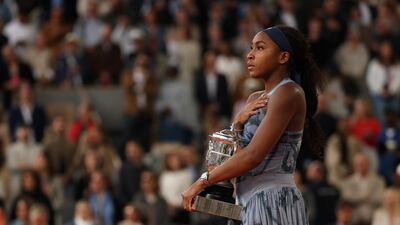
Coco Gauff holds the Suzanne Lenglen Cup after her victory in three sets over Aryna Sabalenka in Paris. Getty Images -
A tearful Aryna Sabalenka during the trophy presentation. Reuters -
Coco Gauff after her 7-6, 2-6, 4-6 French Open final win over Aryna Sabalenka at Roland Garros. Getty Images -
Coco Gauff of United States celebrates beating Belarus's Aryna Sabalenka in two hours and 38 minutes. Getty Images -
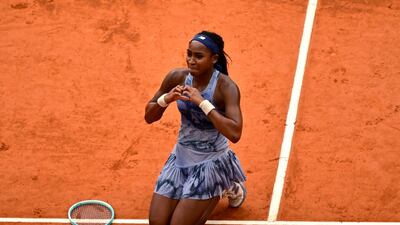
Coco Gauff celebrates after beating Aryna Sabalenka on Court Philippe Chatrier in Paris. AFP -
Coco Gauff celebrates after winning championship point against Aryna Sabalenka. Getty Images -
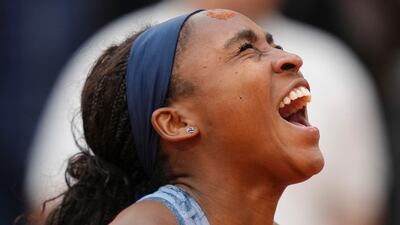
Coco Gauff celebrates after winning match point. AP -
A packed Court Philippe Chatrier during the final between Aryna Sabalenka and Coco Gauff. Reuters -
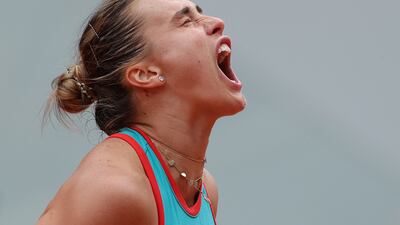
Aryna Sabalenka shows her frustration during the second set which Gauff took 6-2. Reuters -
Aryna Sabalenka eventually won the opening set in 77 enthralling minutes. Getty Images -
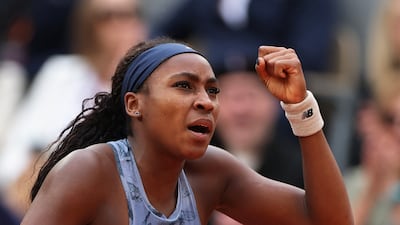
Coco Gauff enjoys winning a point against Aryna Sabalenka. Reuters -
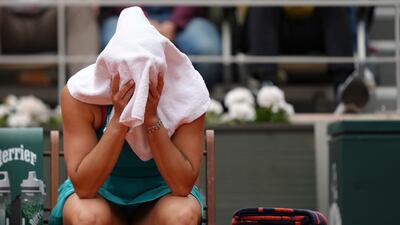
Aryna Sabalenka wraps her head in a towel during the match. AP -
Coco Gauff was 4-1 down in the first set but fought back, only to lose the tie break 7-5. Getty Images -
Aryna Sabalenka was 4-1 up in the first set only for Coco Gauff to fight back and force a tie break. Reuters -
Coco Gauff after winning a point during the thrilling opening set against Aryna Sabalenka. AFP


“We are incredibly grateful what has been done for us. But also, I think we should get our fair share of the big picture.
“I know that we're earning a lot and we are very comfortable in our lives. And we are very grateful for that. But also, we've been working our whole lives for that. Our career is not that long. And I think it's something that we have to discuss in the inner circle.”
The French Tennis Federation (FFT), which runs Roland Garros, sent a statement to The Athletic noting that total prize money at the tournament has increased by roughly 45 per cent since 2019, which they believe reflects “a sustained commitment to increasing player compensation over time.
The FFT also highlighted its desire to dedicate more funds to players competing in the qualifying rounds “to better support players who rely most on prize money to fund their season” and noted that more than €400 million have been recently spent on infrastructure upgrades at the tournament.
“Beyond prize money, the Roland Garros model is based on a specific economic framework. The FFT is a non-profit organisation. All revenue generated by the tournament are reinvested into the Roland Garros tournament, as well as the development of tennis in France and internationally,” the statement continued.
“This includes direct support for the development of the sport at grass-roots level, training and pathway programmes, strong commitment to women’s tennis, inclusive tennis and wheelchair tennis, as well as significant contributions to international tennis development through the ITF …
“Finally, the FFT remains fully committed to ongoing dialogue with all stakeholders in global tennis, including speaking directly with individual players. It will continue working to improve overall player conditions, in line with its responsibilities and its model.”

