

Naomi Osaka gives a little laugh when she’s asked what motivated her to add Abu Dhabi to her schedule.
“I guess not doing so well in Australia, which was unfortunate. But I think I need to play as many matches as possible and I’m hoping that I’m able to find a rhythm here,” she told The National ahead of the start of her Mubadala Abu Dhabi Open campaign.
There is a noticeable aura of calmness and positivity surrounding Osaka these days. After spending years walking around the grounds of tournaments with her headphones on – sometimes with no music playing – as a coping mechanism for social anxiety, she now freely interacts with other players and people on tour.
Since her arrival in Abu Dhabi, she has managed to squeeze in some R&R between practice, visiting Louvre Abu Dhabi and spending some time in the desert.
Making the most of her tennis trips has become a priority for new mother Osaka, who gave birth to her first child, Shai, last July and returned from maternity leave at the start of this season in Australia.
“Since I’ve landed, I’ve experienced so much culture and I’ve been able to do so many fun things,” said the 26-year-old Osaka.
“I realise that travelling is something that makes me really happy and I guess while I was pregnant, I was told to not travel and it’s not too healthy to be on the plane. So I was kind of seeing everyone around me travel a lot and I think it feels really nice to be the one to be on adventures again. It’s so beautiful here and I’ve also never been to Abu Dhabi. So I just want to soak it in as much as I can.”
Making the most of her trips doesn’t just mean enjoying her time off court. Osaka wants to feel like her time away from her daughter was worth it, and that means performing well at tournaments. That perspective can be seen as a source of motivation but it can also bring a great deal of added pressure.
“That’s something I’m still learning to deal with. In Australia it was really tough. I think that would be the main reason why I was so upset,” said the Japanese-Haitian star, who lost two of the three matches she contested across Brisbane and the Australian Open.
“But I think now I’m doing better and I’m learning you can’t win every week, and you can’t really control certain things. You can only control how much work you put in.
“For me, regardless of the outcome, I think Shai will know – well she won’t know now, she’s just doing her own thing, but she’ll know that I tried my best and the only intent was for her life to be better.”
Osaka has big goals for this comeback, which is no surprise considering she is a former world No 1 and a four-time grand slam champion.
In a television interview she gave 10 months ago, when she was still pregnant, Osaka said she wanted to win eight more slams. Now that she’s officially back on tour and has played two tournaments, does she still feel that way?
“I definitely still feel that way,” she responds. “Australia gave me a little bit of self-doubt, just because I wish I could have played more matches and I always do really well in Australia. So it was a bit of a harsh reality.
“But I still think my level is improving every day and I think that I can be better, and I hope that I will be better. I’m always the type of person that would rather set really high goals and maybe I’ll do only 25 per cent of that but the 25 per cent is still really amazing.
“I don’t think that I would have come back and be like, ‘Oh my goal is to get to the quarter-final of a slam’, which is still really good but that’s not why I’m spending time away from Shai.”
While Australia didn’t go as well as she had hoped, it showed Osaka she could compete at a high level, with her losses coming against former world No 1 Karolina Pliskova in the Brisbane second round, and Caroline Garcia, who was ranked No 4 in the world as recently as last June, in the Australian Open first round. Both defeats were close matches.
The draw has not been very kind on Osaka, whose opener in Abu Dhabi will see her take on American qualifier Danielle Collins, who is a former world No 7 and the 2022 Australian Open finalist. The winner of that match will go on to face the top-seeded Elena Rybakina.
Osaka is fully aware she might need to digest some difficult losses before hitting her stride on tour.
“I always knew that going into this. Because even when I left, I was having tough losses, because mentally I wasn’t really in it. And I know coming back, it’s not like I’m in my 2021 form right away,” she explained.
“But I’m trying more one day at a time. I know it’s better to play scrappy matches to get into the form where I want to be. Australia has taught me a lot about getting some pretty harsh draws. So hopefully I’ll get my ranking up and I won’t have to play these really great players in the first round.
“But for right now, I’m the type of person that, even if I play the No 1 seed, I want myself to win and I kind of expect myself to win, which is the delusion part. But I try not to make too many excuses.”
In Melbourne, Osaka told reporters her “delusion” is probably what wins her tournaments.
She fully stands by that statement.
-

Japan's Naomi Osaka had a tough start to the year in Australia but is looking to regain her form at the Mubadala Abu Dhabi Open. AFP -
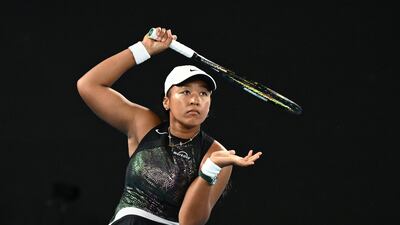
Naomi Osaka lost two of the three matches she contested across Brisbane and the Australian Open. EPA -

Naomi Osaka following her first-round loss to Caroline Garcia at the Australian Open last month. EPA -

Naomi Osaka revealed the losses in Australia were a harsh reality check. Reuters -
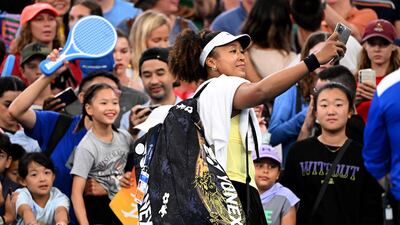
Naomi Osaka takes a selfie with fans in Brisbane. AFP -
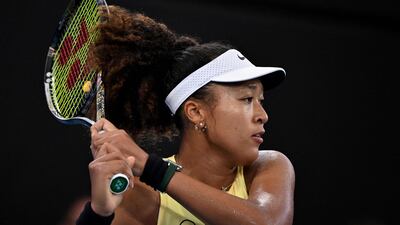
Naomi Osaka is working her way back after becoming a mother. AFP -

Naomi Osaka said she too wants to be a role model like Serena Williams. EPA


“I feel like in some capacity, everyone who has achieved something crazy has been called crazy along the way,” she says. “For me, also just being a more creative person, you have to see things differently and you have to dream big to achieve those dreams. I kind of like my delusions, they’re cool.”
Whether you call it delusion, confidence, or boldness, Osaka’s ability to back herself against all odds is why she has successfully put together a history-making career so far; that pretty much is fact, not theory.
During her time away from tennis, the likes of Iga Swiatek, Aryna Sabalenka, Rybakina and Coco Gauff have shared most of the biggest titles on tour and have been raising the bar week in, week out. Does Osaka see herself as someone motivated to challenge these players and carve a place for herself among them?
“I’m at a weird point right now in this comeback. I, obviously, have so much respect for them and everything that they’ve done. But I don’t really see myself as a challenger, which is a weird thing,” she admits.
“It’s really bold to say but I know what I’m capable of, and I know people are going to probably drag me for saying this, but I don’t think it’s a stretch for me to say that I see myself there. And I hope that I can get there this year, hopefully towards the tail-end of the year. But if not, I’m okay with being patient, I’ve always been a patient person, so I’ll get there eventually.”
Motherhood has helped shift Osaka’s mindset in more ways than one. She has been open about her struggles in the past, revealing she experienced bouts of depression and needed to step away from tennis for mental health reasons.
Like many athletes, Osaka found it difficult to separate herself and her self-worth from her wins and losses. She feels she is doing a much better job at that nowadays.
“It was very difficult for me when you last saw me. Honestly it was getting pretty bad and I think that’s why I needed to step away for a bit, yet again,” she reflects.
“I think now, obviously I haven’t played that many matches and I’m not sure what will happen when I get my ranking to around where I want it to be. But I really think having Shai balanced me out a lot.
“It feels nice to know that no matter what happens, someone’s going to be there that loves you and cares about you. Of course I’m not saying she’s the only person. But for some reason she’s the only one that I think about.”
Another change in perspective for Osaka is related to how much longer she sees herself playing professional tennis. The California-resident has said she would like her daughter to have memories of her playing tennis, but that’s not the only reason why she wants to stick around on tour.
“You know what’s weird? Maybe a couple of years ago, I really couldn’t imagine myself playing past like 32. But I think now, coming back, I realise how important role models are in tennis and how lucky I am to have played Serena,” said Osaka.
“I wish I could have played Li Na, because she’s my other role model that I loved growing up. But just to have those figureheads still in the game when you’re coming up is really cool. I feel like that’s something I would want to, I guess, be on the other end of, towards the tail-end of my career.”
Osaka has committed to playing a full schedule this season, which is something she hasn’t done in years. The tennis tour is unforgiving, and can take a mental and physical toll on players, but Osaka does not seem too concerned about surviving the grind, assuring she is back on the circuit with a newfound purpose.
“I don’t know how to describe this but every day that I wake up and I get new videos of Shai, I feel refreshed and I feel like, this is why I’m playing,” she says.
“And when I’m able to go back home and spend a lot of time with her, it completely clears my mind. So I haven’t felt mentally exhausted or anything. I don’t know what’s going to happen later in the season but I’m feeling pretty optimistic about it.”
For a long time, Osaka has said she wanted to be remembered for more than just being a tennis player. She now realises she will be remembered for different things, by different people. A mum, a friend, a partner, a tennis player, a businesswoman. Ultimately, and after giving it some thought, she describes what she’d like to be remembered for.
“As someone who is very curious, and hopefully that curiosity doesn’t get me in too much trouble,” she concludes with a smile.

