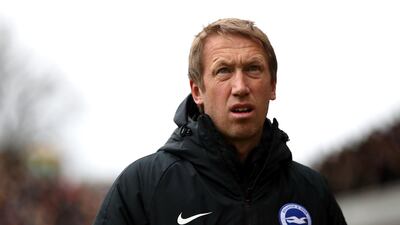

Graham Potter is the softly-spoken, mild-mannered, eminently reasonable revolutionary, the manager who has brought radical change while maintaining the manner of an earnest PE teacher. And yet one thing has not altered: Brighton and Hove Albion remain rooted in the lower third of the table.
Potter has reinvented Brighton. Chris Hughton's ball-shy team have been transformed. Brighton had the fourth least possession in the Premier League in 2018-19. They had the seventh most last season and they are sixth in the charts now. Adam Webster has played the fourth most passes in the Premier League.
Brighton have the second lowest average age this season and seven of their last starting 11 never played a league game under Hughton.
And yet Brighton were the last team in all four divisions to win a game in 2020. They have a have a solitary victory this season. They go to Aston Villa on Saturday in 16th. Is Potter the ineffective revolutionary? The style is dramatically different but the circumstances are similar.
In Potter’s defence, change does not always come quickly. Brighton are better at the process, but the outcome remains the same.
Arguably, they have improved at much bar the one thing that matters most: winning games. They have more goals than Manchester City and Arsenal, with a better expected goals tally than either, plus fourth-place Southampton.
Most remarkably, they have the lowest expected goals against in the division, which suggests that, in some respects, they are England’s best defensive team.
The fact that only four teams have conceded more actual goals explains why goalkeeper Mat Ryan was dropped. Perhaps the numbers are deceptive. They have conceded thunderbolts, to Chelsea’s Reece James, own goals, courtesy of Lewis Dunk, and a series of penalties.
Lies, damned lies and statistics? Maybe. A small sample size? Definitely. But Brighton have only won 10 of 46 top-flight games under Potter.
_______________________________________________________________
Player ratings from Brighton's only win this season – 3-0 at Newcastle
-

NEWCASTLE RATINGS: Karl Darlow - 7: No chance with any of the goals, made a coupe of other decent stops. Left badly exposed by those in front of him. PA -

Javier Manquillo - 6: The Spanish right-back was arguably the best of Newcastle's defence but there really wasn't much competition. Getty -

Federico Fernandez - 4: Usually reliable Argentine had a bad day at the office, like the rest of his teammates. Communication with partner Lascelles poor throughout. Guilty of constantly backing off rather than closing down Brighton's attackers. Getty -

Jamaal Lascelles - 4: Poor show from the captain. Booked in first half as he lost his cool in the face of relentless Brighton pressure. Couldn't cope with Brighton's attackers and their third goal, when he failed to close down Connolly before his fine finish, summed up Lascelles' performance. Getty -

Jamal Lewis - 5: Given torrid time by Lamptey in first 45 minutes - but received no help from Saint-Maximin for most of it. Booked for reckless lunge on the flying wingback. A boot in the face from Bissouma late on put the finishing touch to a tough afternoon. PA -

Isaac Hayden - 5: Another normally rock-solid performer who was off the pace today. Lost the midfield battle alongside Shelvey. Reuters -

Jonjo Shelvey - 5: Let his frustrations get the better of him with first-half booking as Brighton dominated. Unusually poor decision-making with his passing. Still frustrated when he was substituted with 20 minutes left. Getty -

Jeff Hendrick - 5: Back down to earth with a bump after his goalscoring debut last week. Switched flanks in first half to try and stop Lamptey's marauding runs. Had little or no influence on the game. Reuters -

Allan Saint-Maximin - 3: Gave away early penalty with stupid challenge on Lamptey, turned over his ankle soon after and downed tools from there. Hobbled around a bit before finally sitting on the floor and asking to come off with little over half an hour gone. One to forget for the French attacker. AFP -

Andy Carroll - 4: Nothing went right for the big striker. Not a sniff of a goal, poor control, hold-up play non-existent and hooked at half time. Can have little complaints. PA -

Callum Wilson - 6: Another whose goalscoring debut against West Ham last week must have felt like a lifetime ago. Was nearly through on goal in first half but denied by brilliant Lamptey challenge. Missed golden opportunity to pull a goal back for Newcastle but could only head over with goal at his mercy. Getty -

SUBS: Ryan Fraser - (On for Sanit-Maximin 33') 6: At least offered some energy and attacking threat for Newcastle without looking like repeating his midweek League Cup goal against Blackburn. AFP -

Miguel Almiron - (On for Carroll 45') 6: Newcastle looked slightly more solid after the Paraguayan's introduction. Should have been booked for one embarrassing attempt to win a penalty. AFP -

Joelinton - (On for Shelvey 72') 4: Barely touched the ball after coming on. Getty -

BRIGHTON RATINGS: Mathew Ryan - 7: Australian goalkeeper will probably not enjoy an easier afternoon all season. Not a shot on target from Newcastle's powderpuff attack. AFP -

Adam Webster - 7: The Seagulls' defensive trio were all excellent and never gave Newcastle a sniff. PA -

Lewis Dunk - 8: Easily snuffed out the attacking threat of Carroll and helped keep Wilson quiet. Unlike his Newcastle counterpart, his was a real captain's performance. AFP -

Ben White - 7: Solid performance and helped nullify the danger of what little Newcastle offered as an attacking threat. Getty -

Tariq Lamptey - 9: Tore Newcastle to shreds in first half. Brought down for penalty, started move for Maupay's second and was denied a goal of his own by Darlow. At the other end, produced a magnificent sliding tackle to stop Wilson getting clear on goal. Picked up a knock, though, and had to come off before the hour mark - much to Newcastle's relief. PA -

Steven Alzate - 7: Helped Brighton control the middle of the park alongside Bissouma. Played his part in Brighton relentlessly pressuring Newcastle in possession. AP -

Yves Bissouma - 6: Bossed the midfield in the first half and was the fulcrum of Brighton's play. Wayward shooting had been the only blot on his copybook until a dangerous swing of the boot caught Lewis full in the face and was given a straight red after a VAR intervention late on. Getty -

Solly March - 7: Played his part as Brighton dominated midfield, and the game, as manager Potter got his tactics and formation spot on. PA -

Leandro Trossard - 7: Perfect ball across the box set up Maupay's second. Buzzed around, caused Newcastle plenty of problems and nearly scored when his shot from 20 yards hit the post with 20 minutes left. Getty -
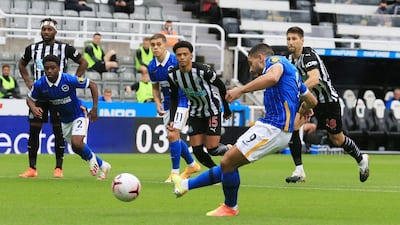
Neal Maupay - 8: Flying start for the striker, calmly hitting a penalty straight down the middle after four minutes, then enjoying all the space of St James' Park to finish the second a few minutes later. Great run and pass helped set up Connolly for the third goal. Blazed over with chance for hat-trick late on. Reuters -

Aaron Connolly - 8: Harassed and harried the Newcastle defence from the start. Unlucky to see second-half finish bounce out off the post. Deserved his goal and produced beautiful curling finish with seven minutes left to seal an excellent Brighton win. PA -

SUBS: Dan Burn - (On for Lamptey 58') 7: Slotted straight in as Brighton continued to dominate despite loss of Lamptey through injury. AP -

Adam Lallana - (On for March 78') NA. No opportunity for the veteran to make an impact. Reuters -

Alireza Jahanbakhsh - (On for Connolly 90') NA. Reuters


_______________________________________________________________
This season's sole triumph, at Newcastle, was emphatic and excellent, but they have struggled to convert promising positions into points.
They impressed against Manchester United but lost. They allowed Crystal Palace a lone shot but drew 1-1. But an inability to beat West Bromwich Albion and Burnley at home feels telling: Brighton have won too few of the winnable games. Last season, they won only three of nine home games against bottom-half finishers.
It reflects on a lack of a clinical streak. Brighton are wasteful at times; Neal Maupay is the only remotely prolific player in Potter’s reign and even he can be profligate.
Perhaps it reflects on Albion’s past poor spending on attackers like Jurgen Locadia, Alireza Jahanbakhsh, Florin Andone and Jose Izquierdo, though if none seemed to suit Hughton, they have delivered still less for Potter.
But everyone else who had the majority of the ball last season scored over 50 goals; Brighton got under 40. Passing has not had enough of an end product.
The sense is that by introducing the rampaging Tariq Lamptey and the assured Ben White, by importing a technician like Adam Lallana, promoting another in Alexis Mac Allister and by prioritising passers over more functional figures such as the departed Dale Stephens and Shane Duffy, Potter has raised Brighton’s ceiling.
They feel a potential top-10 team while sitting in the bottom five. They have more ideas; too many for their own good at times. Potter has made some influential substitutions but there is a question if some of his mid-match tactical switches are agile alterations to correct initial errors that seemed the result of overthinking.
And there is an ongoing debate about progressiveness and pragmatism. Albion have more futuristic plans, but if that involves a detour to the Championship, it will rank as the wrong sort of revolution.

