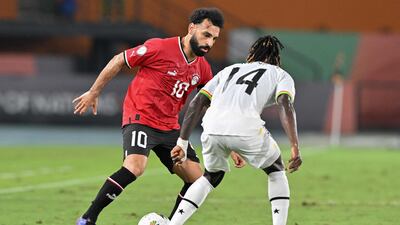
If Egypt are to win the 34th Africa Cup of Nations, they will do so having exhausted Plan A, most of their Plan B, carried to an unlikely triumph on the wild, unpredictable winds that have swept through the tournament.
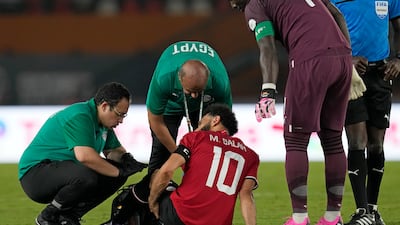
The Pharaohs, installed among the initial favourites but yet to win a fixture on their nail-biting way into the knockout phase, said farewell to captain and lodestar Mohamed Salah, who has flown to Liverpool, his club, for treatment on a muscle injury of undetermined gravity.
There are further setbacks. Goalkeeper Mohamed El Shenawy, perhaps their next most totemic player, has learnt that the shoulder injury he sustained just before the final whistle of the 2-2 draw with Cape Verde that left Egypt hanging onto second place in their group, is a dislocation, ruling him out of the rest of Afcon.
Manager Rui Vitoria and his staff are also urgently diagnosing whatever has afflicted the team’s defensive shape and very identity. In three Afcon matches so far, Egypt have conceded six goals; in three previous Cup of Nations excursions in their entirety – 17 games, including two losing finals and five tranches of extra-time – they let in just five.
“We have defensive problems,” acknowledged Vitoria. “We need to improve our performance in all aspects.”
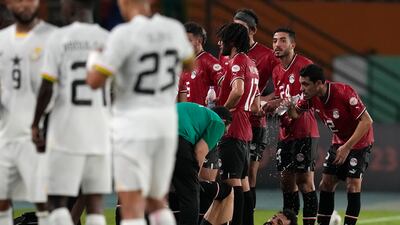
In all three of their 2-2 draws in Abidjan, Egypt have let leads slip, twice in the case of the see-saw contest with Ghana. If there is far less embarrassment in scraping a single point from the likes of Mozambique, as Egypt did only through Salah’s stoppage-time penalty on their opening match day, or Cape Verde, who finished top of Group B, than there might have been at the outset of this tournament of giant-killers, this is still a diminished, uncertain Egyptian campaign.
But he walked off the pitch with reasonable mobility. The initial prognosis was for a two-match recuperation with the captain treated on site, a leader absent off the field until a potential quarter-final but present in the camp, there to lead.
Jurgen Klopp, Salah’s manager at his club, Liverpool, then made it known that the player, the club and the Egyptian Football Association had agreed to Salah undergoing his recovery in Liverpool.
The potential comeback date had been extended to a possible Afcon semi-final on February 7, at the soonest, with Salah’s representative stating that the injury was more serious that initially thought.
Egypt's Mohamed Salah receives medical treatment during the Africa Cup of Nations Group B match against Ghana in Abidjan, Ivory Coast, Thursday, January 18, 2024. AP
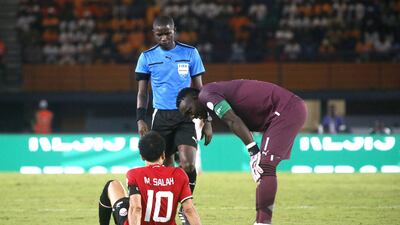
Egypt's Mohamed Salah suffered the injury setback just before half time and received lengthy medical treatment. AP
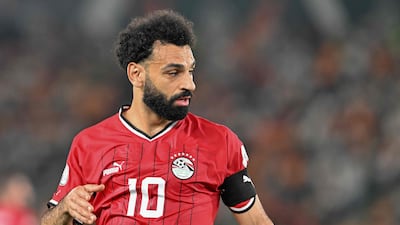
Mohamed Salah of Egypt signaled to the bench he was unable to continue. AP
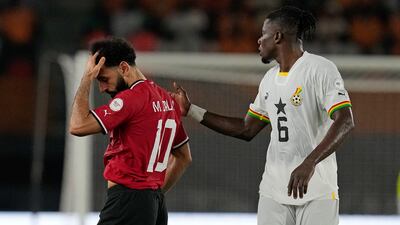
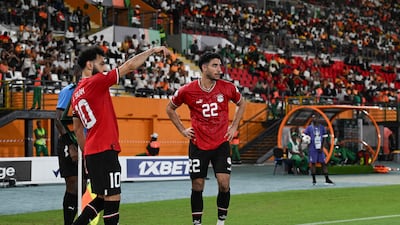
Egypt's Mohamed Salah, left, leaves the field. AP
Egypt's Mohamed Salah prepares to take a corner. AFP
Egypt's Mohamed Salah in action against Ghana at the Felix Houphouet-Boigny Stadium in Abidjan. AFP
Egypt were held to a 2-2 draw by Ghana. AFP
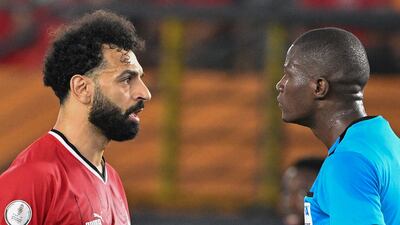
Mohamed Salah speaks with Gabonese referee Pierre Atcho. AFP
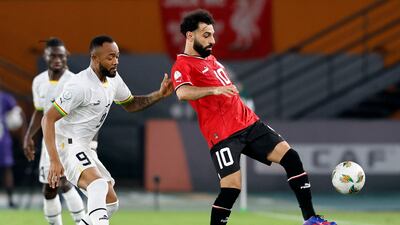
Egypt's Mohamed Salah fights for the ball with Ghana's Gideon Mensah and Jordan Ayew, right. AFP
Egypt's Mohamed Salah up against Ghana's Gideon Mensah. AFP
“I didn't think it was right for Liverpool, via any intermediary, to speak about this,” said Vitoria.
Former Egypt captains, Ahmed Hassan and Wael Gomaa, legendary players from the Pharaohs’ historic sequence of three successive Afcon triumphs up until 2010, slammed a failure of leadership from Egypt’s decision-makers and from the captain.
“Salah made a mistake, he takes part of the responsibility,” said Gomaa, who was on the team’s management staff at the last Afcon, where Egypt lost the final on penalties to Senegal.
“What’s happened around the injury is an insult to the national team, and its status in Africa – big mistakes from start to finish from everybody involved.”
“He is the captain, he should stay with the team no matter what,” said Ahmed Hassan, whose 184 international appearances, up to 2011, make him Egypt’s most capped player. “He could have had someone from Liverpool’s medical staff come to be with him at the competition.”
A fit Salah would have reached a century of caps had he steered Egypt all the way to a third final of the four Afcons he has taken part in. But he leaves a significant marker on his abbreviated campaign.
Salah set up what looked like an immensely promising start, assisting Mostafa Mohamed’s second-minute goal on match day one against Mozambique and converting the injury-time penalty, at 2-1 down, to grasp what has turned out to be a crucial point.
As it was, the shakedown to join upstarts Cape Verde in the next round was nerve-jangling, with Ghana, who finished third in Group B on two points, collapsing from 2-0 up against Mozambique in the 90th minute to a 2-2 draw on Monday.
Earlier in the afternoon, hosts Ivory Coast had been thrashed 4-0 by Equatorial Guinea, leaving the Ivorians on three points from three group games, behind the Equatoguineans and Nigeria and awaiting other results to see whether they progress as one of the four best third-placed finishers, who go into the last 16 along with the top two from each group.
In this topsy-turvy next phase, Egypt will meet the runners-up of Group F, whose final standings will be clear on Wednesday, with Morocco, DR Congo, Zambia and Tanzania all potentially ending up in second place, and remaining in San Pedro.
The coastal city is regarded as an agreeable location by the Group F teams who have spent the last two weeks there, either in the purpose-built athletes’ village or, in the case of Morocco, in a high-spec hotel complex overlooking the Atlantic Ocean.
Vitoria welcomes Egypt’s change of scene. “Moving venue could have a positive impact after two weeks in Abidjan,” said the coach, although even the 200-mile journey to the new site was being framed around the suffocating Salah controversy.
“Because we have to travel to a different city, because of the temperatures, perhaps it makes more sense Salah should have a place for recovery he can go to straight away.”
Yet as long as El Shenawy, also in recovery, remains with the squad in Ivory Coast, the suspicion will be that a different, unique standard has been applied to Salah’s situation and priority given to the interests of Premier League title-chasing Liverpool.

Tips to keep your car cool
Place a sun reflector in your windshield when not driving
Park in shaded or covered areas
Add tint to windows
Wrap your car to change the exterior colour
Pick light interiors - choose colours such as beige and cream for seats and dashboard furniture
Avoid leather interiors as these absorb more heat
Leap of Faith
Michael J Mazarr
Public Affairs
Dh67
How it works
Each player begins with one of the great empires of history, from Julius Caesar's Rome to Ramses of Egypt, spread over Europe and the Middle East.
Round by round, the player expands their empire. The more land they have, the more money they can take from their coffers for each go.
As unruled land and soldiers are acquired, players must feed them. When a player comes up against land held by another army, they can choose to battle for supremacy.
A dice-based battle system is used and players can get the edge on their enemy with by deploying a renowned hero on the battlefield.
Players that lose battles and land will find their coffers dwindle and troops go hungry. The end goal? Global domination of course.
SPECS
Engine: Two-litre four-cylinder turbo Power: 235hp Torque: 350Nm Transmission: Nine-speed automatic Price: From Dh167,500 ($45,000) On sale: Now
Have the ability to differentiate yourself from competitors
Put in place a business continuity plan after Covid-19
Prepare for the worst-case scenario (further lockdowns, long wait for a vaccine, etc.)
Have enough cash to stay afloat for the next 12 to 18 months
Be creative and innovative to reduce expenses
Be prepared to use Covid-19 as an opportunity for your business
* Tips from Jassim Al Marzooqi and Walid Hanna
FIXTURES
Monday, January 28
Iran v Japan, Hazza bin Zayed Stadium (6pm)
Tuesday, January 29
UAEv Qatar, Mohamed Bin Zayed Stadium (6pm)
Friday, February 1
Final, Zayed Sports City Stadium (6pm)
Cultural fiesta
What: The Al Burda Festival
When: November 14 (from 10am)
Where: Warehouse421, Abu Dhabi
The Al Burda Festival is a celebration of Islamic art and culture, featuring talks, performances and exhibitions. Organised by the Ministry of Culture and Knowledge Development, this one-day event opens with a session on the future of Islamic art. With this in mind, it is followed by a number of workshops and “masterclass” sessions in everything from calligraphy and typography to geometry and the origins of Islamic design. There will also be discussions on subjects including ‘Who is the Audience for Islamic Art?’ and ‘New Markets for Islamic Design.’ A live performance from Kuwaiti guitarist Yousif Yaseen should be one of the highlights of the day.
The Pope's itinerary
Sunday, February 3, 2019 - Rome to Abu Dhabi
1pm: departure by plane from Rome / Fiumicino to Abu Dhabi
10pm: arrival at Abu Dhabi Presidential Airport
Monday, February 4
12pm: welcome ceremony at the main entrance of the Presidential Palace
12.20pm: visit Abu Dhabi Crown Prince at Presidential Palace
5pm: private meeting with Muslim Council of Elders at Sheikh Zayed Grand Mosque
6.10pm: Inter-religious in the Founder's Memorial
Tuesday, February 5 - Abu Dhabi to Rome
9.15am: private visit to undisclosed cathedral
10.30am: public mass at Zayed Sports City – with a homily by Pope Francis
12.40pm: farewell at Abu Dhabi Presidential Airport
1pm: departure by plane to Rome
5pm: arrival at the Rome / Ciampino International Airport
Business Insights
As per the document, there are six filing options, including choosing to report on a realisation basis and transitional rules for pre-tax period gains or losses.
SMEs with revenue below Dh3 million per annum can opt for transitional relief until 2026, treating them as having no taxable income.
Larger entities have specific provisions for asset and liability movements, business restructuring, and handling foreign permanent establishments.
Farasan Boat: 128km Away from Anchorage
Director: Mowaffaq Alobaid
Stars: Abdulaziz Almadhi, Mohammed Al Akkasi, Ali Al Suhaibani
March 15 - Australia, Melbourne; March 22 - Bahrain, Sakhir; April 5 - Vietnam, Hanoi; April 19 - China, Shanghai; May 3 - Netherlands, Zandvoort; May 20 - Spain, Barcelona; May 24 - Monaco, Monaco; June 7 - Azerbaijan, Baku; June 14 - Canada, Montreal; June 28 - France, Le Castellet; July 5 - Austria, Spielberg; July 19 - Great Britain, Silverstone; August 2 - Hungary, Budapest; August 30 - Belgium, Spa; September 6 - Italy, Monza; September 20 - Singapore, Singapore; September 27 - Russia, Sochi; October 11 - Japan, Suzuka; October 25 - United States, Austin; November 1 - Mexico City, Mexico City; November 15 - Brazil, Sao Paulo; November 29 - Abu Dhabi, Abu Dhabi.
Teams in the EHL
White Bears, Al Ain Theebs, Dubai Mighty Camels, Abu Dhabi Storms, Abu Dhabi Scorpions and Vipers
Our legal consultant
Name: Dr Hassan Mohsen Elhais
Position: legal consultant with Al Rowaad Advocates and Legal Consultants.
Mercer, the investment consulting arm of US services company Marsh & McLennan, expects its wealth division to at least double its assets under management (AUM) in the Middle East as wealth in the region continues to grow despite economic headwinds, a company official said.
Mercer Wealth, which globally has $160 billion in AUM, plans to boost its AUM in the region to $2-$3bn in the next 2-3 years from the present $1bn, said Yasir AbuShaban, a Dubai-based principal with Mercer Wealth.
“Within the next two to three years, we are looking at reaching $2 to $3 billion as a conservative estimate and we do see an opportunity to do so,” said Mr AbuShaban.
Mercer does not directly make investments, but allocates clients’ money they have discretion to, to professional asset managers. They also provide advice to clients.
“We have buying power. We can negotiate on their (client’s) behalf with asset managers to provide them lower fees than they otherwise would have to get on their own,” he added.
Mercer Wealth’s clients include sovereign wealth funds, family offices, and insurance companies among others.
From its office in Dubai, Mercer also looks after Africa, India and Turkey, where they also see opportunity for growth.
Wealth creation in Middle East and Africa (MEA) grew 8.5 per cent to $8.1 trillion last year from $7.5tn in 2015, higher than last year’s global average of 6 per cent and the second-highest growth in a region after Asia-Pacific which grew 9.9 per cent, according to consultancy Boston Consulting Group (BCG). In the region, where wealth grew just 1.9 per cent in 2015 compared with 2014, a pickup in oil prices has helped in wealth generation.
BCG is forecasting MEA wealth will rise to $12tn by 2021, growing at an annual average of 8 per cent.
Drivers of wealth generation in the region will be split evenly between new wealth creation and growth of performance of existing assets, according to BCG.
Another general trend in the region is clients’ looking for a comprehensive approach to investing, according to Mr AbuShaban.
“Institutional investors or some of the families are seeing a slowdown in the available capital they have to invest and in that sense they are looking at optimizing the way they manage their portfolios and making sure they are not investing haphazardly and different parts of their investment are working together,” said Mr AbuShaban.
Some clients also have a higher appetite for risk, given the low interest-rate environment that does not provide enough yield for some institutional investors. These clients are keen to invest in illiquid assets, such as private equity and infrastructure.
“What we have seen is a desire for higher returns in what has been a low-return environment specifically in various fixed income or bonds,” he said.
“In this environment, we have seen a de facto increase in the risk that clients are taking in things like illiquid investments, private equity investments, infrastructure and private debt, those kind of investments were higher illiquidity results in incrementally higher returns.”
The Abu Dhabi Investment Authority, one of the largest sovereign wealth funds, said in its 2016 report that has gradually increased its exposure in direct private equity and private credit transactions, mainly in Asian markets and especially in China and India. The authority’s private equity department focused on structured equities owing to “their defensive characteristics.”
Key findings of Jenkins report
Founder of the Muslim Brotherhood, Hassan al Banna, "accepted the political utility of violence"
Views of key Muslim Brotherhood ideologue, Sayyid Qutb, have “consistently been understood” as permitting “the use of extreme violence in the pursuit of the perfect Islamic society” and “never been institutionally disowned” by the movement.
Muslim Brotherhood at all levels has repeatedly defended Hamas attacks against Israel, including the use of suicide bombers and the killing of civilians.
Laying out the report in the House of Commons, David Cameron told MPs: "The main findings of the review support the conclusion that membership of, association with, or influence by the Muslim Brotherhood should be considered as a possible indicator of extremism."
1. Lewis Hamilton, Mercedes - 263
2. Sebastian Vettel, Ferrari - 235
3. Valtteri Bottas, Mercedes - 212
4. Daniel Ricciardo, Red Bull - 162
5. Kimi Raikkonen, Ferrari - 138
6. Sergio Perez, Force India - 68
GIANT REVIEW
Starring: Amir El-Masry, Pierce Brosnan
Director: Athale
Rating: 4/5
Avatar: Fire and Ash
Director: James Cameron
Starring: Sam Worthington, Sigourney Weaver, Zoe Saldana
Rating: 4.5/5
Trump v Khan
2016: Feud begins after Khan criticised Trump’s proposed Muslim travel ban to US
2017: Trump criticises Khan’s ‘no reason to be alarmed’ response to London Bridge terror attacks
2019: Trump calls Khan a “stone cold loser” before first state visit
2019: Trump tweets about “Khan’s Londonistan”, calling him “a national disgrace”
2022: Khan’s office attributes rise in Islamophobic abuse against the major to hostility stoked during Trump’s presidency
July 2025 During a golfing trip to Scotland, Trump calls Khan “a nasty person”
Sept 2025 Trump blames Khan for London’s “stabbings and the dirt and the filth”.
Dec 2025 Trump suggests migrants got Khan elected, calls him a “horrible, vicious, disgusting mayor”
1. Sebastian Vettel, Ferrari 1:39:46.713
2. Kimi Raikkonen, Ferrari 00:00.908
3. Valtteri Bottas, Mercedes-GP 00:12.462
4. Lewis Hamilton, Mercedes-GP 00:12.885
5. Max Verstappen, Red Bull Racing 00:13.276
6. Fernando Alonso, McLaren 01:11.223
7. Carlos Sainz Jr, Toro Rosso 1 lap
8. Sergio Perez, Force India 1 lap
9. Esteban Ocon, Force India 1 lap
10. Stoffel Vandoorne, McLaren 1 lap
11. Daniil Kvyat, Toro Rosso 1 lap
12. Jolyon Palmer, Renault 1 lap
13. Kevin Magnussen, Haas 1 lap
14. Lance Stroll, Williams 1 lap
15. Pascal Wehrlein, Sauber 2 laps
16. Marcus Ericsson, Sauber 2 laps
17r. Nico Huelkenberg, Renault 3 laps
r. Paul Di Resta, Williams 10 laps
r. Romain Grosjean, Haas 50 laps
r. Daniel Ricciardo, Red Bull Racing 70 laps
What is Diwali?
The Hindu festival is at once a celebration of the autumn harvest and the triumph of good over evil, as outlined in the Ramayana.
According to the Sanskrit epic, penned by the sage Valmiki, Diwali marks the time that the exiled king Rama – a mortal with superhuman powers – returned home to the city of Ayodhya with his wife Sita and brother Lakshman, after vanquishing the 10-headed demon Ravana and conquering his kingdom of Lanka. The people of Ayodhya are believed to have lit thousands of earthen lamps to illuminate the city and to guide the royal family home.
In its current iteration, Diwali is celebrated with a puja to welcome the goodness of prosperity Lakshmi (an incarnation of Sita) into the home, which is decorated with diyas (oil lamps) or fairy lights and rangoli designs with coloured powder. Fireworks light up the sky in some parts of the word, and sweetmeats are made (or bought) by most households. It is customary to get new clothes stitched, and visit friends and family to exchange gifts and greetings.
Clinical psychologist, Dr Saliha Afridi at The Lighthouse Arabia suggests three easy things you can do every day to cut back on the time you spend online.
1. Put the social media app in a folder on the second or third screen of your phone so it has to remain a conscious decision to open, rather than something your fingers gravitate towards without consideration.
2. Schedule a time to use social media instead of consistently throughout the day. I recommend setting aside certain times of the day or week when you upload pictures or share information.
3. Take a mental snapshot rather than a photo on your phone. Instead of sharing it with your social world, try to absorb the moment, connect with your feeling, experience the moment with all five of your senses. You will have a memory of that moment more vividly and for far longer than if you take a picture of it.