


Hard to pinpoint the precise moment when Africa, en masse, fell in love with Morocco’s national football team, but the peak of pan-continental support would probably have been reached sometime between quarter to four, Casablanca time, on December 10, 2022 and about an hour and seven minutes later.
The first moment was when Youssef En-Nesyri defied gravity in Qatar, rising so high in front of Ruben Dias that the Portugal defender seemed almost to shrink in stature. En Nesyri’s commanding header put Morocco 1-0 ahead in their World Cup quarter-final.
At ten to five, with the stadium clock ticking past 90 minutes, Yassine Bounou – ‘Bono’ to his hundreds of millions of fans across Africa and the Arab world – then scrambled off his line to save from Cristiano Ronaldo.
Morocco had hung on, and delivered a piece of history to share across huge portions of the planet. They were the first African or Arab side to make the last four of a World Cup.
The feelgood factor lives on, felt not only in the curiosity that attaches to the Atlas Lions as they embark, at an Africa Cup of Nations beginning in Ivory Coast on Saturday, on their first major tournament since the World Cup.
The legacy has helped put an extra spring in the step of African football as a whole. At the next World Cup, with its expanded format, nine African countries, up from the current five, will go to North America aspiring to match, or better, Morocco’s landmark of a semi-final.
At the World Cup after that, some will have a chance of playing on their own continent, Morocco’s joint candidacy with Spain and Portugal having been approved, with a tweak or two, by Fifa for the 2030 event.
But then Morocco rather needed to reach out to Africa, to be better appreciated there. Rewind less than a decade and Morocco was the continent’s ungrateful rebel.

Back in 2015 it was supposed to be hosting an Afcon, but pulled out very late, citing concerns about the spread of the Ebola virus, which at the time was afflicting parts of west Africa. Caf, the region’s governing body, were left in the lurch, Morocco initially banned for two successive Afcons before that suspension was overturned.
Not that being reinstated to the 2017 and 2019 Afcons gave Morocco the platform to show they were building up to be brilliant World Cup pioneers. Afcons are Morocco’s Achilles heel. No so-called heavyweight of African football has such a consistently poor record at the biannual showpiece.
“It’s time to lift the curse,” says Walid Regragui, architect of the journey to the Qatar 2022 semi-final as he looks over a barren sequence of Cup of Nations trips that reaches back almost half a century. Morocco won their only Afcon title in 1976; their sole appearance in a final since then was 20 years ago, when they lost to Tunisia in Tunis.
“The last time we lifted this trophy gets further and further back,” admitted Regragui, who played in the 2004 final and was part of the Morocco team in the drab, winless group stage elimination two years later. “But that gap is no reason to put pressure on ourselves.”
-
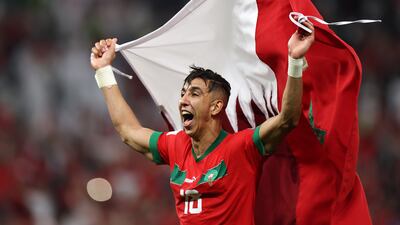
Morocco's Jawad El Yamiq celebrates after the 1-0 World Cup quarter-final win against Portugal at Al Thumama Stadium on December 10, 2022. Getty -
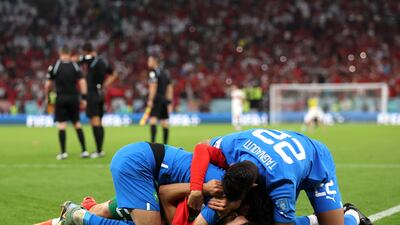
Yassine Bounou, Bilal El Khannouss, Reda Tagnaouti and Achraf Hakimi of Morocco celebrate the team's victory. Getty -
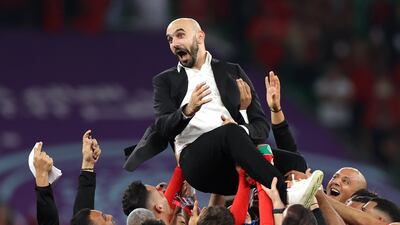
Walid Regragui, coach of Morocco, celebrates with the team. Getty -
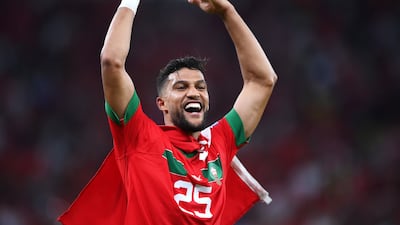
Yahya Attiat-Allah of Morocco celebrates. Getty -
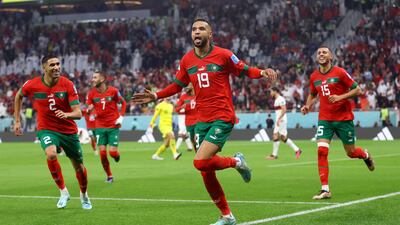
Morocco's Youssef En-Nesyri celebrates after scoring the only goal. Reuters -
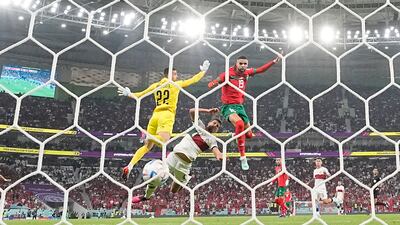
Morocco's Youssef En-Nesyri heads home in the first half. AP -
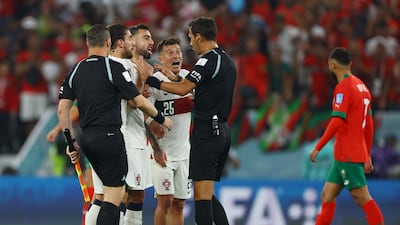
Portugal's Otavio, Bruno Fernandes and Ruben Neves argue with referee Facundo Tello. Reuters -
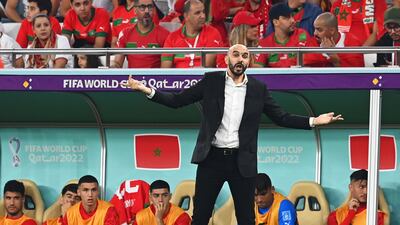
Morocco manager Walid Regragui. EPA -
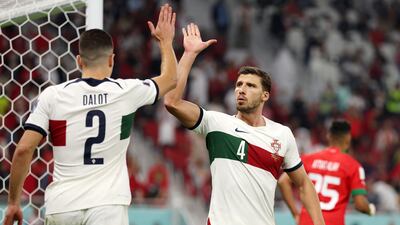
Portugal's Ruben Dias with Diogo Dalot. Getty -
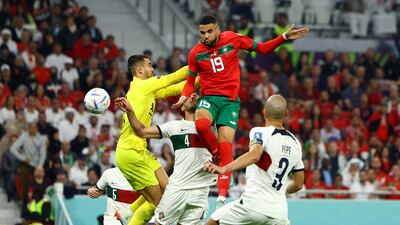
Moussef En-Nesyri scores for Morocco. Reuters -
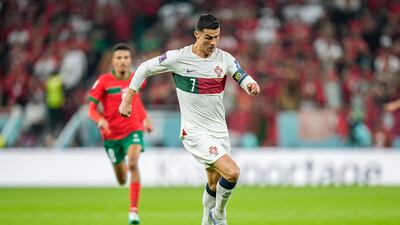
Portugal's Cristiano Ronaldo runs with the ball after coming on in the second half. AP -
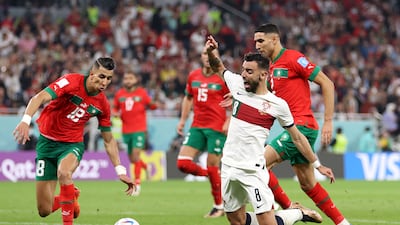
Portugal's Bruno Fernandes goes down in the box but no penalty was given. Getty -
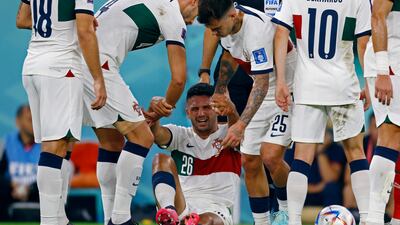
Portugal's Goncalo Ramos is helped up by Ruben Dias and Otavio. Reuters -

Morocco's Achraf Hakimi goes head-to-head with Otavio of Portugal. EPA -
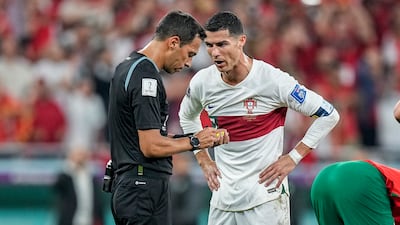
Portugal's Cristiano Ronaldo talks with the referee Facundo Tello. AP -
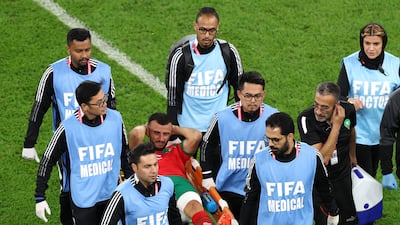
Morocco's Romain Saiss is carried off in the second half. Getty -
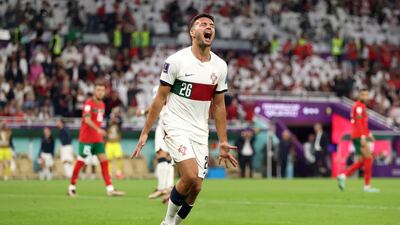
Goncalo Ramos of Portugal reacts after missing a chance. Getty -
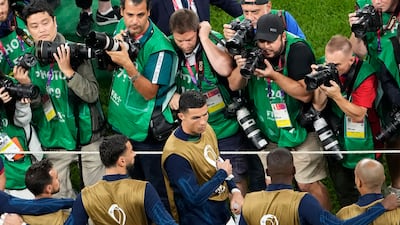
Phtographers surround Portugal subsitute Cristiano Ronaldo before the match. AP


Pressure boiled over at Morocco’s exit from the last Afcon – before Regragui’s appointment as manager – with several players and staff involved in heated scuffling with opponents at the end of Egypt’s quarter-final win.
Regragui has put some pressure on himself. In the immediate euphoria of the World Cup, he undertook to win an Afcon at the next opportunity or else step down from the job. He has since retreated a little but will consider his position if Morocco have not reached at least the semi-finals in a month’s time.
He has been loyal to the personnel from the adventure in Qatar, a number of whom moved clubs on the back of the impact they made there.
Sofyan Amrabat is at Manchester United, having pushed to leave Fiorentina. Hakim Ziyech is no longer a fringe winger at Chelsea but at Galatasaray while Bono and defender Roman Saiss were part of last year’s influx of talent to Saudi Arabia’s Pro League.

With them in Ivory Coast are some graduates from the under-23 side who claimed Morocco’s first African title in that age group. Encouraged by the momentum of Regragui’s side, players such as midfielder Amir Richardson, also eligible for France and the USA, and Bayer Leverkusen’s Amine Adli, a former France under-21 international, have recently committed to Morocco internationally.
Preparation has been meticulous. African football’s standard-bearers, demanding that Afcon’s standards meet Morocco’ own, elected to chose their own hotel in San Pedro, their base for the group matches against Tanzania, DR Congo and Zambia, rather than use accommodation Caf guided them towards.
They arrived early, too, in time to arrange Thursday's warm-up game against Sierra Leone, six days ahead of their opener, against Tanzania, who are the lowest-ranked side at Afcon but still capable of dreaming, thanks partly to Morocco’s great 2022 adventure, of one day making an impact on a global stage.

