

Liverpool manager Jurgen Klopp said he took more umbrage with his side's defensive failings than a contentious VAR call denying his side against Toulouse.
Individual mistakes and a lack of collective cohesion saw the hosts take a 3-1 lead in Thursday's Europa League group match but Diogo Jota’s 89th-minute strike, after Cristian Casseres’ own goal had got them back into the game, set up a dramatic conclusion.
In the seventh and final minute of added time 20-year-old centre-back Jarell Quansah thought he had equalised but after a long delay referee Georgi Kabakov was advised to go to the pitchside monitor and he ruled Alexis Mac Allister had handled the ball in the move for the goal.
“I only saw the video back now and for me it’s not a handball – but how can I decide that?” said Klopp.
“Actually, I am a bit more concerned about [the fact that] I would have loved us to have played better, to be honest. That’s my main issue tonight.
“In the end, we were intense, we threw everything in, but the problem is in a football game you have to make the decisive things in the right moment to do them right.”
Toulouse v Liverpool ratings
-

Endured one or two nervy moments, especially with the ball at his feet. However, the Toulouse goalkeeper dealt well with efforts at his goal - and was virtually helpless to prevent Liverpool’s two consolations. Getty -

Started very slowly, getting bullied by Diaz in their early exchanges. However, the Danish wing-back was a revelation going forward, with his crosses into the Liverpool box causing mayhem. AP -

Toulouse’s best defender on the night. The 22-year-old put his body on the line and was especially dominant aerially. AP -

Composed at the back for the hosts, largely keeping Liverpool’s Cody Gakpo quiet. Getty -
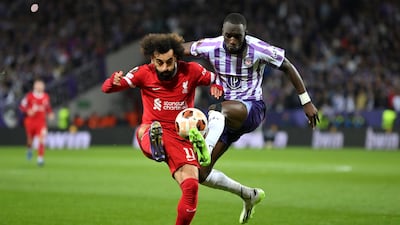
Like his fellow wing-back, Diarra struggled early on defending against the tricky Ben Doak. Nevertheless, the Frenchman stuck to his task well and was positionally solid throughout. Getty -

Was fairly isolated for Toulouse out wide, and was a tad wasteful in possession when he did venture into Liverpool’s half. Getty -

While he may have lacked end product, the German certainly put in a shift. Having run himself into the ground, Schmidt was replaced early in the second half. AFP -

Toulouse’s’ engine, providing tenacity in the tackle, and creative guile in the final third. EPA -

Screened the defensive line very well for much of the game. Unfortunately for the Venezuelan, he put the ball into his own net for Liverpool’s opener after turning his back at the wrong time. AFP -

Scorer of Toulouse’s opener, which came after the forward forced a mistake from Kostas Tsimikas with some fine pressing. His finish may have taken a fortunate deflection, but he made his own luck. AFP -

Arguably the man of the match, having led the line supremely well for the home side. He capped off a perfect night with a clinical goal in the second half – which all came from his delicate first touch. AFP -

SUBS: Scorer of Toulouse’s third goal, slotting home coolly from close range minutes after his second-half introduction. Reuters -

Pressed Liverpool’s midfielders well in the closing minutes as the visitors searched for a late equaliser; Cesar Gelabert : N/A – Replaced the superb Dallinga with a few minutes of play left. AFP -

A disappointing night from the young Irishman, who looks to be low on confidence. While he couldn’t do much about the first two Toulouse goals, his distribution and commanding of the defence left much to be desired. AFP -

Very nearly handed Liverpool an early lead, after hitting the crossbar from a header in the opening minutes. However, that was as good as things got for the Englishman, who got exposed in the second half while playing as a makeshift Left-back. AFP -

A dreadful outing from the towering defender, who looked well off the pace. Having been consistently bullied by Toulouse’s powerful forwards, tonight was certainly one to forget. Getty -

Had it not been for the hand of Alexis Mac Allister – and some slightly dubious refereeing – the England U20 international would have scored his first goal for the club – and handed his side a point. Disallowed goal aside, the youngster seemed to tire badly in the second period after a bright start. AFP -

The less said about this performance, the better. It was the Greek international’s first-half error that handed the hosts a 1-0 lead, a mistake that saw him unceremoniously hooked at the break. AP -

One of the few bright sparks for Liverpool, who gave his all from the first minute to the last. His final ball did often lack quality. Getty -

Another of Liverpool’s players who looked off the boil. The Japanese midfielder gave away far too many fouls, and rightly picked up a yellow card for doing so in the first half. Getty -

Cost his side a point after his handball led to Quansah’s late equaliser being disallowed. It was another worryingly quiet display from the World Cup winner. AFP -

The livewire winger reinforced what we already know – that he has incredible pace and the ability to beat a man, but that the end product isn’t always there. Nevertheless, it’s an experience the 17-year-old will learn a lot from. Getty -

Provided the free-kick inside the first few minutes from which Gomez hit the bar. For the remainder of the game, the Dutch forward was fairly anonymous. Getty -
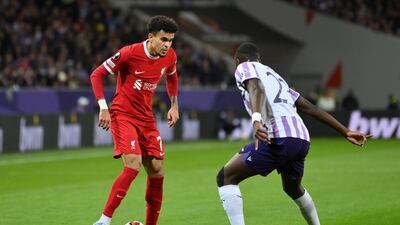
Not a vintage display from the 26-year-old, but then again, after the week he’s had, it seldom matters. Getty -

SUBS: Failed to inspire a Liverpool comeback after coming on for the second half. In fact, was arguably at fault for the home side’s third goal due to his poor positioning. Getty -

An underwhelming – and uncharacteristic – second half cameo from the Hungarian, who was reduced to speculative long-range shots in the closing stages. EPA -

Instantly made Liverpool look more dangerous in the final third, but the Egyptian was strangely wasteful when he arrived in good positions. EPA -

Looked sharp after his late introduction, while he also gave the Toulouse defenders something to think about aerially. Reuters -

Scorer of Liverpool’s second goal, which he took superbly well after skipping past a couple of tired-looking defenders. AFP


Liverpool’s problem was a lack of any rhythm, and their cause was not helped by Kostas Tsimikas’ costly error that allowed Toulouse to take a 36th-minute lead.
The Greek defender dawdled on the ball and was dispossessed by Aron Donnum, who raced clear and slotted past Caoimhin Kelleher with the aid of a deflection.
“We cannot concede the goals we conceded again,” added Klopp.
“The first goal can happen, but then it happened in the second half with similar situations: we were completely open, last line too deep, counter-attack.
“They scored five goals, two disallowed, and that is obviously then not good. Yes, the result is the opposite of good, but the performance was just not good enough.
“It was well deserved to lose because they won pretty much all the decisive battles. We had too many situations where we should have won the ball but we didn’t.
“On top of that we gave the ball away easily at least twice – one was a goal, the other I am not sure if it was an allowed goal or a disallowed goal.
“Defending-wise it was just not good enough.”

