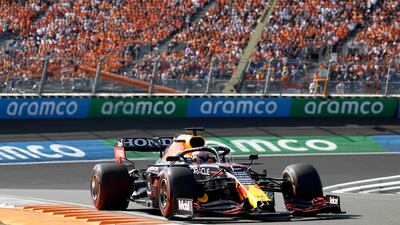
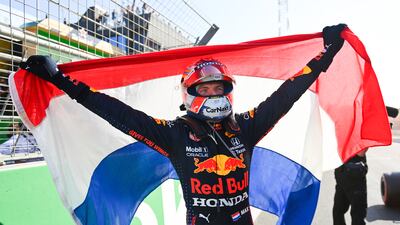
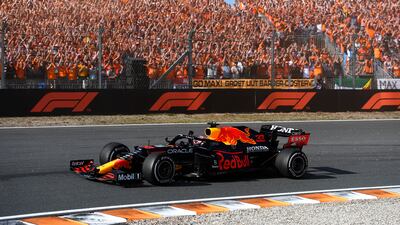
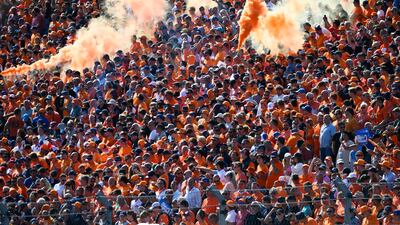
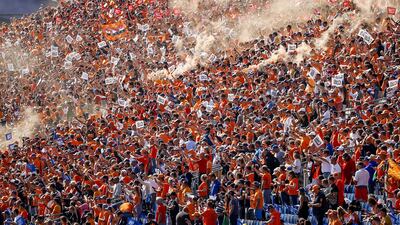
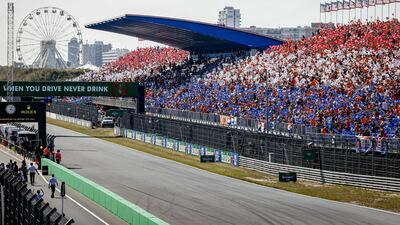
Glory, glory and more glory for Max Verstappen. Sunday’s Dutch Grand Prix should be a cake walk bathed in orange in front of his adoring home fans.
And part of a developing nightmare for everyone else, especially Lewis Hamilton.
The grizzled old champ is in that place where there are career-ending dark days ahead or massive steps towards redemption with that historic eighth title. There’s no middle way when you stand at the crossroads. It’s the price of being a legend.
But first Verstappen. Here’s a stat for you: the young Dutchman has won the last two races from 10th and 14th and that’s the first time anyone has won consecutive races from lower than 10th in 62 years.
The odd flash in the pan victory from the deeper recesses of the grid happens almost every year. But to do it twice in a row and match a 62-year-old record is a sign of devastating dominance even when things are going against you.
Let’s not forget Ferrari did the same with Charles Leclerc in taking an engine grid penalty, and where did he end up in the Belgian Grand Prix? Nowhere. He even tried to beat Verstappen’s fastest lap with 28 kilos less fuel and failed by six-tenths of a second.
The Monegasque needed to take Spa by the scruff of the neck to boost Ferrari at the start of the second half of the season. But as Verstappen was decisive in slicing through the pack, Leclerc was hesitant.
These days he cuts a disconsolate figure knowing a championship that had his name on it in Bahrain has been fumbled and ultimately stolen by Verstappen. In all likelihood the Dutchman will win more than four of the remaining eight races to record the most dominant season in history.
As for Hamilton, a different game is afoot.
He went to Spa talking about regeneration and renewed chances of victory after the summer break.
Verstappen wins 2021 Dutch GP
It turned out he was dreaming. Two days later he described his 1.8 sec gap to pole as “a kick in the teeth”.
And for the first time in his Mercedes’ career he admitted he couldn’t wait to see the back of his car at the season’s end.
It’s an F1 truism that cars born bad (ie slow) normally stay that way. You can always make a fast car reliable or more predictable but slow cars usually remain slow.
And it appears Mercedes have finally accepted this truth. Their no sidepods concept is a dud.
So what to do? Well, there are two paths: go for a radical redesign of what they’ve got or abandon the concept altogether and start afresh. The problem is there is no guarantee a new path will be any more successful, especially in a budget-control era.
Let’s not forget what is at stake here: among other things Hamilton’s place as the greatest driver of all time. Undisputed.
I would contend that is all he is hanging around for now. One more championship. And it’s clearly not going to happen this season. So the focus – for him at least – is already on 2023.
Of course he loves his racing but it is clear that he has limited affection for messing around in the hope of making fifth or sixth or, if he’s lucky, a podium. And who can blame him?
The clash with Fernando Alonso at Spa was a careless mistake that a fully focused Hamilton battling for a title would never have made.
So it appears Mercedes’ best option is to ditch this year’s attempts to refine a bad car and turn the rest of the season into a glorified test session for 2023.
After all, the best Mercedes can hope for now is third overall and they are not about that. The odd lucky win would be plaster on a fatal disease.
Look at Ferrari: they consolidated in 2021 after two of the worst seasons in their history. It wasn’t pretty for a while but they have bounced back instantly as an (admittedly flawed) championship contender.
As for Zandvoort on Sunday, Verstappen won last year’s race at a canter and should do the same again on a fast, flowing and bumpy circuit with an old-school feel.

WIDE%20VIEW
%3Cp%3EThe%20benefits%20of%20HoloLens%202%2C%20according%20to%20Microsoft%3A%3C%2Fp%3E%0A%3Cp%3E%3Cstrong%3EManufacturing%3A%3C%2Fstrong%3E%20Reduces%20downtime%20and%20speeds%20up%20onboarding%20and%20upskilling%3C%2Fp%3E%0A%3Cp%3E%3Cstrong%3EEngineering%20and%20construction%3A%3C%2Fstrong%3E%20Accelerates%20the%20pace%20of%20construction%20and%20mitigates%20risks%20earlier%20in%20the%20construction%20cycle%3C%2Fp%3E%0A%3Cp%3E%3Cstrong%3EHealth%20care%3A%3C%2Fstrong%3E%20Enhances%20the%20delivery%20of%20patient%20treatment%20at%20the%20point%20of%20care%3C%2Fp%3E%0A%3Cp%3E%3Cstrong%3EEducation%3A%3C%2Fstrong%3E%20Improves%20student%20outcomes%20and%20teaches%20from%20anywhere%20with%20experiential%20learning%3C%2Fp%3E%0A
Graduated from the American University of Sharjah
She is the eldest of three brothers and two sisters
Has helped solve 15 cases of electric shocks
Enjoys travelling, reading and horse riding
Mercer, the investment consulting arm of US services company Marsh & McLennan, expects its wealth division to at least double its assets under management (AUM) in the Middle East as wealth in the region continues to grow despite economic headwinds, a company official said.
Mercer Wealth, which globally has $160 billion in AUM, plans to boost its AUM in the region to $2-$3bn in the next 2-3 years from the present $1bn, said Yasir AbuShaban, a Dubai-based principal with Mercer Wealth.
“Within the next two to three years, we are looking at reaching $2 to $3 billion as a conservative estimate and we do see an opportunity to do so,” said Mr AbuShaban.
Mercer does not directly make investments, but allocates clients’ money they have discretion to, to professional asset managers. They also provide advice to clients.
“We have buying power. We can negotiate on their (client’s) behalf with asset managers to provide them lower fees than they otherwise would have to get on their own,” he added.
Mercer Wealth’s clients include sovereign wealth funds, family offices, and insurance companies among others.
From its office in Dubai, Mercer also looks after Africa, India and Turkey, where they also see opportunity for growth.
Wealth creation in Middle East and Africa (MEA) grew 8.5 per cent to $8.1 trillion last year from $7.5tn in 2015, higher than last year’s global average of 6 per cent and the second-highest growth in a region after Asia-Pacific which grew 9.9 per cent, according to consultancy Boston Consulting Group (BCG). In the region, where wealth grew just 1.9 per cent in 2015 compared with 2014, a pickup in oil prices has helped in wealth generation.
BCG is forecasting MEA wealth will rise to $12tn by 2021, growing at an annual average of 8 per cent.
Drivers of wealth generation in the region will be split evenly between new wealth creation and growth of performance of existing assets, according to BCG.
Another general trend in the region is clients’ looking for a comprehensive approach to investing, according to Mr AbuShaban.
“Institutional investors or some of the families are seeing a slowdown in the available capital they have to invest and in that sense they are looking at optimizing the way they manage their portfolios and making sure they are not investing haphazardly and different parts of their investment are working together,” said Mr AbuShaban.
Some clients also have a higher appetite for risk, given the low interest-rate environment that does not provide enough yield for some institutional investors. These clients are keen to invest in illiquid assets, such as private equity and infrastructure.
“What we have seen is a desire for higher returns in what has been a low-return environment specifically in various fixed income or bonds,” he said.
“In this environment, we have seen a de facto increase in the risk that clients are taking in things like illiquid investments, private equity investments, infrastructure and private debt, those kind of investments were higher illiquidity results in incrementally higher returns.”
The Abu Dhabi Investment Authority, one of the largest sovereign wealth funds, said in its 2016 report that has gradually increased its exposure in direct private equity and private credit transactions, mainly in Asian markets and especially in China and India. The authority’s private equity department focused on structured equities owing to “their defensive characteristics.”
Look%20Both%20Ways
%3Cp%3EDirector%3A%20Wanuri%20Kahiu%3Cbr%3EStars%3A%20Lili%20Reinhart%2C%20Danny%20Ramirez%2C%20David%20Corenswet%2C%20Luke%20Wilson%2C%20Nia%20Long%3Cbr%3ERating%3A%203%2F5%3Cbr%3E%3C%2Fp%3E%0A
Expert advice
“Join in with a group like Cycle Safe Dubai or TrainYAS, where you’ll meet like-minded people and always have support on hand.”
Stewart Howison, co-founder of Cycle Safe Dubai and owner of Revolution Cycles
“When you sweat a lot, you lose a lot of salt and other electrolytes from your body. If your electrolytes drop enough, you will be at risk of cramping. To prevent salt deficiency, simply add an electrolyte mix to your water.”
Cornelia Gloor, head of RAK Hospital’s Rehabilitation and Physiotherapy Centre
“Don’t make the mistake of thinking you can ride as fast or as far during the summer as you do in cooler weather. The heat will make you expend more energy to maintain a speed that might normally be comfortable, so pace yourself when riding during the hotter parts of the day.”
Chandrashekar Nandi, physiotherapist at Burjeel Hospital in Dubai
Bullet%20Train
%3Cp%3E%3Cstrong%3EDirector%3A%3C%2Fstrong%3E%20David%20Leitch%3Cbr%3E%3Cstrong%3EStars%3A%3C%2Fstrong%3E%20Brad%20Pitt%2C%20Aaron%20Taylor-Johnson%2C%20Brian%20Tyree%20Henry%2C%20Sandra%20Bullock%3Cbr%3E%3Cstrong%3ERating%3A%3C%2Fstrong%3E%203%2F5%3C%2Fp%3E%0A
Maestro
%3Cp%3E%3Cstrong%3EDirector%3A%20%3C%2Fstrong%3EBradley%20Cooper%3C%2Fp%3E%0A%3Cp%3E%3Cstrong%3EStarring%3A%20%3C%2Fstrong%3EBradley%20Cooper%2C%20Carey%20Mulligan%2C%20Maya%20Hawke%3C%2Fp%3E%0A%3Cp%3E%3Cstrong%3ERating%3A%3C%2Fstrong%3E%203%2F5%3C%2Fp%3E%0A