

Was Monday's IPL final really Mahendra Singh Dhoni's last appearance on the cricket field? Has he really retired for good?
At 41, surely Dhoni was not expected to go for another year, especially after he hurt his knee at the start of the IPL two months back. He endured the rigours of back-to-back T20 cricket across India – in the summer – through sheer grit. Most would not have put their bodies through so much, but Dhoni had a reason – Chennai Super Kings and their fervent supporters.
On the will-he-or-won't-he question, Dhoni gave a typically cryptic answer as to whether he will return to play for Chennai in next year's IPL.
"Looking for an answer? Circumstantially if you see, this is the best time to announce my retirement. But the amount of love and affection I have been shown wherever I have been this year, the easy thing would be for me to say 'Thank you very much', but the tough thing for me is to work hard for another nine months and come back and play at least one more season of IPL," said Dhoni.
"A lot depends on the body, I have 6-7 months to decide. It will be more like a gift from my side, it's not easy for me but that's a gift. The way they've [the fans] shown their love and affection, I think that's something I need to do for them," he said.
It is difficult to explain just how much Chennai loves Dhoni. You have to be at the ground to experience it. Every single Chennai match this IPL has seen yellow jerseys dominate the stands, be it home or away. Even Chennai's training sessions have thousands turn up at short notice. All of that only for a glimpse of Dhoni. That's it, just a glimpse.
The social fabric of southern Indian states like Tamil Nadu, whose capital is Chennai, celebrities and movie stars are literally worshipped to such a degree, they become leaders with considerable following and routinely become top-level politicians.

But Dhoni is different. He is an outsider – hailing from the western Indian state of Jharkhand – who became Chennai's very own Thala (which means "leader" in Tamil) having transformed the franchise into the most dominant team in IPL. And there is nothing make-believe or "filmy" about Dhoni's superstardom.
People watch Chennai's games just to see him bat. It does not matter that has was forced to restrict himself to two overs of batting at best this season, due to his knee injury. The batsmen playing before him have been regularly cheered off the ground after their dismissal as that means the crowd get the chance to see who they really came to watch.
It's not that Dhoni is the most destructive batsman of IPL 2023; he has batted just 57 balls the entire tournament and was out for a rare golden duck in Sunday's final as Chennai claimed a record-equaling fifth IPL title. But it is the promise of one more six deep into the stands, possibly for the final time, that has had fans bubbling with emotions and memories of the glory days of Indian cricket when he was the captain who won it all.
-
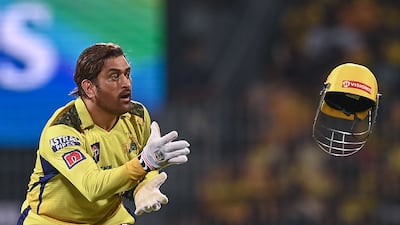
Chennai Super Kings' Mahendra Singh Dhoni is one of the most successful captains in cricket history. AFP -
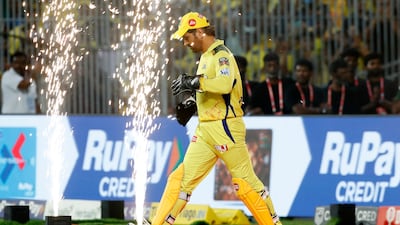
At 41, MS Dhoni is almost at the end of his playing days. Getty -
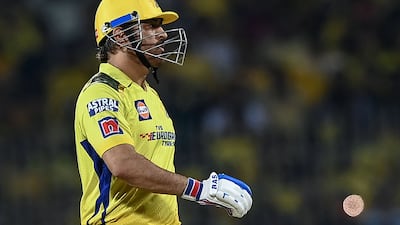
Chennai Super Kings' MS Dhoni played with a knee injury this season. AFP -
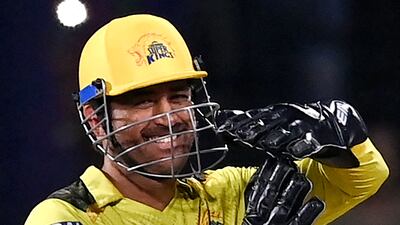
MS Dhoni remains the biggest draw in IPL. AFP -
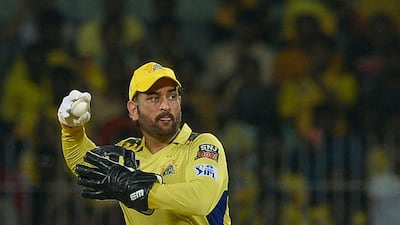
Dhoni retired from international cricket four years back but remains a crowd favourite. AFP -
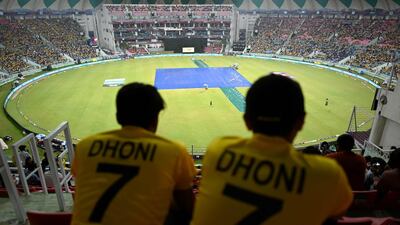
MS Dhoni fans at the Ekana Cricket Stadium in Lucknow. AFP


The tournament has witnessed unprecedented digital viewership this year, mainly because it is being shown for free in India. But, even so, Chennai and Dhoni have dominated the charts; the Super Kings' qualifier win against Gujarat had peak concurrent online viewership of 32 million.
Which gives rise to one important question – what happens after Dhoni? It is a question that runs to the very core of the franchise, and by extension the IPL itself. A disproportionate portion of the overall traffic is driven by superstar names like Dhoni and Virat Kohli.
Up-and-coming star Shubman Gull is also attracting many eyeballs, but no one comes close to Dhoni, and possibly Kohli.
If and when Dhoni hangs up his gloves, the tournament will experience a seismic shift. Teams without the "right" star power have struggled to get traction in terms of viewers, with some games not receiving even half the numbers that a Chennai or Bangalore match does.
Take Dhoni out of the equation, and who will the fans watch on a weekday, or in between important work?
For Chennai, the challenge is equally daunting. The longest-serving captain in the IPL has moulded the franchise in his image, transfusing his ethos and personality into the structure of the Super Kings. They way Chennai play, train, conduct team meetings, recruit players and assess performances all originate from Dhoni's style of thinking.
-

Chennai Super Kings players celebrate after their win in the IPL final against Gujarat Titans in Ahmedabad, India, on Tuesday. AP -

The Super Kings took their fifth title, equalling Mumbai Indians, in a rain-interrupted Twenty20 final. AFP -
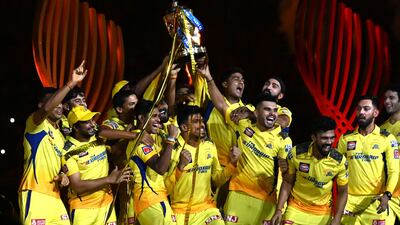
The Super Kings celebrate at the Narendra Modi Stadium in Ahmedabad. AFP -
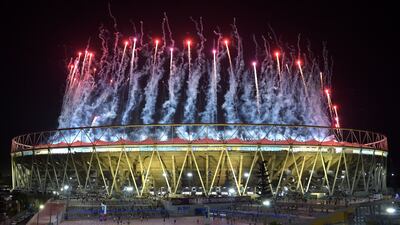
Fireworks at the Narendra Modi Stadium after the Chennai Super Kings' victory. AFP -
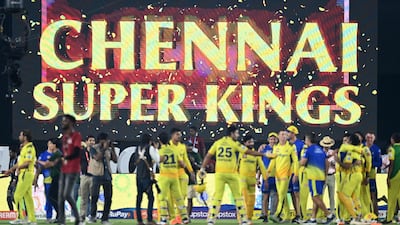
Chennai Super Kings help skipper MS Dhoni to victory in what might be his IPL swansong. AFP -
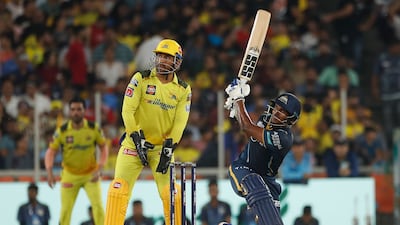
Sai Sudharsan hits out on his way to top scoring for Gujarat Titans with a total of 96 off 47 balls. Getty -
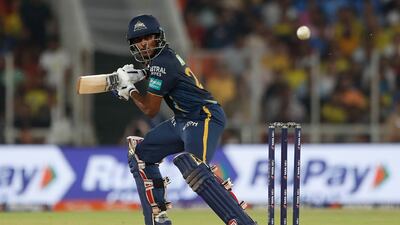
Sai Sudharsan of the Gujarat Titans bats. Getty -
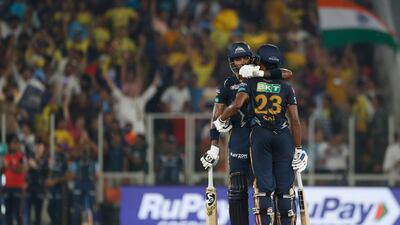
Gujarat Titans' captain Hardik Pandya embraces Sai Sudharsan during the 2023 IPL final. Getty -
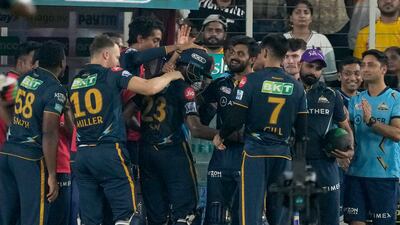
Teammates applaud Gujarat Titans' Sai Sudharsan (23) as he walks off the field after losing his wicket. AP -

Gujarat Titans' Wriddhiman Saha, left, celebrates his half century - on his way to a total of 54 off 39 - with batting partner Sai Sudharsan. AP -
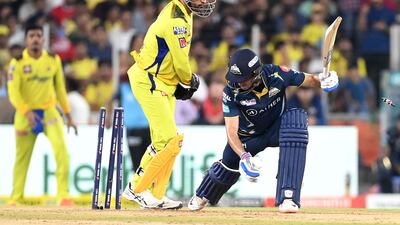
Gujarat Titans' Shubman Gill is stumped Chennai Super Kings' wicketkeeper and captain Mahendra Singh Dhoni after making 39 off 20. AFP -

Gujarat Titans' Shubman Gill plays a shot. AFP -
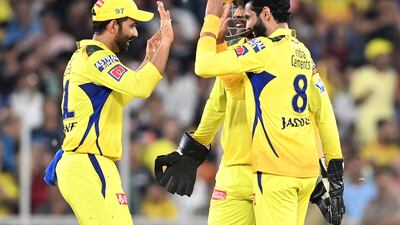
Chennai Super Kings' players celebrate after the dismissal of Gujarat Titans' Shubman Gill. AFP -
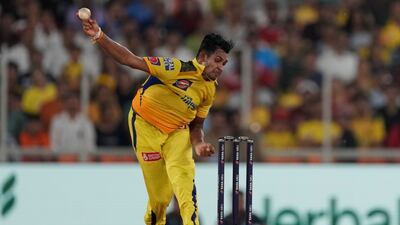
Chennai Super Kings' Matheesha Pathiranatook two wickets for 44 runs off his four overs, including the scalps of Sai Sudharsan and Rashid Khan. AP -
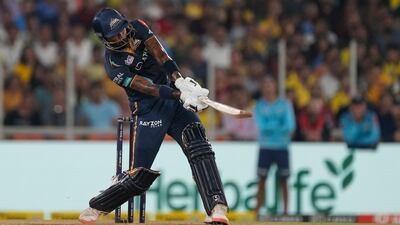
Gujarat Titans' captain Hardik Pandya plays a shot on his way to 21 runs off 12 balls. AP -

Chennai Super Kings' Devon Conway plays a shot. AP -
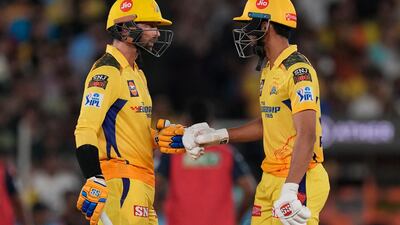
Chennai Super Kings' Devon Conway, left, and Ruturaj Gaikwad. AP -
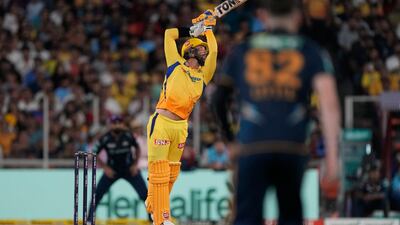
Chennai Super Kings' Devon Conway plays over the top. AP -
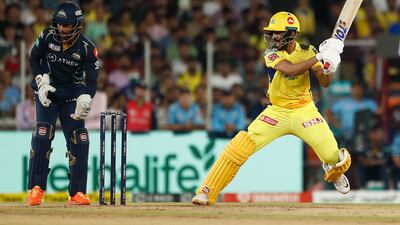
Ruturaj Gaikwad of the Chennai Super Kings bats during the 2023 IPL final. Getty -
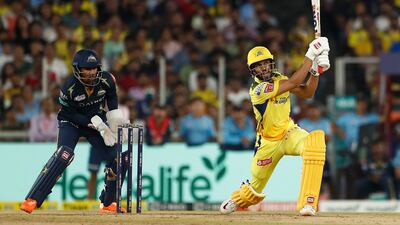
AHMEDABAD, INDIA - MAY 29: Ruturaj Gaikwad of the Chennai Super Kings hits out. Getty -

Gujarat Titans' Noor Ahmad celebrates with teammates after taking the wicket of Chennai Super Kings' Devon Conway. AFP -
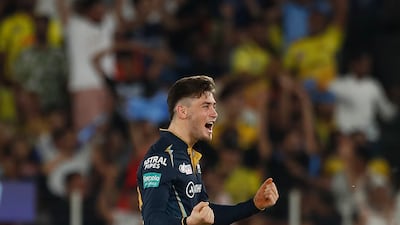
Noor Ahmad of the Gujarat Titans celebrates the wicket of Ruturaj Gaikwad. Getty -

Noor Ahmed of the Gujarat Titans bowls during the 2023 IPL final. Getty -

Chennai Super Kings' Ajinkya Rahane plays a shot. AP


The wicketkeeper batsman has said he will continue to be a part of Chennai Super Kings even after retirement – no surprises there. He is likely to continue calling the shots for the immediate future.
But the Super Kings will be wise to realise that tying your identity to one person can't be a viable long-term plan, no matter how great the star. They have not had to worry about leadership struggles and transition like other franchises have. They will do now.
And even though Dhoni will be there with them to help get over the pain, the Super Kings must learn to live life without Dhoni, sooner or later.

