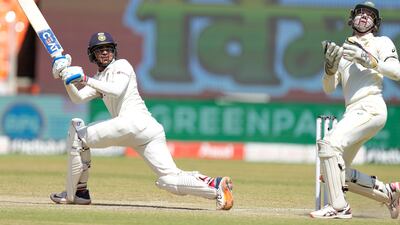
India's Shubman Gill plays a shot during the third day of the fourth and final Test cricket match between India and Australia at the Narendra Modi Stadium in Ahmedabad on March 11, 2023. (Photo by Punit PARANJPE / AFP) / ----IMAGE RESTRICTED TO EDITORIAL USE - STRICTLY NO COMMERCIAL USE-----
India's Shubman Gill plays a shot during the third day of the fourth and final Test cricket match between India and Australia at the Narendra Modi Stadium in Ahmedabad on March 11, 2023. (Photo by Pun

Shubman Gill proves his class to lead India's strong reply in Ahmedabad Test


  • English
  • Arabic

Opening batsman Shubman Gill proved he is the most in-form all-format batsman in India as he hit a fluent century on the third day of the Ahmedabad Test against Australia to keep the hosts in the game.

India ended the day's play on 289-3, still trailing Australia by 191 runs on a flat wicket at the Narendra Modi Stadium on Saturday.

Virat Kohli was batting on 59 and Ravindra Jadeja on 16 at stumps, setting the stage for a big first innings score for India on the penultimate day of the fourth Test.

India's response was set up by Gill, who hit his second Test century. He looked in control against pace and spin, reaching his ton with a fine sweep off Todd Murphy.

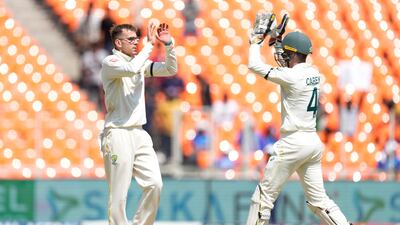
However, Gill lost his partner Cheteshwar Pujara, for 42, four balls later. Murphy trapped Pujara lbw to end a 113-run second-wicket stand which prospered after captain Rohit Sharma fell for 35 in the morning session.

  • India's Shubman Gill scored another century during the third day of the fourth Test against Australia in Ahmedabad on Saturday, March 11, 2023. AP
    India's Shubman Gill scored another century during the third day of the fourth Test against Australia in Ahmedabad on Saturday, March 11, 2023. AP
  • India's Shubman Gill raises his bat to celebrate his century. AP
    India's Shubman Gill raises his bat to celebrate his century. AP
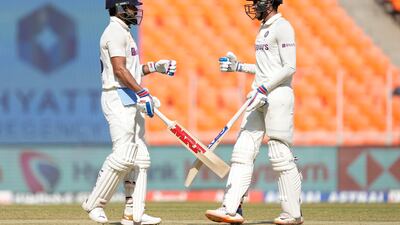
  • India's Virat Kohli, left, and Shubman Gill put the hosts in a strong position. AP
    India's Virat Kohli, left, and Shubman Gill put the hosts in a strong position. AP
  • Shubman Gill has scored five centuries across formats this year. AFP
    Shubman Gill has scored five centuries across formats this year. AFP
  • India's Virat Kohli, left, scored an unbeaten fifty. AFP
    India's Virat Kohli, left, scored an unbeaten fifty. AFP
  • Australia's Todd Murphy, left, celebrates the wicket India's Cheteshwar Pujara. AP
    Australia's Todd Murphy, left, celebrates the wicket India's Cheteshwar Pujara. AP
  • Cheteshwar Pujara provided good resistance with the bat. AFP
    Cheteshwar Pujara provided good resistance with the bat. AFP

It was another slow grind for both teams as neither wickets nor runs came in a hurry. India's scoring rate was below three an over, which means getting a result on the surface would be tough unless it breaks up in the Gujarat heat.

Earlier, both the Indian openers signalled their attacking intent after they resumed on 36 for no loss.

Gill started with an exquisite cover drive against Mitchell Starc, while Rohit pulled the left-arm quick for a six as India reached the 50-mark in the 13th over.

Left-arm spinner Matt Kuhnemann broke the 74-run opening stand when Rohit's backfoot punch went straight to Marnus Labuschagne at short extra cover.

Gill and Pujara consolidated India's position even though runs were not easy to come by in the second session.

The run-rate plummeted and India endured a 16-over boundary drought which Gill eventually ended with back-to-back fours off Cameron Green.

After Pujara's dismissal, Gill and Kohli put together a half-century stand before Nathan Lyon trapped Gill lbw for 128. Kohli and Jadeja then took the hosts to stumps.

Australia's bowlers struggled in the 36º Celsius heat, and will need a major effort in the morning session on Sunday to force a result.

India need to win the match to seal their place in the final of the World Test Championship against Australia at The Oval in June.

Gill has now scored five centuries since the beginning of the year in all three formats, including an ODI double ton.


Mercer, the investment consulting arm of US services company Marsh & McLennan, expects its wealth division to at least double its assets under management (AUM) in the Middle East as wealth in the region continues to grow despite economic headwinds, a company official said.

Mercer Wealth, which globally has $160 billion in AUM, plans to boost its AUM in the region to $2-$3bn in the next 2-3 years from the present $1bn, said Yasir AbuShaban, a Dubai-based principal with Mercer Wealth.

Within the next two to three years, we are looking at reaching $2 to $3 billion as a conservative estimate and we do see an opportunity to do so,” said Mr AbuShaban.

Mercer does not directly make investments, but allocates clients’ money they have discretion to, to professional asset managers. They also provide advice to clients.

“We have buying power. We can negotiate on their (client’s) behalf with asset managers to provide them lower fees than they otherwise would have to get on their own,” he added.

Mercer Wealth’s clients include sovereign wealth funds, family offices, and insurance companies among others.

From its office in Dubai, Mercer also looks after Africa, India and Turkey, where they also see opportunity for growth.

Wealth creation in Middle East and Africa (MEA) grew 8.5 per cent to $8.1 trillion last year from $7.5tn in 2015, higher than last year’s global average of 6 per cent and the second-highest growth in a region after Asia-Pacific which grew 9.9 per cent, according to consultancy Boston Consulting Group (BCG). In the region, where wealth grew just 1.9 per cent in 2015 compared with 2014, a pickup in oil prices has helped in wealth generation.

BCG is forecasting MEA wealth will rise to $12tn by 2021, growing at an annual average of 8 per cent.

Drivers of wealth generation in the region will be split evenly between new wealth creation and growth of performance of existing assets, according to BCG.

Another general trend in the region is clients’ looking for a comprehensive approach to investing, according to Mr AbuShaban.

“Institutional investors or some of the families are seeing a slowdown in the available capital they have to invest and in that sense they are looking at optimizing the way they manage their portfolios and making sure they are not investing haphazardly and different parts of their investment are working together,” said Mr AbuShaban.

Some clients also have a higher appetite for risk, given the low interest-rate environment that does not provide enough yield for some institutional investors. These clients are keen to invest in illiquid assets, such as private equity and infrastructure.

“What we have seen is a desire for higher returns in what has been a low-return environment specifically in various fixed income or bonds,” he said.

“In this environment, we have seen a de facto increase in the risk that clients are taking in things like illiquid investments, private equity investments, infrastructure and private debt, those kind of investments were higher illiquidity results in incrementally higher returns.”

The Abu Dhabi Investment Authority, one of the largest sovereign wealth funds, said in its 2016 report that has gradually increased its exposure in direct private equity and private credit transactions, mainly in Asian markets and especially in China and India. The authority’s private equity department focused on structured equities owing to “their defensive characteristics.”

How Alia's experiment will help humans get to Mars

Alia’s winning experiment examined how genes might change under the stresses caused by being in space, such as cosmic radiation and microgravity.

Her samples were placed in a machine on board the International Space Station. called a miniPCR thermal cycler, which can copy DNA multiple times.

After the samples were examined on return to Earth, scientists were able to successfully detect changes caused by being in space in the way DNA transmits instructions through proteins and other molecules in living organisms.

Although Alia’s samples were taken from nematode worms, the results have much bigger long term applications, especially for human space flight and long term missions, such as to Mars.

It also means that the first DNA experiments using human genomes can now be carried out on the ISS.


SPECS
%3Cp%3E%3Cstrong%3EEngine%3A%3C%2Fstrong%3E%20Dual%20electric%20motors%20with%20102kW%20battery%20pack%3C%2Fp%3E%0A%3Cp%3E%3Cstrong%3EPower%3A%20%3C%2Fstrong%3E570hp%3C%2Fp%3E%0A%3Cp%3E%3Cstrong%3ETorque%3A%3C%2Fstrong%3E%20890Nm%3C%2Fp%3E%0A%3Cp%3E%3Cstrong%3ERange%3A%3C%2Fstrong%3E%20Up%20to%20428km%3C%2Fp%3E%0A%3Cp%3E%3Cstrong%3EOn%20sale%3A%3C%2Fstrong%3E%20Now%3C%2Fp%3E%0A%3Cp%3E%3Cstrong%3EPrice%3A%20%3C%2Fstrong%3EFrom%20Dh1%2C700%2C000%3C%2Fp%3E%0A
COMPANY%20PROFILE
%3Cp%3E%3Cstrong%3EName%3A%3C%2Fstrong%3E%20Carzaty%2C%20now%20Kavak%3Cbr%3E%3Cstrong%3EBased%3A%3C%2Fstrong%3E%20Dubai%3Cbr%3E%3Cstrong%3ELaunch%20year%3A%20%3C%2Fstrong%3ECarzaty%20launched%20in%202018%2C%20Kavak%20in%20the%20GCC%20launched%20in%202022%3Cbr%3E%3Cstrong%3ENumber%20of%20employees%3A%3C%2Fstrong%3E%20140%3Cbr%3E%3Cstrong%3ESector%3A%3C%2Fstrong%3E%20Automotive%3Cbr%3E%3Cstrong%3EFunding%3A%20%3C%2Fstrong%3ECarzaty%20raised%20%246m%20in%20equity%20and%20%244m%20in%20debt%3B%20Kavak%20plans%20%24130m%20investment%20in%20the%20GCC%3C%2Fp%3E%0A
Updated: March 11, 2023, 12:11 PM