

Sebastian Coe is a double Olympic champion, a former UK Member of Parliament, sits in the House of Lords, and serves as president of World Athletics. He is also an increasingly influential voice in the UAE thanks to a new link up with Gems Education.
Coe made his name as an elite middle distance runner, winning 1500m gold in Moscow in 1980, and defending the title four years later in Los Angeles. There were two silvers as well, in the 800m, and his era-defining rivalry with compatriot Steve Ovett elevated British athletics.
Those sporting achievements are sometimes easy to forget given his profile and longevity as a politician and a leading sports administrator.

Coe, 69, was recently appointed as a senior adviser to Gems, a role that will see him shape the educational network's sports programme. He says he will be “encouraging the students, particularly those who have an ambition to compete at an elite level, but also not to dissuade those who want to, or see sport in a slightly different way [and] want to use it as a way of mental well-being and physicality.”
While visiting Dubai, Coe spoke to The National about his new role, and also the burning governance issues he has been synonymous with throughout his career away from the track. That included the World Athletics response to the geopolitical crises in Ukraine and Palestine, the continuing search for workable policy on gender in sports, and the spectre of this summer's Enhanced Games in Las Vegas.
Russia ban remains but no plans to sanction Israel
One of Coe’s most forceful interventions as World Athletics president came in response to Russia’s invasion of Ukraine. Russian athletes were first banned by the IAAF (now World Athletics) in 2015 following allegations of state-sponsored doping, supported by the McLaren Report the following year.
“Let’s be clear that Russia was suspended from our sport not for passports or politics,” Coe told The National. “They were suspended in 2015 for an egregious attack on the integrity of the sport through the violation of our anti-doping policies.”
Yet, while the Russian Federation has now been reinstated after satisfying anti-doping requirements, their athletes remain banned from international competition following the invasion of Ukraine in February 2022. The ban was extended in March last year and there are currently no plans to reintegrate Russian athletes.
“You had a Ukraine team that routinely would be 70 or 80 strong going to a major championship and suddenly that team was decimated,” Coe explained. “None of the male athletes could be there because they were fighting for the sovereignty of their country. Their coaches were doing the same. We lost 190 track and field athletes in that conflict.
“So, this was really about the integrity of competition. When there is finally some kind of solution to this, then of course we can look at what the next steps might be.”
Given the tough stance on Russia, there has been criticism of World Athletics for not imposing sanctions on Israel following the invasion of Gaza and the catastrophic losses suffered by Palestine.
“I've spent many hours discussing this with both the Israel Track and Field Federation and the Palestinian Track and Field Federation, and of course, all my federations in the Gulf,” said Coe. “These are challenging times for everybody. I've never been a great one for, well, 'what about?'
“You know, we made a judgment about Russia, we made a judgment about Belarus. Of course, I accept the world is a complicated place. You can only do it on the basis of what you're dealing with at the time, and there were sanctionable violations that Russia [committed] upheld [by] organisations like the United Nations, and that's where we settled.
“But I absolutely accept that there are challenges globally and maybe at some stage individual sports will have to confront those. We were the first to really confront the challenges around anti-doping and that was extended through the Russia-Belarus challenge.”
Asked if World Athletics might revisit its stance on Israel, Coe added: “No. I mean, look, as a sport and as a federation president, everything you watch closely, you have to. But, no, at the moment, that is the position that we've taken.”
Protecting women's sport
Aside from geopolitics, determining policy on gender has been one of global sport's biggest challenges in recent years.
High-profile cases such as that of the South African athlete Caster Semenya, and also the accusations directed at Algeria's Imane Khelif at Paris 2024, have created global headlines in a political climate where gender can be an incendiary topic.
In March 2023, World Athletics officially barred transgender athletes, or those who had experienced male puberty from competing in the female category. The framework was later expanded to include those with differences of sex development (DSD), with World Athletics estimating that 50-60 DSD athletes had competed in its finals since 2000.
-
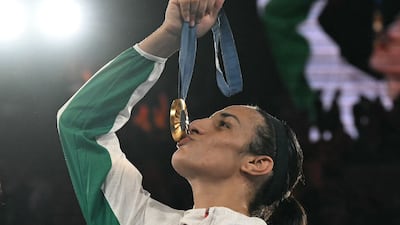
Gold medallist Imane Khelif poses on the podium. AFP -
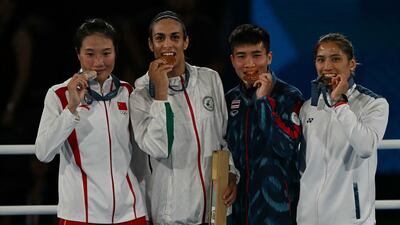
From the left: Silver medallist China's Yang Liu, gold medallist Algeria's Imane Khelif and bronze medallists Thailand's Janjaem Suwannapheng and Taiwan's Chen Nien. AFP -

Gold medallist Imane Khelif poses on the podium during the medal ceremony. AFP -
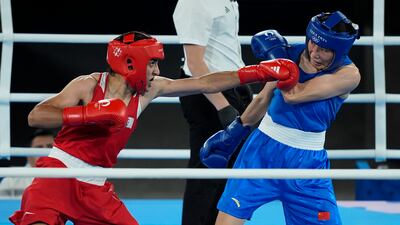
Algeria's Imane Khelif, left, fights China's Yang Liu. AP -
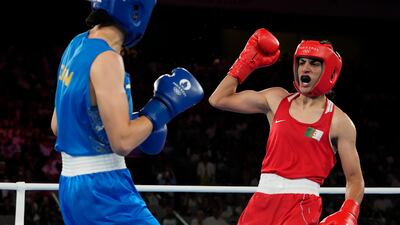
Algeria's Imane Khelif, right, fights China's Yang Liu. AP -
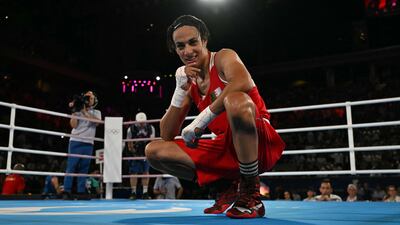
Algeria's Imane Khelif after beating China's Yang Liu. AFP -

Algerian fans celebrate as they watch their compatriot Imane Khelif win the gold medal. EPA -
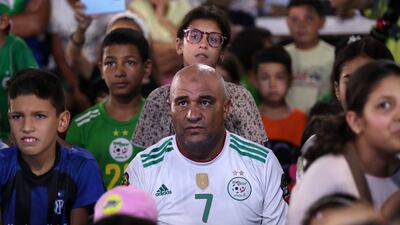
Algerian fans celebrate as they watch their compatriot Imane Khelif win the gold medal. EPA -

Algerian fans celebrate as they watch their compatriot Imane Khelif win the gold medal. EPA -
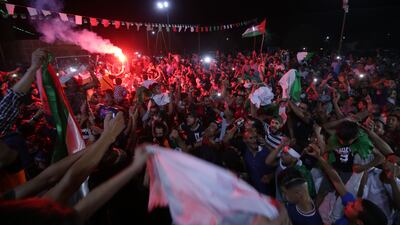
Algerian fans celebrate as they watch their compatriot Imane Khelif win the gold medal. EPA


They now use SRY testing as part of its eligibility criteria. The test, conducted through cheek swabs and blood spot analysis, identifies the presence of the SRY gene on the Y chromosome, which plays a key role in male sex development. The federation maintains that this provides clarity in determining eligibility for the female category.
“Gender can never trump biology,” Coe said. “Biology is the determining factor. Testosterone is probably, of those determining factors, the key.
“If you don’t protect and promote the female category, then you will lose women’s sport,” he added. “And I’m not prepared to see that happen in athletics. That's why we have banned transgender athletes from competing in our international competitions.”
SRY testing has its critics, including Professor Andrew Sinclair, who discovered the SRY gene. Professor Sinclair has argued that biological sex is far more complex than a single genetic marker.
But Coe said: “There are very few scientific disagreements, and not worthy, really not issues that are really worthy if I may say so. Nobody really argues about the impact that testosterone has on competition.”
Asked whether World Athletics had considered creating an open or additional category to accommodate DSD athletes, Coe said: “No. We’ve gone through various iterations. This is not an individual decision I’ve taken. I have a global council of 26 people, 13 men and 13 women. We feel very strongly that this is about integrity. My successors may see this differently, but at the moment, we have no intention of creating a third category.
“If you don’t [implement policy], you run the risk of girls not wanting to take part in sport,” he added.
Enhanced Games lacks integrity
At the time of Coe's visit to Dubai, the athletes participating in this summer's Enhanced Games were assembling in Abu Dhabi for a training camp ahead of the event's debut in Las Vegas this summer.
The controversial competition permits the use of performance-enhancingIts and banned substances in a controlled environment with attractive financial packages and bonuses on offer for athletes who compete, win and break records. It's backers defend its legitimacy and say it simply offers an alternative model.
But Coe, a staunch defender of anti-doping protocol, said: “I don’t see it being an alternate system … For 33 centuries people have gone into sport because they understand free, fair, open competition. The outcome is often losing. It’s not always winning.
“I don’t think anything is going to fundamentally shift the human condition or our philosophical disposition towards that. The vast majority of athletes at this very moment are training with integrity, training with coaches that are giving up hundreds of hours of their year, often volunteers, and having to balance family life and business and coaching. Those are the people I focus on.”
Developing UAE talent
Coe’s visit to Dubai centred on his advisory role with Gems Education, where he offers expertise on sport, well-being and athlete development.
He praised the group’s inclusive approach, stressing that elite performance and participation are treated as complementary rather than competing pathways.
“Nobody’s left behind,” he said. “If you're an elite competitor, you are given all the coaching credibility that you need, and certainly the infrastructure. But if you want to be a participating competitor or participant, then you're equally encouraged to do that and both operate within a very rigorous academic structure too."
He added: “I was talking to some students this morning, a very good question from one of them, who said to me, 'What are the challenges that we face that you didn’t?' And I said, 'Look, I was probably as hungry to do what I did as you are. You’re getting up and training at five o’clock in the morning in the pool, regularly on the road at 6, 6.30, running 10 miles before breakfast.' There are commonalities, whatever generation you are from.
“But what I didn’t have was the constant bombardment from social media. I didn’t have those types of distractions. But there are some huge advantages that are available now to this cohort of athletes that I didn’t have. If you look at diagnostics, you look at injury prevention, injury treatment, AI is going to be a game-changer in sport, but it’s also going to pose some challenges if you don’t have the right safeguards and guardrails around it.”
Coe also feels that with the right framework in place, it is only a matter of time before more elite athletes emerge from the UAE and other Gulf states. “You have some good examples of some outstanding athletes,” he said. “Mutaz Barshim from Qatar, the Olympic high jump champion. There is no reason why the progress that this region can make in sport can’t be profound.”
Hopes for Man United and Old Trafford
Last month, Coe formally became Chair Designate of the Mayoral Development Corporation for the Old Trafford regeneration project.
Premier League giants Manchester United hope that “New Trafford” can become the north of England's answer to Wembley Stadium, and even released ambitious Norman Foster-created designs last year. It is hoped the £2 billion project could be completed by 2030.
Drawing on his experience of London 2012, where he oversaw the creation of the Olympic Stadium and numerous other infrastructure projects, Coe said legacy would be central to the project.
“It’s my ambition to help the club build an outstanding, iconic stadium and that’s important,” he said. “But I see it leading to the regeneration also of a very poor part of a city that I know well.”
Addressing concerns about heritage, he added that “the development will take place in and around the same site” adding that the club’s current owners, including Sir Jim Ratcliffe, “will be fierce protectors of the history and heritage of the club.”

