Muhammad Waseem would have been forgiven for watching Monday night’s HBL Pakistan Super League final with a hint of envy.
At least one player had stolen his life for a day, if not two.
The UAE captain was picked up by Islamabad United as a replacement player in February, due reward for his brilliance as an opening batter in T20 cricket.
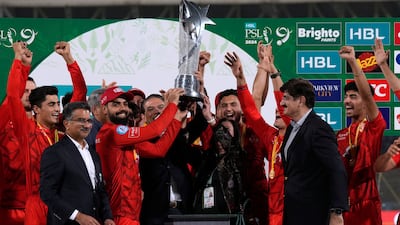
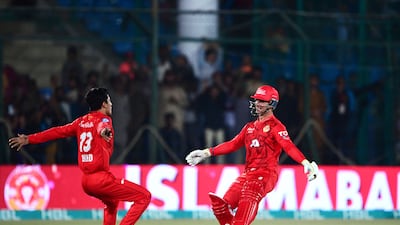
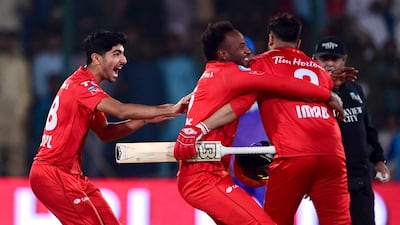
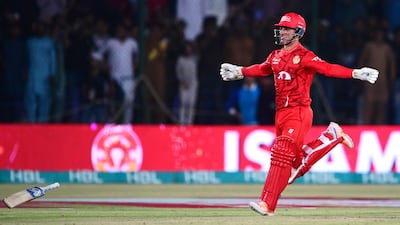
Yet, as they were celebrating a third PSL title on Monday night after a thrilling final against Multan Sultans, he was left to watch from afar.
Waseem was not able to take up his contract with Islamabad as the meat of the tournament clashed with the UAE’s international series against Canada and Scotland.
There was a small window of opportunity either side of national duty. However, so brief was it that Waseem did not feel he could justify making the trip.
At the beginning, he opted instead for a rapid flying visit to the Bangladesh Premier League, for one game only. Then at the end he did not fly in for the business end of the PSL, after the UAE’s drab T20 series loss to Scotland.
He might have been a welcome arrival. Two of Islamabad's three overseas openers were at odds at the time.
Englishman Alex Hales was suddenly runless as the season’s finish line approached. The single run he made in the second eliminator match against Peshawar Zalmi was his last chance in the competition.
For the final he was replaced by Martin Guptill, who had himself only made his tournament introduction in the first eliminator match in place of Colin Munro, who was struggling with a hamstring injury.
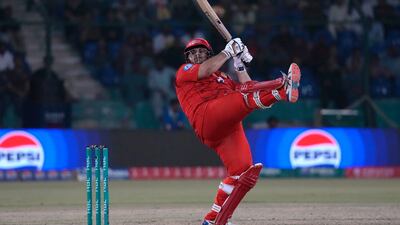
Guptill had three games to make himself a star and he took his chance. In the final, he got Islamabad’s pursuit of 160 to win off to a flying start with 50 from 32 balls. That might so easily have been Waseem instead.
Despite Waseem’s absence, the UAE were represented – to an extent – in the final.
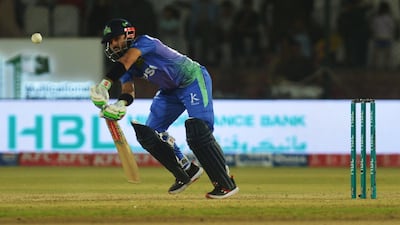
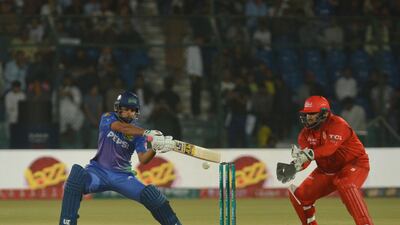
Usman Khan decorated the ninth season of PSL in the brightest hues. At the end of it, he was named the batter of the tournament.
With 430 runs, he was actually the season's second-leading run getter, with a full 139 runs fewer than Babar Azam.
But Usman’s haul came in four less matches, and it was a stunning feat. The 430 he managed in seven games came at an average of 107.5 and a strike rate of 164.12. They are unbelievable numbers.
Nominally, he is from the UAE, although his remains a curious case. He was recruited by Multan as an overseas player, even though he can’t play for the UAE until midway through 2025, but could play for Pakistan tomorrow.
He has lived in the UAE long enough to be eligible to represent the national team. However, his qualification via the ICC’s residency criteria has been delayed due to the number of days he has spent out of the country playing PSL and BPL cricket.
Usman remains committed to playing for the UAE in the future, but his resolve might well be tested if Pakistan come calling.
Surely anybody would want him after the excellence he showed this season. His run of scores, which included a canny half-century in the final which gave himself something to defend, could not fail to get him noticed.
It is a wonder that he has reached this point of his career without being fully fancied. Andy Flower, the coach who first gave him his chance at Multan, suggested Usman’s greatest strengths are on game day.
“When we gave him a chance at Multan, it was a little bit of a gamble because in nets, you might not see a top-class player in there,” Flower said of Usman during the DP World International League T20 earlier this year.
“But when he plays in a game, I think he is a great game player and great competitor. He likes the competition and finding solutions to whatever problems the opposition are posing him. That is one of his biggest assets.”
So it proved in the final. Islamabad had hit on a plan for the rising star when he came to the wicket in Karachi. Their fast bowlers went short at him, and initially he looked uncomfortable.
He was hit on his right arm off the first ball he faced, from the rapid Pakistan fast bowler Naseem Shah. He ran the next ball he faced down to third man to get off the mark, but required treatment at the end of the over.
By the time of Multan’s fielding effort, he had been forced out of the game, left to watch from the dug out with his forearm heavily bandaged.
Still, though – as Flower suggested – Usman found solutions. He cut a four off Imad Wasim in his second over, then later a six and four – albeit via a dropped catch by Hunain Shah – signalled that he was into his work.
By the time he made it to 50, his name was being roared around the National Bank Stadium.
Seven runs later, he fell, caught by Islamabad’s substitute fielder Jordan Cox, who is coincidentally Usman’s teammate at Gulf Giants in the ILT20.
Injury dictated that was to be Usman’s last involvement in the final. Instead, he was left as a nervous spectator unable to influence proceedings.
The man who might soon be his international captain knew the feeling only too well.

THE BIO
Mr Al Qassimi is 37 and lives in Dubai
He is a keen drummer and loves gardening
His favourite way to unwind is spending time with his two children and cooking
STAGE 4 RESULTS
1 Sam Bennett (IRL) Deceuninck-QuickStep - 4:51:51
2 David Dekker (NED) Team Jumbo-Visma
3 Caleb Ewan (AUS) Lotto Soudal
4 Elia Viviani (ITA) Cofidis
5 Matteo Moschetti (ITA) Trek-Segafredo
General Classification
1 Tadej Pogacar (SLO) UAE Team Emirates - 12:50:21
2 Adam Yates (GBR) Teamn Ineos Grenadiers - 0:00:43
3 Joao Almeida (POR) Deceuninck-QuickStep - 0:01:03
4 Chris Harper (AUS) Jumbo-Visma - 0:01:43
5 Neilson Powless (USA) EF Education-Nippo - 0:01:45
%3Cp%3E%3Cstrong%3ETHE%20SPECS%3C%2Fstrong%3E%0D%3Cbr%3EEngine%3A%203.5-litre%20V6%0D%3Cbr%3ETransmission%3A%209-speed%20automatc%0D%3Cbr%3EPower%3A%20279hp%0D%3Cbr%3ETorque%3A%20350Nm%0D%3Cbr%3EPrice%3A%20From%20Dh250%2C000%0D%3Cbr%3EOn%20sale%3A%20Now%3C%2Fp%3E%0A
COMPANY%20PROFILE
%3Cp%3E%3Cstrong%3EName%3A%20%3C%2Fstrong%3EKinetic%207%3Cbr%3E%3Cstrong%3EStarted%3A%3C%2Fstrong%3E%202018%3Cbr%3E%3Cstrong%3EFounder%3A%3C%2Fstrong%3E%20Rick%20Parish%3Cbr%3E%3Cstrong%3EBased%3A%3C%2Fstrong%3E%20Abu%20Dhabi%2C%20UAE%3Cbr%3E%3Cstrong%3EIndustry%3A%3C%2Fstrong%3E%20Clean%20cooking%3Cbr%3E%3Cstrong%3EFunding%3A%3C%2Fstrong%3E%20%2410%20million%3Cbr%3E%3Cstrong%3EInvestors%3A%3C%2Fstrong%3E%20Self-funded%3C%2Fp%3E%0A
What are the influencer academy modules?
- Mastery of audio-visual content creation.
- Cinematography, shots and movement.
- All aspects of post-production.
- Emerging technologies and VFX with AI and CGI.
- Understanding of marketing objectives and audience engagement.
- Tourism industry knowledge.
- Professional ethics.
More on animal trafficking
Mercer, the investment consulting arm of US services company Marsh & McLennan, expects its wealth division to at least double its assets under management (AUM) in the Middle East as wealth in the region continues to grow despite economic headwinds, a company official said.
Mercer Wealth, which globally has $160 billion in AUM, plans to boost its AUM in the region to $2-$3bn in the next 2-3 years from the present $1bn, said Yasir AbuShaban, a Dubai-based principal with Mercer Wealth.
“Within the next two to three years, we are looking at reaching $2 to $3 billion as a conservative estimate and we do see an opportunity to do so,” said Mr AbuShaban.
Mercer does not directly make investments, but allocates clients’ money they have discretion to, to professional asset managers. They also provide advice to clients.
“We have buying power. We can negotiate on their (client’s) behalf with asset managers to provide them lower fees than they otherwise would have to get on their own,” he added.
Mercer Wealth’s clients include sovereign wealth funds, family offices, and insurance companies among others.
From its office in Dubai, Mercer also looks after Africa, India and Turkey, where they also see opportunity for growth.
Wealth creation in Middle East and Africa (MEA) grew 8.5 per cent to $8.1 trillion last year from $7.5tn in 2015, higher than last year’s global average of 6 per cent and the second-highest growth in a region after Asia-Pacific which grew 9.9 per cent, according to consultancy Boston Consulting Group (BCG). In the region, where wealth grew just 1.9 per cent in 2015 compared with 2014, a pickup in oil prices has helped in wealth generation.
BCG is forecasting MEA wealth will rise to $12tn by 2021, growing at an annual average of 8 per cent.
Drivers of wealth generation in the region will be split evenly between new wealth creation and growth of performance of existing assets, according to BCG.
Another general trend in the region is clients’ looking for a comprehensive approach to investing, according to Mr AbuShaban.
“Institutional investors or some of the families are seeing a slowdown in the available capital they have to invest and in that sense they are looking at optimizing the way they manage their portfolios and making sure they are not investing haphazardly and different parts of their investment are working together,” said Mr AbuShaban.
Some clients also have a higher appetite for risk, given the low interest-rate environment that does not provide enough yield for some institutional investors. These clients are keen to invest in illiquid assets, such as private equity and infrastructure.
“What we have seen is a desire for higher returns in what has been a low-return environment specifically in various fixed income or bonds,” he said.
“In this environment, we have seen a de facto increase in the risk that clients are taking in things like illiquid investments, private equity investments, infrastructure and private debt, those kind of investments were higher illiquidity results in incrementally higher returns.”
The Abu Dhabi Investment Authority, one of the largest sovereign wealth funds, said in its 2016 report that has gradually increased its exposure in direct private equity and private credit transactions, mainly in Asian markets and especially in China and India. The authority’s private equity department focused on structured equities owing to “their defensive characteristics.”
The President's Cake
Director: Hasan Hadi
Starring: Baneen Ahmad Nayyef, Waheed Thabet Khreibat, Sajad Mohamad Qasem
Rating: 4/5
Tips on buying property during a pandemic
Islay Robinson, group chief executive of mortgage broker Enness Global, offers his advice on buying property in today's market.
While many have been quick to call a market collapse, this simply isn’t what we’re seeing on the ground. Many pockets of the global property market, including London and the UAE, continue to be compelling locations to invest in real estate.
While an air of uncertainty remains, the outlook is far better than anyone could have predicted. However, it is still important to consider the wider threat posed by Covid-19 when buying bricks and mortar.
Anything with outside space, gardens and private entrances is a must and these property features will see your investment keep its value should the pandemic drag on. In contrast, flats and particularly high-rise developments are falling in popularity and investors should avoid them at all costs.
Attractive investment property can be hard to find amid strong demand and heightened buyer activity. When you do find one, be prepared to move hard and fast to secure it. If you have your finances in order, this shouldn’t be an issue.
Lenders continue to lend and rates remain at an all-time low, so utilise this. There is no point in tying up cash when you can keep this liquidity to maximise other opportunities.
Keep your head and, as always when investing, take the long-term view. External factors such as coronavirus or Brexit will present challenges in the short-term, but the long-term outlook remains strong.
Finally, keep an eye on your currency. Whenever currency fluctuations favour foreign buyers, you can bet that demand will increase, as they act to secure what is essentially a discounted property.
MATCH INFO
Liverpool v Manchester City, Sunday, 8.30pm UAE
Avatar: Fire and Ash
Director: James Cameron
Starring: Sam Worthington, Sigourney Weaver, Zoe Saldana
Rating: 4.5/5
Key facilities
- Olympic-size swimming pool with a split bulkhead for multi-use configurations, including water polo and 50m/25m training lanes
- Premier League-standard football pitch
- 400m Olympic running track
- NBA-spec basketball court with auditorium
- 600-seat auditorium
- Spaces for historical and cultural exploration
- An elevated football field that doubles as a helipad
- Specialist robotics and science laboratories
- AR and VR-enabled learning centres
- Disruption Lab and Research Centre for developing entrepreneurial skills
Kandahar%20
%3Cp%3E%3Cstrong%3EDirector%3A%3C%2Fstrong%3E%20Ric%20Roman%20Waugh%3C%2Fp%3E%0A%3Cp%3E%3Cstrong%3EStars%3A%C2%A0%3C%2Fstrong%3EGerard%20Butler%2C%20Navid%20Negahban%2C%20Ali%20Fazal%3C%2Fp%3E%0A%3Cp%3E%3Cstrong%3ERating%3A%3C%2Fstrong%3E%202.5%2F5%3C%2Fp%3E%0A
Sustainable Development Goals
1. End poverty in all its forms everywhere
2. End hunger, achieve food security and improved nutrition and promote sustainable agriculture
3. Ensure healthy lives and promote well-being for all at all ages
4. Ensure inclusive and equitable quality education and promote lifelong learning opportunities for all
5. Achieve gender equality and empower all women and girls
6. Ensure availability and sustainable management of water and sanitation for all
7. Ensure access to affordable, reliable, sustainable and modern energy for all
8. Promote sustained, inclusive and sustainable economic growth, full and productive employment and decent work for all
9. Build resilient infrastructure, promote inclusive and sustainable industrialisation and foster innovation
10. Reduce inequality within and among countries
11. Make cities and human settlements inclusive, safe, resilient and sustainable
12. Ensure sustainable consumption and production patterns
13. Take urgent action to combat climate change and its effects
14. Conserve and sustainably use the oceans, seas and marine resources for sustainable development
15. Protect, restore and promote sustainable use of terrestrial ecosystems, sustainably manage forests, combat desertification, and halt and reverse land degradation and halt biodiversity loss
16. Promote peaceful and inclusive societies for sustainable development, provide access to justice for all and build effective, accountable and inclusive institutions at all levels
17. Strengthen the means of implementation and revitalise the global partnership for sustainable development
Heather, the Totality
Matthew Weiner,
Canongate