

An Australian judge demanded Monday to know what more Novak Djokovic could have done to meet the country's strict pandemic entry requirements, offering a glimmer of hope to the detained tennis superstar as he fights deportation.
The 34-year-old world No 1 arrived in Melbourne last week ahead of the Australian Open, hoping to win a record-breaking 21st Grand Slam title.
But guards at Melbourne's Tullamarine Airport decided the unvaccinated star had failed to present a solid medical reason for not being jabbed.
Djokovic's visa was revoked and he was moved to a notorious immigration detention facility pending deportation.
In an emergency online court hearing Monday, federal Judge Anthony Kelly listened to extended legal wrangling about the process, before jumping to the 34-year-old's defence.
Declaring himself "somewhat agitated", Kelly said Djokovic had provided evidence from "a professor and an eminently qualified physician" about a medical exemption.
"What more could this man have done?" the judge demanded.
Djokovic's lawyers raced through the last of their legal arguments -centred around Djokovic's treatment by officials at the airport - and have now wrapped up.
They requested the judge make a ruling as soon as possible given the desire for Djokovic to participate in the upcoming Australian Open.
Proceedings were repeatedly delayed as the court's online system crashed under a surge of worldwide interest.
Anti-vaccine activists shared a link to the livestream and defied a court order by broadcasting proceedings live on YouTube.
Eventually, the judge pressed ahead without a public livestream, and Djokovic's team of top-flight lawyers made his case.
During overnight questioning at the airport, they said Djokovic was "utterly confused" about the situation.
The Australian Open gets under way in just seven days, and the nine-time defending champion's participation now entirely depends on whether Judge Kelly believes the government acted improperly in revoking his visa.
Most foreigners are still banned from travel to Australia, and those granted entry must be fully vaccinated or have an exemption like "acute" illness.
-
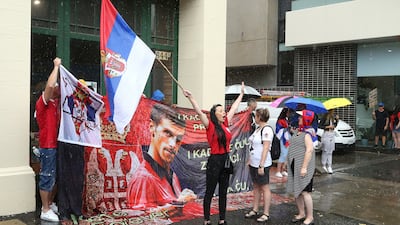
Protestors gather outside an immigration detention hotel where Serbia's Novak Djokovic is believed to stay, in Melbourne, Australia. AP Photo -

Novak Djokovic is fighting his visa cancellation and pending deportation in a Federal Court challenge. EPA -
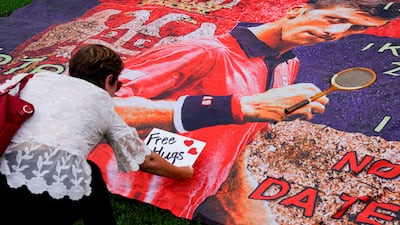
A woman places a "Free hugs" sign on a banner of Novak Djokovic outside the Park Hotel in Melbourne. Reuters -
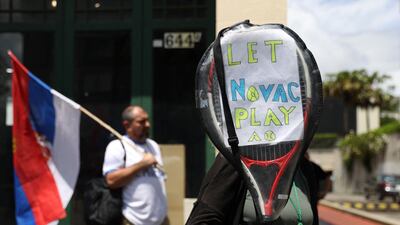
A supporter of Serbian tennis player Novak Djokovic holds up a sign outside the Park Hotel. Reuters -

Police stand guard at a government detention centre where Serbia's tennis champion Novak Djokovic is reported to be staying. AFP -
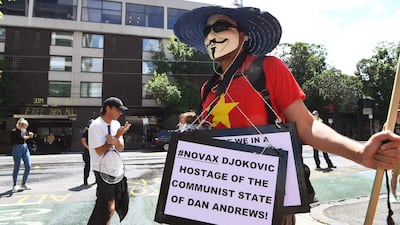
An anti-vax protester holds placards at a government detention centre where Serbia's tennis champion Novak Djokovic is reported to be staying. AFP -

Daniel Stepanovic, a supporter of Serbian tennis player Novak Djokovic, waves a flag. Reuters -

A supporter of Serbian tennis player Novak Djokovic holds a decorated tennis racket. Reuters -

Supporters unfurl a banner outside the Park hotel quarantine facility. EPA


Another tennis player - Czech doubles specialist Renata Voracova - has also had her visa cancelled after obtaining a medical exemption.
She flew out of Australia on Saturday after being held in the same Melbourne centre as Djokovic.
Government lawyers reject Djokovic's case, and are expected to argue later Monday that he fails to meet the medical criteria as his recent infection was not "acute".
They will seek to have his appeal dismissed with costs, according to a 13-page court submission, paving the way for his deportation as soon as Monday evening.
Despite Djokovic's claim of a positive test on December 16, he attended a gathering that day for the Serbian national postal service launching a stamp series in his honour.
Pictures shared by the Belgrade tennis federation also showed him at a young players' event in the city on December 17.
It reported that he had handed over cups and prizes to players. No one was wearing a mask.
Djokovic is in detention at the former Park Hotel, a five-storey facility that holds about 32 migrants trapped in Australia's hardline immigration system - some for years on end.
For days, demonstrators and counter-demonstrators have gathered outside the facility. Nobody is usually allowed in or out except staff.
But Djokovic won permission from the court to watch Monday's proceedings from another, undisclosed location before returning to the detention centre when hearings conclude.
An early plea to be moved to a facility where he can train for the Australian Open has fallen on deaf ears, his lawyers said.
The detention centre gained notoriety last year when a fire forced migrants to be evacuated, and maggots were allegedly found in the food.
Hours before the hearing, a pro-refugee banner was unfurled from the roof and police removed a small number of protestors from the scene.
Meanwhile at a rally in Belgrade, Djokovic's mother Dijana claimed her son was staying "in not human conditions".
"They detained him and even don't give him breakfast, he has only lunch and dinner," she said, quoted by local media.
"He does not have a normal window, he stares at a wall."
'Gluten-free food'
Prime Minister Ana Brnabic said this weekend that Serbia was fully behind the player and that she had held "constructive talks" with her Australian counterpart.
"We managed that he gets gluten-free food, exercise equipment, a laptop," she told Serbia's Pink television.
As other players now enter the final intense phase of preparations for the tournament, Djokovic faces huge pressure to be ready in time.
Djokovic's lawyers have told the court that Tennis Australia needs an answer by Tuesday. The draw for the event is scheduled for Thursday.
But Judge Kelly has warned justice will move at its own pace through all necessary appeals.
"The tail won't be wagging the dog here," he said.
Tennis Australia chief Craig Tiley on Monday defended his organisation from criticism that it failed to warn players that a previous infection did not qualify them for entry without a Covid-19 vaccination.
Tiley said he had asked the government to review medical exemptions before the players arrived, but "they declined".
"We asked if they could please assess our decisions. We said we're going to need some help to make sure we're doing the right thing. We'd be in a different situation today," he told The Sydney Morning Herald.
Meanwhile, much of Australia is tightening restrictions to battle an Omicron-fuelled wave of infections.
The country is now approaching 100,000 cases a day, having been virus-free for much of the pandemic.

