Beyond the Headlines: the Suez Canal crisis and how to stop ships getting stuck


James Haines-Young
  • English
  • Arabic

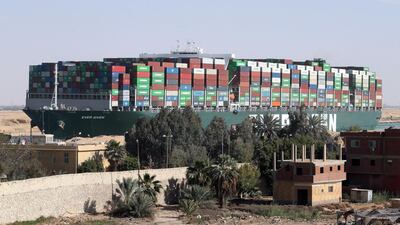
The Ever Given is nearly 400 metres long but for nearly a week it brought billions of dollars of global trade to a total standstill.

The Suez Canal Authority is looking at demanding $1bn in compensation. Hundreds of other shipping companies are likely to do the same.

So how did all of this happen, how did it impact you and how do we stop it from happening again?

Those are the questions we ask this week on Beyond the Headlines as we're joined by two maritime experts, former Royal Navy Captain Garry Northwood and former merchant navy officer turned maritime analyst for data company Refinitiv, Ranjith Raja.

The 220,000-tonne container ship ran aground on March 23 in the southern part of the canal and was freed on Monday.

The initial backlog of 422 ships was estimated to take three-and-a-half days to clear, Egypt's President Abdel Fattah El Sisi said on Tuesday.

According to the shipping journal Lloyd’s List, each day of blockage disrupts goods worth more than $9 billion, translating to about $400 million an hour.

"The accident showed the world the importance of the Suez Canal after some people spoke about alternative routes," Mr El Sisi said

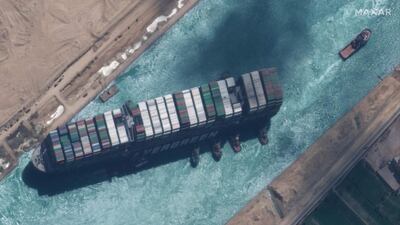
  • This satellite imagery released by Maxar Technologies shows a close up overview of the MV Ever Given container ship and tugboats in the Suez Canal. AFP / Maxar Technologies
    This satellite imagery released by Maxar Technologies shows a close up overview of the MV Ever Given container ship and tugboats in the Suez Canal. AFP / Maxar Technologies
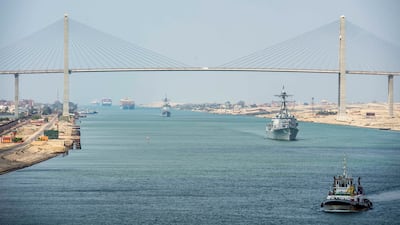
  • The guided-missile cruiser USS Monterey (CG 61), left, and the guided-missile destroyer USS Thomas Hudner (DDG 116) sail behind the aircraft carrier USS Dwight D. Eisenhower (CVN 69) during a Suez Canal transit, in this picture taken April 2, 2021 and released by U.S. Navy. Reuters
    The guided-missile cruiser USS Monterey (CG 61), left, and the guided-missile destroyer USS Thomas Hudner (DDG 116) sail behind the aircraft carrier USS Dwight D. Eisenhower (CVN 69) during a Suez Canal transit, in this picture taken April 2, 2021 and released by U.S. Navy. Reuters
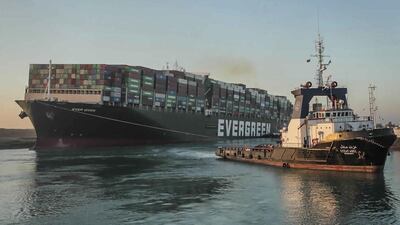
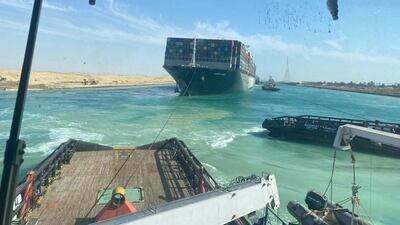
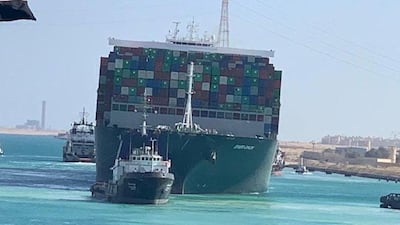
  • In this photo released by Suez Canal Authority, the Ever Given, a Panama-flagged cargo ship, is pulled by one of the Suez Canal tugboats, in the Suez Canal, Egypt. AP Photo
    In this photo released by Suez Canal Authority, the Ever Given, a Panama-flagged cargo ship, is pulled by one of the Suez Canal tugboats, in the Suez Canal, Egypt. AP Photo
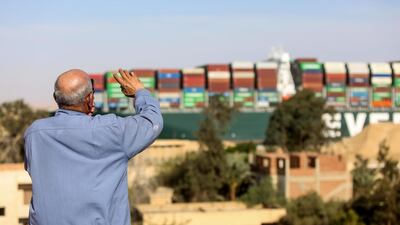
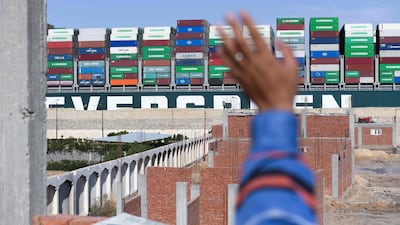
  • A spectator waves as the Ever Given container ship moves along the Suez Canal towards Ismailia after being freed from the canal bank in Suez, Egypt. Bloomberg
    A spectator waves as the Ever Given container ship moves along the Suez Canal towards Ismailia after being freed from the canal bank in Suez, Egypt. Bloomberg
  • A man waves at the Panama-flagged MV 'Ever Given' container ship as it is tugged in Egypt's Suez Canal after it was fully dislodged from the banks, near Suez city. AFP
    A man waves at the Panama-flagged MV 'Ever Given' container ship as it is tugged in Egypt's Suez Canal after it was fully dislodged from the banks, near Suez city. AFP
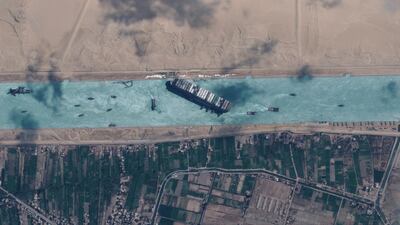
  • A view shows Ever Given container ship in Suez Canal in this Maxar Technologies satellite image. Satellite image ©2021 Maxar Technologies/Handout via Reuters
    A view shows Ever Given container ship in Suez Canal in this Maxar Technologies satellite image. Satellite image ©2021 Maxar Technologies/Handout via Reuters
  • A handout photograph made available by the Suez Canal Authority shows the Ever Given container ship after it was refloated in the Suez Canal, Egypt. EPA
    A handout photograph made available by the Suez Canal Authority shows the Ever Given container ship after it was refloated in the Suez Canal, Egypt. EPA
  • A handout photograph made available by the Suez Canal Authority shows the Ever Given container ship after it was refloated in the Suez Canal, Egypt. The head of the Suez Canal Authority announced on 29 March that the large container ship, which ran aground in the Suez Canal on 23 March, is now free floating after responding to the pulling maneuvers. EPA
    A handout photograph made available by the Suez Canal Authority shows the Ever Given container ship after it was refloated in the Suez Canal, Egypt. The head of the Suez Canal Authority announced on 29 March that the large container ship, which ran aground in the Suez Canal on 23 March, is now free floating after responding to the pulling maneuvers. EPA
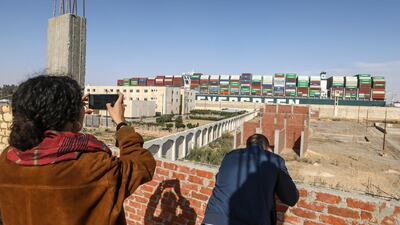
  • People watch Ever Given, a Panama-flagged cargo ship, that has been stuck sideways and blocked traffic in Egypt's Suez Canal, move past after it was set free by salvage teams. AP Photo
    People watch Ever Given, a Panama-flagged cargo ship, that has been stuck sideways and blocked traffic in Egypt's Suez Canal, move past after it was set free by salvage teams. AP Photo
  • People watch as the container ship 'Ever Given' is refloated, unblocking the Suez Canal in Suez, Egypt. This morning the container ship came partly unstuck from the shoreline, where it ran aground in the canal last Tuesday, and later resumed its course shortly after 3pm local time. Getty Images
    People watch as the container ship 'Ever Given' is refloated, unblocking the Suez Canal in Suez, Egypt. This morning the container ship came partly unstuck from the shoreline, where it ran aground in the canal last Tuesday, and later resumed its course shortly after 3pm local time. Getty Images
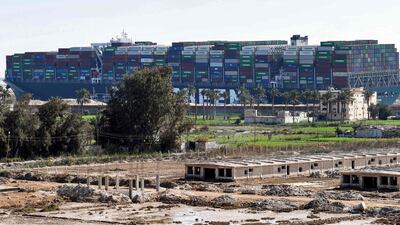
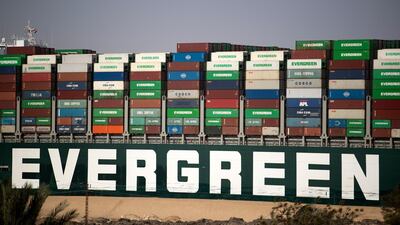
  • A view of the Panama-flagged MV 'Ever Given' (operated by Taiwan-based Evergreen Marine) container ship, a 400-metre- (1,300-foot-)long and 59-metre wide vessel, as it remains lodged sideways impeding traffic across Egypt's Suez Canal waterway. AFP
    A view of the Panama-flagged MV 'Ever Given' (operated by Taiwan-based Evergreen Marine) container ship, a 400-metre- (1,300-foot-)long and 59-metre wide vessel, as it remains lodged sideways impeding traffic across Egypt's Suez Canal waterway. AFP
  • Ship Ever Given, one of the world's largest container ships, is seen after it was fully floated in Suez Canal, Egypt. Suez Canal Authority/Handout via Reuters
    Ship Ever Given, one of the world's largest container ships, is seen after it was fully floated in Suez Canal, Egypt. Suez Canal Authority/Handout via Reuters
  • The container ship 'Ever Given' is refloated, unblocking the Suez Canal in Suez, Egypt. This morning the container ship came partly unstuck from the shoreline, where it ran aground in the canal last Tuesday, and later resumed its course shortly after 3pm local time. Getty Images
    The container ship 'Ever Given' is refloated, unblocking the Suez Canal in Suez, Egypt. This morning the container ship came partly unstuck from the shoreline, where it ran aground in the canal last Tuesday, and later resumed its course shortly after 3pm local time. Getty Images
  • The container ship 'Ever Given' is moving in the Suez Canal, Egypt. The Suez Canal Authority on 29 March said that traffic is to resume after the large container ship 'Ever Given' was refloated. EPA
    The container ship 'Ever Given' is moving in the Suez Canal, Egypt. The Suez Canal Authority on 29 March said that traffic is to resume after the large container ship 'Ever Given' was refloated. EPA
How%20to%20avoid%20getting%20scammed
%3Cul%3E%0A%3Cli%3ENever%20click%20on%20links%20provided%20via%20app%20or%20SMS%2C%20even%20if%20they%20seem%20to%20come%20from%20authorised%20senders%20at%20first%20glance%3C%2Fli%3E%0A%3Cli%3EAlways%20double-check%20the%20authenticity%20of%20websites%3C%2Fli%3E%0A%3Cli%3EEnable%20Two-Factor%20Authentication%20(2FA)%20for%20all%20your%20working%20and%20personal%20services%3C%2Fli%3E%0A%3Cli%3EOnly%20use%20official%20links%20published%20by%20the%20respective%20entity%3C%2Fli%3E%0A%3Cli%3EDouble-check%20the%20web%20addresses%20to%20reduce%20exposure%20to%20fake%20sites%20created%20with%20domain%20names%20containing%20spelling%20errors%3C%2Fli%3E%0A%3C%2Ful%3E%0A
Mobile phone packages comparison
%20Ramez%20Gab%20Min%20El%20Akher
%3Cp%3E%3Cstrong%3ECreator%3A%3C%2Fstrong%3E%20Ramez%20Galal%3C%2Fp%3E%0A%3Cp%3E%3Cstrong%3EStarring%3A%3C%2Fstrong%3E%20Ramez%20Galal%3C%2Fp%3E%0A%3Cp%3E%3Cstrong%3EStreaming%20on%3A%20%3C%2Fstrong%3EMBC%20Shahid%3C%2Fp%3E%0A%3Cp%3E%3Cstrong%3ERating%3A%20%3C%2Fstrong%3E2.5%2F5%3C%2Fp%3E%0A
Why the Tourist Club?

Originally, The Club (which many people chose to call the “British Club”) was the only place where one could use the beach with changing rooms and a shower, and get refreshments.

In the early 1970s, the Government of Abu Dhabi wanted to give more people a place to get together on the beach, with some facilities for children. The place chosen was where the annual boat race was held, which Sheikh Zayed always attended and which brought crowds of locals and expatriates to the stretch of beach to the left of Le Méridien and the Marina.

It started with a round two-storey building, erected in about two weeks by Orient Contracting for Sheikh Zayed to use at one these races. Soon many facilities were planned and built, and members were invited to join.

Why it was called “Nadi Al Siyahi” is beyond me. But it is likely that one wanted to convey the idea that this was open to all comers. Because there was no danger of encountering alcohol on the premises, unlike at The Club, it was a place in particular for the many Arab expatriate civil servants to join. Initially the fees were very low and membership was offered free to many people, too.

Eventually there was a skating rink, bowling and many other amusements.

Frauke Heard-Bey is a historian and has lived in Abu Dhabi since 1968.

Mercer, the investment consulting arm of US services company Marsh & McLennan, expects its wealth division to at least double its assets under management (AUM) in the Middle East as wealth in the region continues to grow despite economic headwinds, a company official said.

Mercer Wealth, which globally has $160 billion in AUM, plans to boost its AUM in the region to $2-$3bn in the next 2-3 years from the present $1bn, said Yasir AbuShaban, a Dubai-based principal with Mercer Wealth.

Within the next two to three years, we are looking at reaching $2 to $3 billion as a conservative estimate and we do see an opportunity to do so,” said Mr AbuShaban.

Mercer does not directly make investments, but allocates clients’ money they have discretion to, to professional asset managers. They also provide advice to clients.

“We have buying power. We can negotiate on their (client’s) behalf with asset managers to provide them lower fees than they otherwise would have to get on their own,” he added.

Mercer Wealth’s clients include sovereign wealth funds, family offices, and insurance companies among others.

From its office in Dubai, Mercer also looks after Africa, India and Turkey, where they also see opportunity for growth.

Wealth creation in Middle East and Africa (MEA) grew 8.5 per cent to $8.1 trillion last year from $7.5tn in 2015, higher than last year’s global average of 6 per cent and the second-highest growth in a region after Asia-Pacific which grew 9.9 per cent, according to consultancy Boston Consulting Group (BCG). In the region, where wealth grew just 1.9 per cent in 2015 compared with 2014, a pickup in oil prices has helped in wealth generation.

BCG is forecasting MEA wealth will rise to $12tn by 2021, growing at an annual average of 8 per cent.

Drivers of wealth generation in the region will be split evenly between new wealth creation and growth of performance of existing assets, according to BCG.

Another general trend in the region is clients’ looking for a comprehensive approach to investing, according to Mr AbuShaban.

“Institutional investors or some of the families are seeing a slowdown in the available capital they have to invest and in that sense they are looking at optimizing the way they manage their portfolios and making sure they are not investing haphazardly and different parts of their investment are working together,” said Mr AbuShaban.

Some clients also have a higher appetite for risk, given the low interest-rate environment that does not provide enough yield for some institutional investors. These clients are keen to invest in illiquid assets, such as private equity and infrastructure.

“What we have seen is a desire for higher returns in what has been a low-return environment specifically in various fixed income or bonds,” he said.

“In this environment, we have seen a de facto increase in the risk that clients are taking in things like illiquid investments, private equity investments, infrastructure and private debt, those kind of investments were higher illiquidity results in incrementally higher returns.”

The Abu Dhabi Investment Authority, one of the largest sovereign wealth funds, said in its 2016 report that has gradually increased its exposure in direct private equity and private credit transactions, mainly in Asian markets and especially in China and India. The authority’s private equity department focused on structured equities owing to “their defensive characteristics.”

COMPANY PROFILE
Name: ARDH Collective
Based: Dubai
Founders: Alhaan Ahmed, Alyina Ahmed and Maximo Tettamanzi
Sector: Sustainability
Total funding: Self funded
Number of employees: 4