Beyond the Headlines: the Middle East's Captagon crisis


  • English
  • Arabic

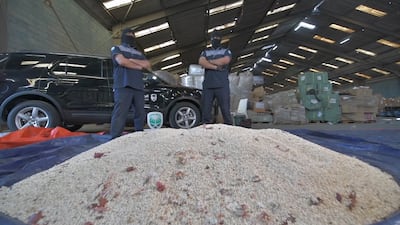
In April 2021, customs officers in the Saudi city of Jeddah searched a shipment of Lebanese pomegranates.

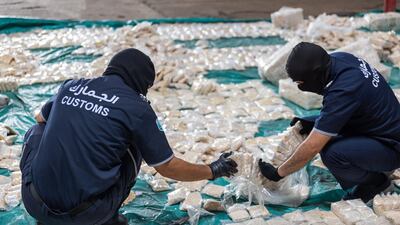
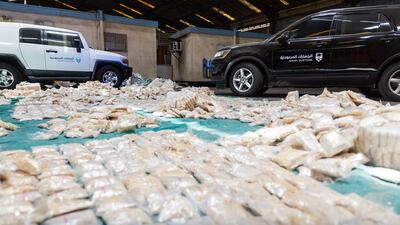
Hidden inside the fruit were more than five million round, beige Captagon pills — illegal amphetamines.

It was the latest in a long line of interceptions in recent years in which law enforcement officers in the kingdom have stopped millions of pills and tonnes of drugs from being smuggled in.

But for Saudi Arabia, it was the final straw.

The kingdom announced a ban on imported fruits and vegetables from Lebanon, dealing a devastating blow to farmers already suffering due to the country’s economic collapse and sending a shock wave through the region.

Over the past decade, Captagon has spread across the Middle East and has become one of the most highly consumed narcotics.

It gained infamy and near-mythical status in the early years of the Syrian war as the drug of choice for militants belonging to groups such as ISIS.

Fighters popped the pills on the battlefield, with the drugs seemingly giving them superhuman strength as they fuelled them to fight for days without sleep or food. ISIS took over large areas of Syria and Iraq in 2013 and 2014 and ruled an area the size of the UK.

Far from the battlefields, Captagon also found favour.

Today, experts and officials say Captagon has become the most popular recreational drug in the Arabian peninsula.

In this week's Beyond the Headlines, we delve into a major investigation by The National into the Middle East’s Captagon crisis.

Our reporters in six countries spent months tracing the drug from Syrian producers to Lebanese smugglers to Saudi and UAE customs official, unravelling a game of cat and mouse that is harming thousands across the region as it enriches warlords and gunmen.

We unearthed some of the more creative ways traffickers smuggle drugs in the region, from hidden compartments to Bedouin herders, even as the Covid pandemic closed borders

We’ll go inside Saudi Arabia’s crackdown on Captagon smuggling and find out how customs officials in Dubai have been able to intercept drug shipments using state-of-the-art technology.

And we’ll speak to experts trying to make sense of the scale of the Captagon trade in the Middle East, where data is hard to come by and even talking about addiction is often taboo.

Hosted by James Haines-Young

Produced by Arthur Scott-Geddes, Arthur Eddyson and Ayesha Khan


UAE currency: the story behind the money in your pockets
Why are asylum seekers being housed in hotels?

The number of asylum applications in the UK has reached a new record high, driven by those illegally entering the country in small boats crossing the English Channel.

A total of 111,084 people applied for asylum in the UK in the year to June 2025, the highest number for any 12-month period since current records began in 2001.

Asylum seekers and their families can be housed in temporary accommodation while their claim is assessed.

The Home Office provides the accommodation, meaning asylum seekers cannot choose where they live.

When there is not enough housing, the Home Office can move people to hotels or large sites like former military bases.

THE BIO

Born: Mukalla, Yemen, 1979

Education: UAE University, Al Ain

Family: Married with two daughters: Asayel, 7, and Sara, 6

Favourite piece of music: Horse Dance by Naseer Shamma

Favourite book: Science and geology

Favourite place to travel to: Washington DC

Best advice you’ve ever been given: If you have a dream, you have to believe it, then you will see it.

Mercer, the investment consulting arm of US services company Marsh & McLennan, expects its wealth division to at least double its assets under management (AUM) in the Middle East as wealth in the region continues to grow despite economic headwinds, a company official said.

Mercer Wealth, which globally has $160 billion in AUM, plans to boost its AUM in the region to $2-$3bn in the next 2-3 years from the present $1bn, said Yasir AbuShaban, a Dubai-based principal with Mercer Wealth.

Within the next two to three years, we are looking at reaching $2 to $3 billion as a conservative estimate and we do see an opportunity to do so,” said Mr AbuShaban.

Mercer does not directly make investments, but allocates clients’ money they have discretion to, to professional asset managers. They also provide advice to clients.

“We have buying power. We can negotiate on their (client’s) behalf with asset managers to provide them lower fees than they otherwise would have to get on their own,” he added.

Mercer Wealth’s clients include sovereign wealth funds, family offices, and insurance companies among others.

From its office in Dubai, Mercer also looks after Africa, India and Turkey, where they also see opportunity for growth.

Wealth creation in Middle East and Africa (MEA) grew 8.5 per cent to $8.1 trillion last year from $7.5tn in 2015, higher than last year’s global average of 6 per cent and the second-highest growth in a region after Asia-Pacific which grew 9.9 per cent, according to consultancy Boston Consulting Group (BCG). In the region, where wealth grew just 1.9 per cent in 2015 compared with 2014, a pickup in oil prices has helped in wealth generation.

BCG is forecasting MEA wealth will rise to $12tn by 2021, growing at an annual average of 8 per cent.

Drivers of wealth generation in the region will be split evenly between new wealth creation and growth of performance of existing assets, according to BCG.

Another general trend in the region is clients’ looking for a comprehensive approach to investing, according to Mr AbuShaban.

“Institutional investors or some of the families are seeing a slowdown in the available capital they have to invest and in that sense they are looking at optimizing the way they manage their portfolios and making sure they are not investing haphazardly and different parts of their investment are working together,” said Mr AbuShaban.

Some clients also have a higher appetite for risk, given the low interest-rate environment that does not provide enough yield for some institutional investors. These clients are keen to invest in illiquid assets, such as private equity and infrastructure.

“What we have seen is a desire for higher returns in what has been a low-return environment specifically in various fixed income or bonds,” he said.

“In this environment, we have seen a de facto increase in the risk that clients are taking in things like illiquid investments, private equity investments, infrastructure and private debt, those kind of investments were higher illiquidity results in incrementally higher returns.”

The Abu Dhabi Investment Authority, one of the largest sovereign wealth funds, said in its 2016 report that has gradually increased its exposure in direct private equity and private credit transactions, mainly in Asian markets and especially in China and India. The authority’s private equity department focused on structured equities owing to “their defensive characteristics.”

Updated: August 30, 2021, 7:26 AM
More podcasts