Beyond the Headlines: tear gas, fireworks and politics in Lebanon's revolution


  • English
  • Arabic

After more than three months of protests, Lebanon's politicians agreed on a new government. But this has done little to ease anger on the streets.

Hassan Diab announced the formation of his 20-member government on Tuesday and vowed to get to work on fixing the country's mounting problems.

Lebanon faces a huge economic crisis – debt has topped $85 billion, growth is flat, unemployment is rising and the currency has lost nearly 40 per cent of its value in the past three months.

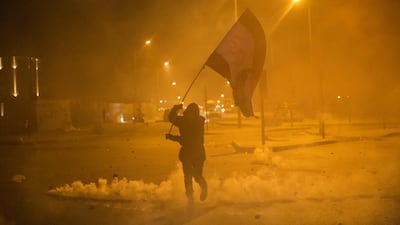
  • An anti-government protester holds a Lebanese flag during clashes with riot police in Beirut, Lebanon. Getty Images
    An anti-government protester holds a Lebanese flag during clashes with riot police in Beirut, Lebanon. Getty Images
  • Anti government protesters and riot police clash during a second day of violence. Getty Images
    Anti government protesters and riot police clash during a second day of violence. Getty Images
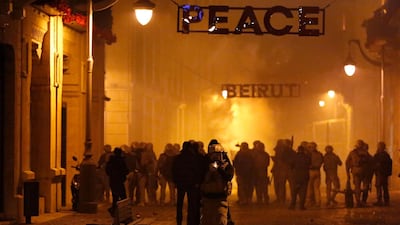
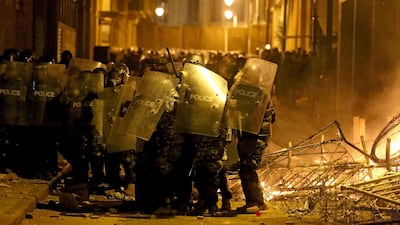
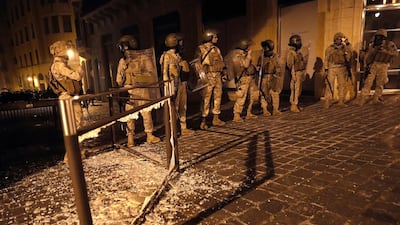
  • Special forces police advance as they push back the anti-government protesters in downtown Beirut. AP Photo
    Special forces police advance as they push back the anti-government protesters in downtown Beirut. AP Photo
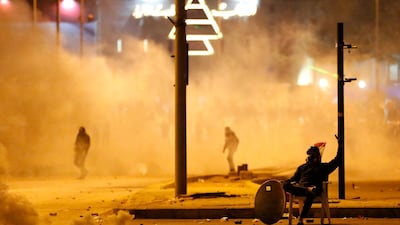
  • An anti-government protester covered by the smoke of the tear gas, sits in the middle of a street. AP Photo
    An anti-government protester covered by the smoke of the tear gas, sits in the middle of a street. AP Photo
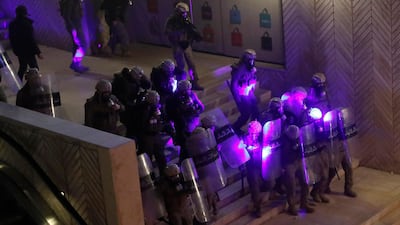
  • Special forces police are illuminated by laser pointers from anti-government protesters. AP Photo
    Special forces police are illuminated by laser pointers from anti-government protesters. AP Photo
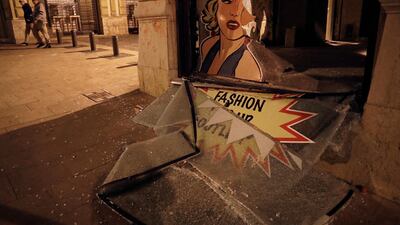
  • A window shop smashed by anti-government protesters is seen during a protest against the new government, in downtown Beirut. AP Photo
    A window shop smashed by anti-government protesters is seen during a protest against the new government, in downtown Beirut. AP Photo
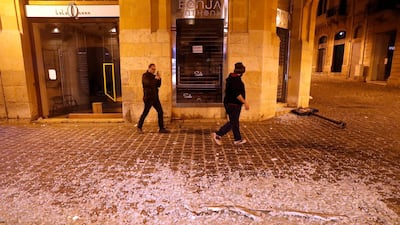
  • Men pass in front of a coffee shop that was smashed by anti-government protesters. AP Photo
    Men pass in front of a coffee shop that was smashed by anti-government protesters. AP Photo
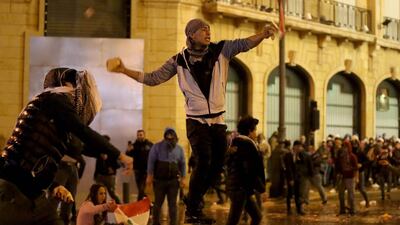
  • A Lebanese anti-government protester hurls stones at riot police. AFP
    A Lebanese anti-government protester hurls stones at riot police. AFP
  • Riot police forces block a road leading to the parliament during clashes with anti-government protesters. AFP
    Riot police forces block a road leading to the parliament during clashes with anti-government protesters. AFP
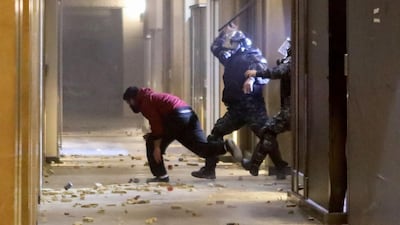
  • Riot police chase an anti-government protester. AFP
    Riot police chase an anti-government protester. AFP
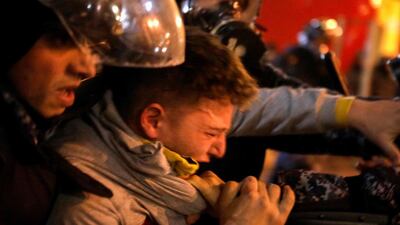
  • Riot police detain an anti-government protester. AFP
    Riot police detain an anti-government protester. AFP
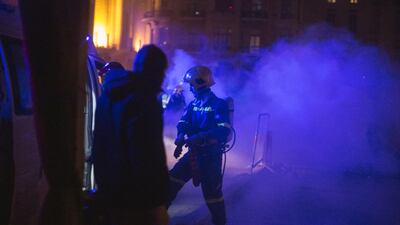
  • Teargas engulfs Red Cross medics as anti government protesters and riot police clash during a second day of violence. Getty Images
    Teargas engulfs Red Cross medics as anti government protesters and riot police clash during a second day of violence. Getty Images
  • Army soldiers deploy on a street where anti-government protesters clash with riot police. AP Photo
    Army soldiers deploy on a street where anti-government protesters clash with riot police. AP Photo
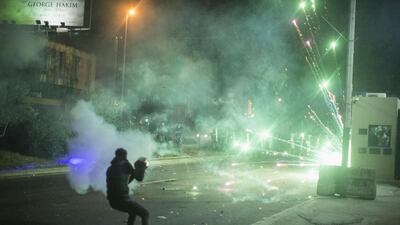
  • An anti government protester fires fireworks at riot police as they clash during a second day of violence. Getty Images
    An anti government protester fires fireworks at riot police as they clash during a second day of violence. Getty Images
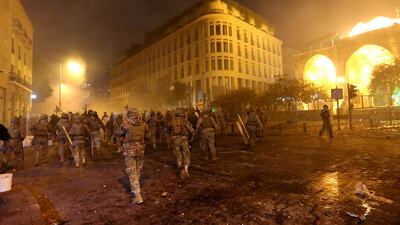
  • Smoke rises as Lebanese army soldiers walk during a protest against the newly formed government in Beirut. Reuters
    Smoke rises as Lebanese army soldiers walk during a protest against the newly formed government in Beirut. Reuters

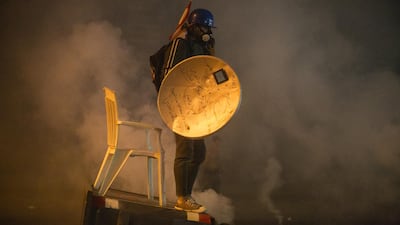
But his administration hasn't been welcomed on the streets of Beirut, where protesters are clashing most evenings with police.

One side is throwing rocks, debris and fireworks, the other is firing tear gas, rubber bullets and water cannon.

Dozens have been wounded on both sides.

On this week's Beyond the Headlines, The National's Willy Lowry reported from the tear gas-filled streets of Beirut. He spoke to young people angry at what they've called Mr Diab's "one-colour" government.

We also spoke to Nasser Saidi, a former Lebanese economy minister and former vice governor of the central bank of Lebanon. He laid out plainly the scale of the crisis and his recommendations of what the new government should do.

If you've not listened to last week's episode, check it out here.

After the death of Sultan Qaboos, Beyond the Headlines looked at the legacy of the canny negotiator and much-loved leader of Oman.

How to get exposure to gold

Although you can buy gold easily on the Dubai markets, the problem with buying physical bars, coins or jewellery is that you then have storage, security and insurance issues.

A far easier option is to invest in a low-cost exchange traded fund (ETF) that invests in the precious metal instead, for example, ETFS Physical Gold (PHAU) and iShares Physical Gold (SGLN) both track physical gold. The VanEck Vectors Gold Miners ETF invests directly in mining companies.

Alternatively, BlackRock Gold & General seeks to achieve long-term capital growth primarily through an actively managed portfolio of gold mining, commodity and precious-metal related shares. Its largest portfolio holdings include gold miners Newcrest Mining, Barrick Gold Corp, Agnico Eagle Mines and the NewMont Goldcorp.

Brave investors could take on the added risk of buying individual gold mining stocks, many of which have performed wonderfully well lately.

London-listed Centamin is up more than 70 per cent in just three months, although in a sign of its volatility, it is down 5 per cent on two years ago. Trans-Siberian Gold, listed on London's alternative investment market (AIM) for small stocks, has seen its share price almost quadruple from 34p to 124p over the same period, but do not assume this kind of runaway growth can continue for long

However, buying individual equities like these is highly risky, as their share prices can crash just as quickly, which isn't what what you want from a supposedly safe haven.

Company%20profile%20
%3Cp%3E%3Cstrong%3EName%3A%20%3C%2Fstrong%3EElggo%3Cbr%3E%3Cstrong%3EStarted%3A%3C%2Fstrong%3E%20August%202022%3Cbr%3E%3Cstrong%3EFounders%3A%3C%2Fstrong%3E%20Luma%20Makari%20and%20Mirna%20Mneimneh%3Cbr%3E%3Cstrong%3EBased%3A%3C%2Fstrong%3E%20Dubai%2C%20UAE%3Cbr%3E%3Cstrong%3ESector%3A%3C%2Fstrong%3E%20Education%20technology%20%2F%20health%20technology%3Cbr%3E%3Cstrong%3ESize%3A%3C%2Fstrong%3E%20Four%20employees%3Cbr%3E%3Cstrong%3EInvestment%20stage%3A%3C%2Fstrong%3E%20Pre-seed%3C%2Fp%3E%0A
MATCH RESULT

Liverpool 4 Brighton and Hove Albion 0
Liverpool: 
Salah (26'), Lovren (40'), Solanke (53'), Robertson (85')    

Ten tax points to be aware of in 2026

1. Domestic VAT refund amendments: request your refund within five years

If a business does not apply for the refund on time, they lose their credit.

2. E-invoicing in the UAE

Businesses should continue preparing for the implementation of e-invoicing in the UAE, with 2026 a preparation and transition period ahead of phased mandatory adoption. 

3. More tax audits

Tax authorities are increasingly using data already available across multiple filings to identify audit risks. 

4. More beneficial VAT and excise tax penalty regime

Tax disputes are expected to become more frequent and more structured, with clearer administrative objection and appeal processes. The UAE has adopted a new penalty regime for VAT and excise disputes, which now mirrors the penalty regime for corporate tax.

5. Greater emphasis on statutory audit

There is a greater need for the accuracy of financial statements. The International Financial Reporting Standards standards need to be strictly adhered to and, as a result, the quality of the audits will need to increase.

6. Further transfer pricing enforcement

Transfer pricing enforcement, which refers to the practice of establishing prices for internal transactions between related entities, is expected to broaden in scope. The UAE will shortly open the possibility to negotiate advance pricing agreements, or essentially rulings for transfer pricing purposes. 

7. Limited time periods for audits

Recent amendments also introduce a default five-year limitation period for tax audits and assessments, subject to specific statutory exceptions. While the standard audit and assessment period is five years, this may be extended to up to 15 years in cases involving fraud or tax evasion. 

8. Pillar 2 implementation 

Many multinational groups will begin to feel the practical effect of the Domestic Minimum Top-Up Tax (DMTT), the UAE's implementation of the OECD’s global minimum tax under Pillar 2. While the rules apply for financial years starting on or after January 1, 2025, it is 2026 that marks the transition to an operational phase.

9. Reduced compliance obligations for imported goods and services

Businesses that apply the reverse-charge mechanism for VAT purposes in the UAE may benefit from reduced compliance obligations. 

10. Substance and CbC reporting focus

Tax authorities are expected to continue strengthening the enforcement of economic substance and Country-by-Country (CbC) reporting frameworks. In the UAE, these regimes are increasingly being used as risk-assessment tools, providing tax authorities with a comprehensive view of multinational groups’ global footprints and enabling them to assess whether profits are aligned with real economic activity. 

Contributed by Thomas Vanhee and Hend Rashwan, Aurifer

Classification of skills

A worker is categorised as skilled by the MOHRE based on nine levels given in the International Standard Classification of Occupations (ISCO) issued by the International Labour Organisation. 

A skilled worker would be someone at a professional level (levels 1 – 5) which includes managers, professionals, technicians and associate professionals, clerical support workers, and service and sales workers.

The worker must also have an attested educational certificate higher than secondary or an equivalent certification, and earn a monthly salary of at least Dh4,000. 

EA Sports FC 26

Publisher: EA Sports

Consoles: PC, PlayStation 4/5, Xbox Series X/S

Rating: 3/5

Match info

Uefa Nations League A Group 4

England 2 (Lingard 78', Kane 85')
Croatia 1 (Kramaric 57')

Man of the match: Harry Kane (England)

The burning issue

The internal combustion engine is facing a watershed moment – major manufacturer Volvo is to stop producing petroleum-powered vehicles by 2021 and countries in Europe, including the UK, have vowed to ban their sale before 2040. The National takes a look at the story of one of the most successful technologies of the last 100 years and how it has impacted life in the UAE.

Read part three: the age of the electric vehicle begins

Read part two: how climate change drove the race for an alternative 

Read part one: how cars came to the UAE

SPECS

Engine: Two-litre four-cylinder turbo
Power: 235hp
Torque: 350Nm
Transmission: Nine-speed automatic
Price: From Dh167,500 ($45,000)
On sale: Now

More podcasts