


For the past few months, Rishi Sunak and his inner circle of advisers have been homing in on the word “security”.
It has become their watchword for the general election campaign. As such, it covers a multitude of others, including “stability”, “safety”, “trust”, “responsible”, “defence”, and “law and order”.
These are the words that have come up time and time again in their private polling sessions with the critical swing voters – those who say they are undecided how they will vote.
Asked to describe the qualities of the Tory party in the focus groups, selecting cards on which is written a single word, these are the ones they pick.
That is why placards proclaiming “security”, “economic stability” and “immigration” are being flourished at Sunak rallies and will appear prominently in posters and advertisements.
Led by chief strategist Isaac Levido, the Tories are putting their faith in these themes to return Mr Sunak to Number 10. They play to the traditional divide between the two main parties.
The Conservatives are historically seen as better at managing the economy, trusted with other people’s money, behaving responsibly.
Labour, by contrast, is commonly regarded as standing for public spending, more caring and sharing, but economically not so sure.
It is a split that says, as well, the Tories are keener on the military and police, compared with Labour’s tendency towards pacifism and upholding the rights of the offender.
The Tories, too, are often portrayed as anti-immigrant.
It is no coincidence that if you cast your mind back over recent months, you will find these topics recurring. Mr Sunak and Mr Levido have been softening the nation up for a snap election.
Rishi Sunak through the years – in pictures
-
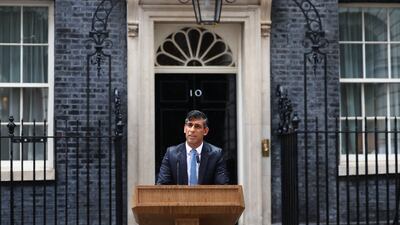
British Prime Minister Rishi Sunak announces July 4 as the date for the 2024 general election at No 10 Downing Street. Here, The National looks back at his political career. Getty Images -
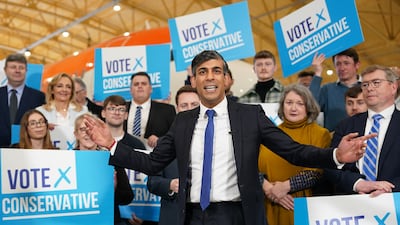
Mr Sunak during local election campaigning in Teesside in May 2024. Getty Images -
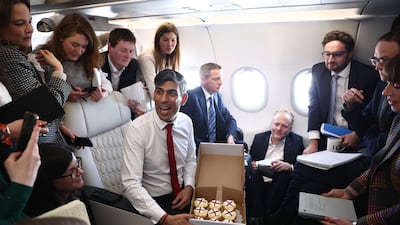
Mr Sunak presents cupcakes to journalists on board a plane on the way to Warsaw in April 2024. Getty Images -
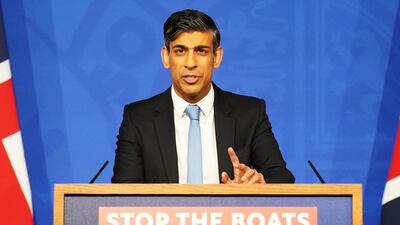
Mr Sunak during a press conference in Downing Street in January after the Safety of Rwanda Bill passed its third reading in the House of Commons. Getty Images -
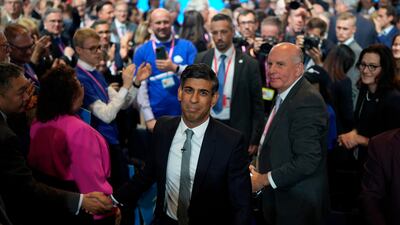
Being applauded after his speech at the Conservative Party conference in October 2023. Getty Images -
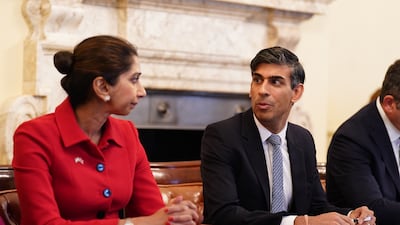
Looking pensive alongside then-home secretary Suella Braverman at No 10 in October 2023. She didn't last much longer in the cabinet. Getty Images -
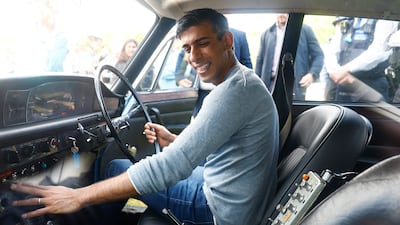
Mr Sunak sits in an old Special Branch police vehicle which was used to transport former prime minister Margaret Thatcher, in July 2023. Getty Images -

On board Border Agency cutter HMC Seeker during a visit to Dover in June 2023. Getty Images -
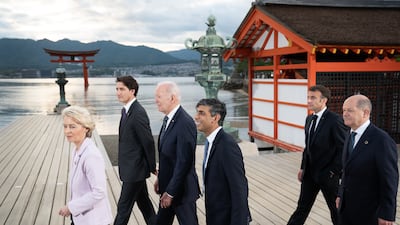
Mr Sunak alongside European Commission President Ursula von der Leyen, Canada's Prime Minister Justin Trudeau, US President Joe Biden, French President Emmanuel Macron and German Chancellor Olaf Scholz during the G7 Summit in May 2023. Getty Images -
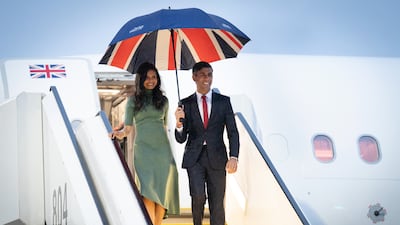
Mr Sunak and his wife Akshata Murty arriving in Japan ahead of the G7 Summit in May 2023. Getty Images -
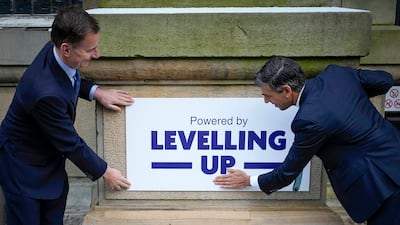
Mr Sunak and Chancellor Jeremy Hunt sending a message at Accrington Market Hall in January 2023. Getty Images -
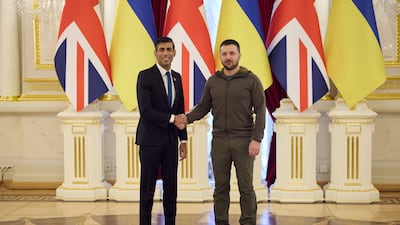
Mr Sunak and Ukrainian President Volodymyr Zelenskyy meet in Ukraine's capital Kyiv in November 2022. Getty Images -

King Charles III welcomes Mr Sunak during an audience at Buckingham Palace, where he invited the newly elected leader of the Conservative Party to become Prime Minister and form a new government in October 2022. Getty Images -
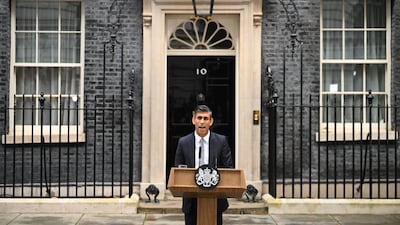
Mr Sunak makes a statement outside No 10 in October 2022 after taking office. Getty Images -
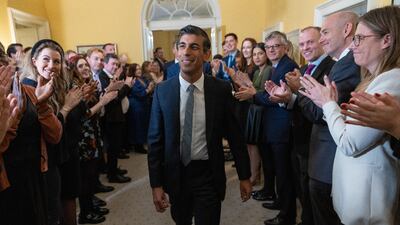
Mr Sunak arrives inside Number 10 in October 2022. Photo: Simon Walker/ No 10 Downing Street -
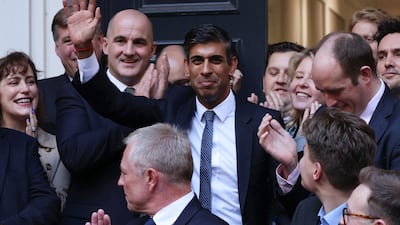
Greeted by colleagues at Conservative Party HQ after having been announced winner of the leadership contest in October 2022. Getty Images -
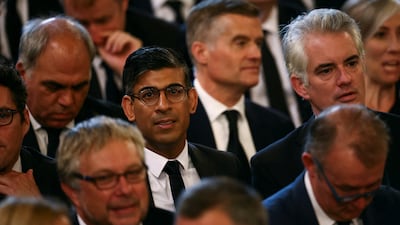
Mr Sunak at Westminster Hall in London following the death of Queen Elizabeth II in September 2022. PA -

Mr Sunak visits his family's old business, Bassett Pharmacy, on the campaign trail in August 2022. Getty Images -
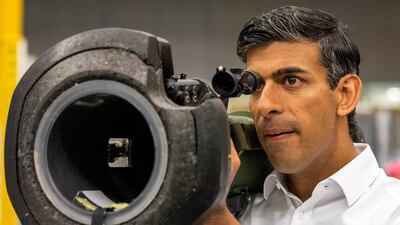
Mr Sunak looks at an NLAW anti-tank launcher during a visit to the Thales Defence System plant in Belfast in August 2022. Getty Images -
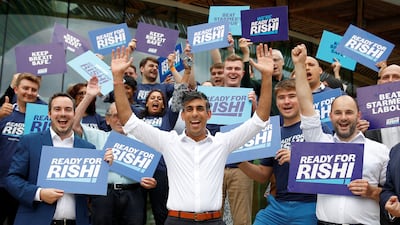
At a hustings event in Exeter in August 2022. Getty Images -
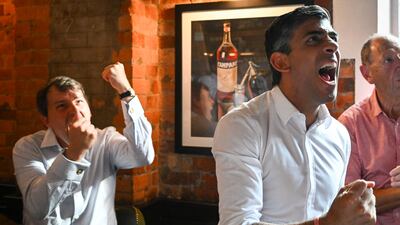
Celebrates England's first goal as he watches the Women's Euro 2022 final in Salisbury in July 2022. Getty Images -
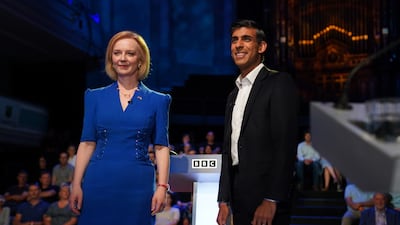
Mr Sunak and Ms Truss take part in the BBC Leadership debate at Victoria Hall, Hanley, in July 2022. Getty Images -
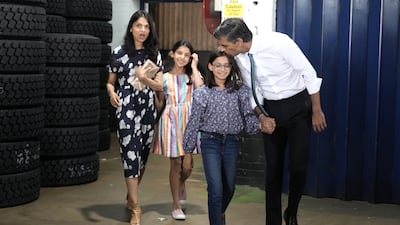
With daughters Krisna and Anoushka and wife Akshata Murthy in July 2022. Getty Images -
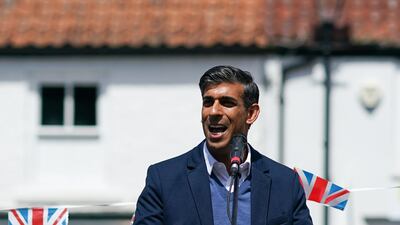
Opening the Great Ayton Village Fete during the queen’s Platinum Jubilee celebrations in June 2022. Getty Images -
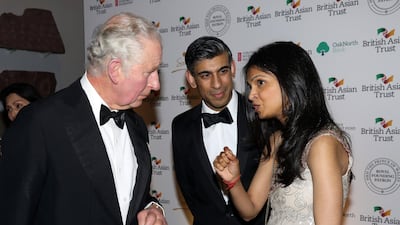
Mr Sunak and Ms Murthy speak to then-Prince Charles at a British Asian Trust event in February 2022. Getty Images -
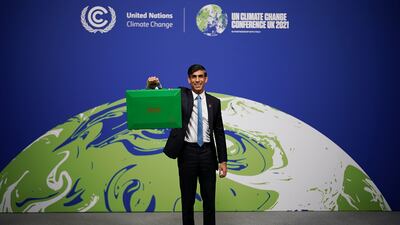
Mr Sunak arrives at COP26 in Glasgow in November 2021 when he was chancellor. Getty Images -
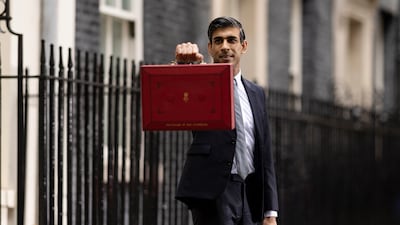
Holding the budget box as he departs 11 Downing Street to deliver his Autumn Budget in October 2021. Getty Images -
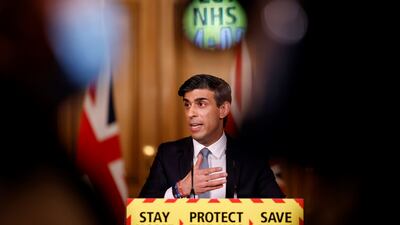
At a press conference on the 2021 Budget in London in March 2021. Getty Images -
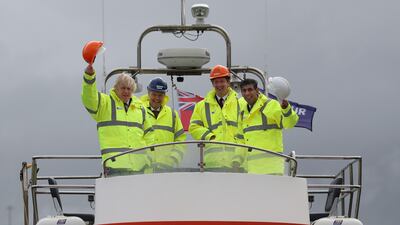
With former prime minister Boris Johnson during a visit to PD Ports on the River Tees in March 2021. Getty Images -
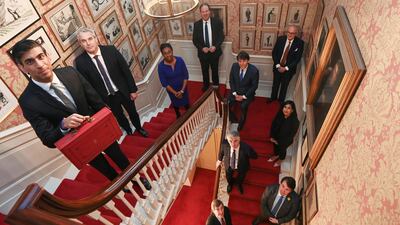
Mr Sunak poses with the budget box at 11 Downing Street in March 2021. Getty Images -
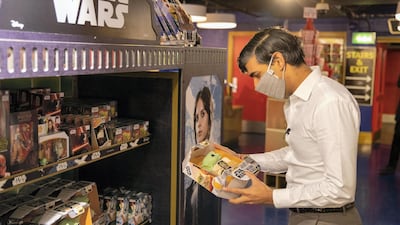
Meeting staff back at work after being furloughed at Hamleys toy shop in London, December 2020. Photo: HM Treasury -
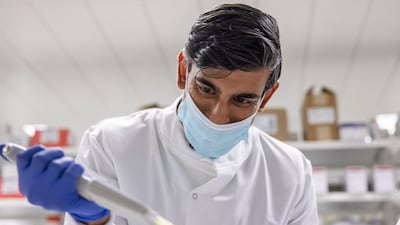
Mr Sunak visits the Imperial Clinic Research Facility at Hammersmith Hospital, London, in November 2020. Getty Images -
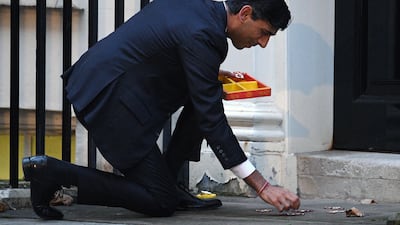
Lighting a candle for Diwali on Downing Street, November 2020. Getty Images -
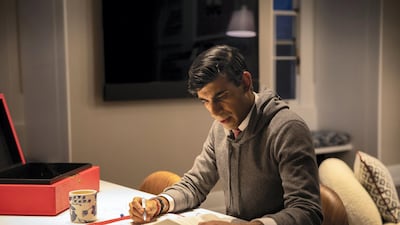
Working on a speech in his flat above 11 Downing Street in November 2020. Photo: HM Treasury -
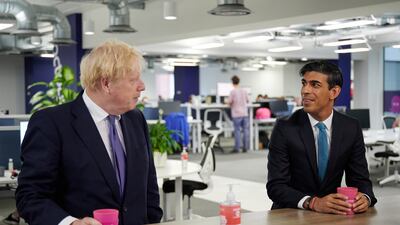
Mr Johnson and Mr Sunak visit the headquarters of Octopus Energy in London in October 2020. Getty Images -
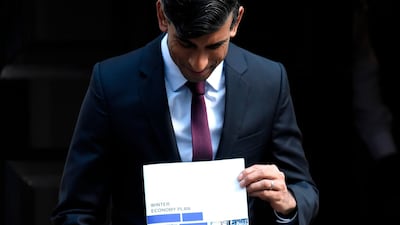
With his 'Winter Economy Plan' outside 11 Downing Street in September 2020. AFP -
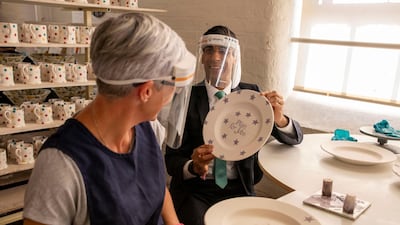
Decorating a plate at Emma Bridgewater pottery in Stoke pottery in September 2020. Getty Images -
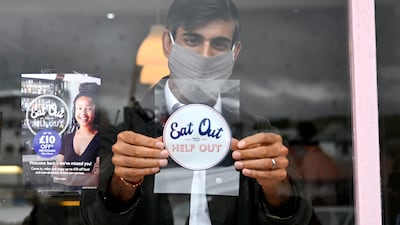
Promoting 'eat out to help out' on the Isle of Bute, Scotland, in August 2020. Getty Images -
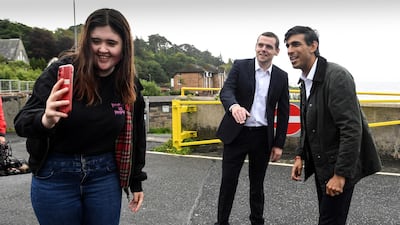
A member of the public takes a selfie with Rishi Sunak during a visit to Scotland in August 2020. AFP -

Visiting a Wagamama restaurant in central London in July 2020. Photo: HM Treasury -
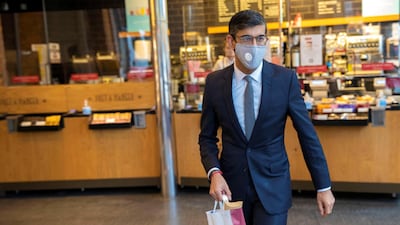
Rishi Sunak visits a Pret A Manger in Westminster in July 2020. HM Treasury -
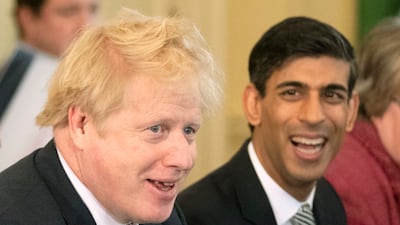
With Mr Johnson at his first Cabinet meeting after a reshuffle at 10 Downing Street in February 2020. Getty Images -
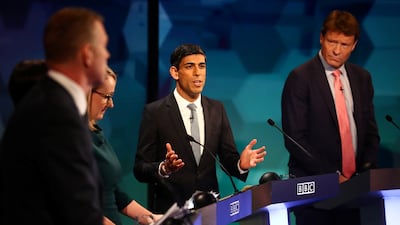
Mr Sunak speaks during a general election debate in Cardiff in November 2019. Getty Images


We have seen an out-of-the-blue boost for defence spending, while on immigration, we are told repeatedly it is not the fault of Mr Sunak that illegal immigrants have not been flown to Rwanda but leftie human rights lawyers and judges.
On the economy, Mr Sunak waited for one positive piece of news to drop – that inflation is down – before making his move.
He could have gone to the country later in the year but there was no way of telling what might happen between now and then. Here was something concrete he could latch on to.
With a fair wind, the Bank of England will be cutting interest rates when the vote occurs, emphasising that the economy is in capable, Tory hands.
Adding to that feel-good, they hope, will be England’s progress in the Euro 2024 football tournament.
Don’t underestimate this. England has a young, immensely talented, diverse team – one that if successful will paint the country in the same light.
It may seem trivial, but not for nothing is Mr Sunak already mentioning the football on the campaign trail.
They have based their campaign, too, on the belief that voting in a general election differs from local elections and by-elections.
In the main contest, voters are selecting the nation’s leader, the person who will be managing the money, the army, the one who takes us to war and who must keep the lights on.
It’s not a protest vote but an altogether more serious, grown-up affair.

This is where Mr Sunak and his advisers drew encouragement from the recent local elections.
Whereas everyone else focused on the scale of Tory losses, insiders say they determined that the Labour vote was “soft”, that those Tory defectors did not switch mainly to Labour. Many of them opted for alternative parties such as Reform.
In the national ballot, history suggests those lesser parties will fall by the wayside and voters will focus on what really matters, deciding between the Tories and Labour.
The local elections told Mr Levido and Co that the country was not enamoured with Labour; that the jury is firmly out where the party and its leader, Keir Starmer, is concerned.
If this was 1997, when Tony Blair swept to power, it would be game over for the Tories; there was no question back then who was going to win.
But it isn’t, and the Tories believe that despite a substantial lead in the opinion polls, Labour is far from home and dry, there is still all to play for, that they really can see a “narrow route to victory”.
It may seem perverse, Mr Sunak the incumbent, calling upon solid Tory values, among them faith in the status quo, when we’ve been subjected to years of Tory misrule and turmoil evidenced in the reigns of Boris Johnson and Liz Truss.
But his team see it as Mr Sunak saying he is different, he is not the same as his immediate predecessors.
We can expect to hear plenty of references to Mr Sunak not being like them. Weirdly, this will see both main parties stressing “change”. Indeed, that word is the prime Labour slogan.
Mr Sunak has no choice; he cannot profess to being the same as Mr Johnson and Ms Truss. By investing in him, we’re told, you’re plumping for someone much more serious and reliable.
There is, though, a difficulty here. Mr Starmer is widely regarded as dull and predictable – a cautious plodder, as opposed to a reckless Johnsonian charger.
On the very core of Mr Sunak’s messaging, Mr Starmer scores more highly – he is seen as a safer pair of hands than the Prime Minister.
“The choice at the next election is: who do you trust to keep you safe?” Mr Sunak asked in a keynote speech to the right-wing think tank Policy Exchange, in the week before the election was called.
To his chagrin, plenty of people right now would say “Starmer”.
That’s why, strangely, Mr Sunak, the current occupier of Number 10, is presenting himself as the underdog candidate. The British always like an underdog.
While Mr Starmer is going down the safety-first route – as well as “change” he is stressing “an end to chaos” – the Sunak ruse and hope is to draw him out, to show that his polices are not properly costed, that yet again, Labour cannot be trusted.
In Scotland, too, there is a strange, blink-and-you-missed-it aspect to the messaging from the First Minister, John Swinney.
He is new to the top job, coming in on the end of a similarly turbulent period – first with the dethronement of Nicola Sturgeon, then the sudden resignation of Humza Yousaf.
Like the Tories, the SNP have been in charge for more than a decade; like the Tories, the new SNP chief is presenting himself as the trusted, safety-first choice.
Keir Starmer through the years - in pictures
-
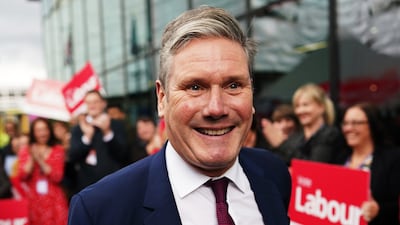
Keir Starmer has been the Labour party's leader since 2020, and is now the UK's prime minister. Here The National looks back through his political career. Getty Images -
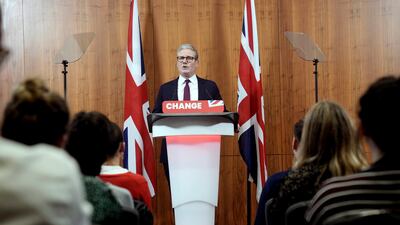
Mr Starmer speaking in Westminster, London, in May after Rishi Sunak announced the general election for July 4. AP -
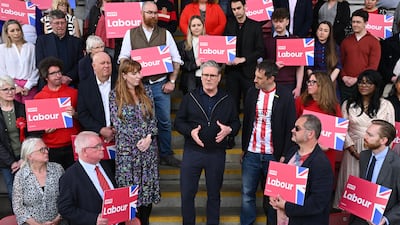
Mr Starmer speaks to Labour supporters at Harlow Town Football Club's stadium in Essex, on the eve of local elections in May. Getty Images -
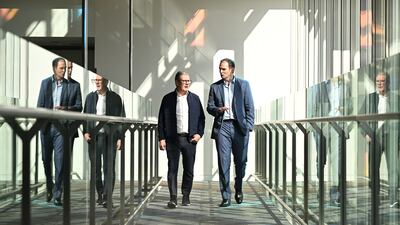
Mr Starmer talks to Dan Poulter at the Francis Crick Institute in London in April, after the MP had defected from the Conservative Party to Labour. Getty Images -

Mayor of London Sadiq Khan and Mr Starmer during the launch of Mr Khan's mayoral re-election campaign in March, which proved successful. Getty Images -
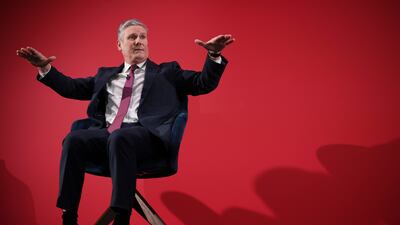
Mr Starmer addresses the Labour Business Conference in London in February. Getty Images -
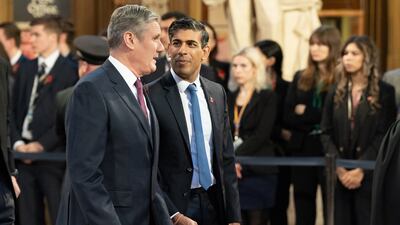
Mr Starmer and Mr Sunak at the Palace of Westminster for the State Opening of Parliament in November 2023. Getty Images -
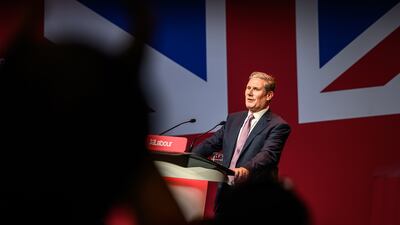
Mr Starmer addresses delegates at the National Annual Women's Conference in Liverpool in October 2023. Getty Images -
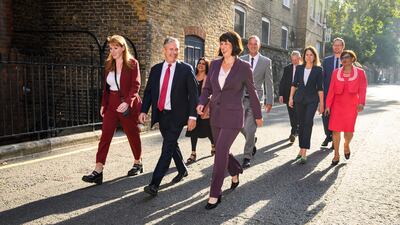
Mr Starmer with his shadow cabinet in London in September 2023. Getty Images -
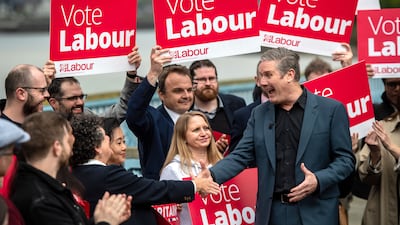
Mr Starmer speaks to supporters in Chatham after a Labour win in local elections in May 2023. Getty Images -
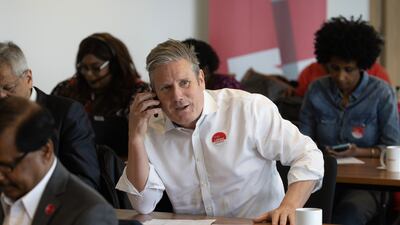
Joining party activists at a national phone bank on local elections day in London in May 2023. Getty Images -
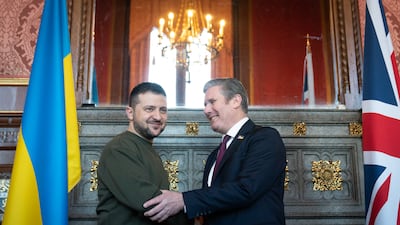
Mr Starmer meets Ukrainian President Volodymyr Zelenskyy at Speaker's House in the Palace of Westminster, London, in February 2023. Getty Images -
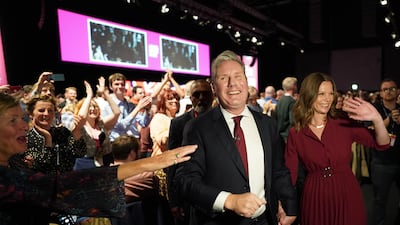
The Labour leader and his wife Victoria leave the stage after his speech at the party conference in Liverpool in September 2022. Getty Images -
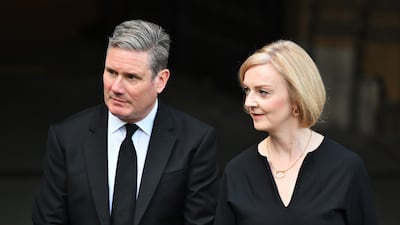
Mr Starmer and then-UK prime minister Liz Truss leave the Palace of Westminster in September 2022. Getty Images -
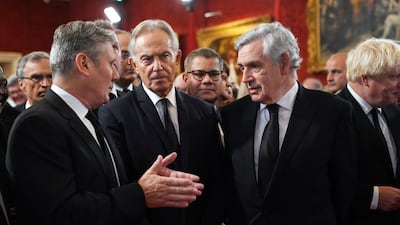
With former Labour prime ministers Tony Blair, centre, and Gordon Brown, right, at St James's Palace, London, where King Charles III was formally proclaimed monarch in September 2022. Getty Images -
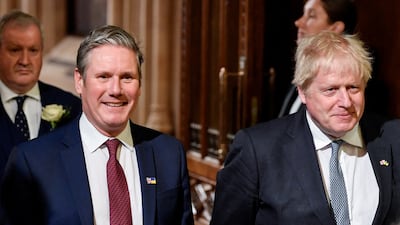
Mr Starmer and then-prime minister Boris Johnson attend the State Opening of Parliament in May 2022. Getty Images -
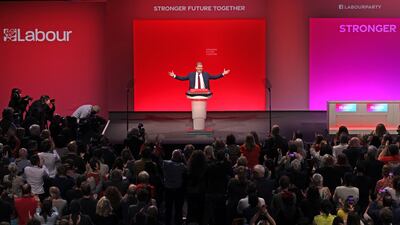
Mr Starmer makes his keynote speech to the Labour conference for the first time as party leader in September 2021 in Brighton. Getty Images -
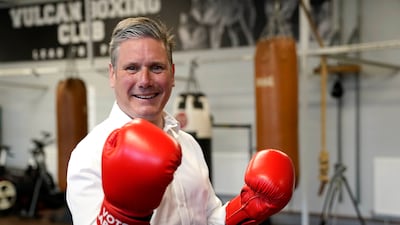
The gloves are on during a visit to the Vulcan Boxing Club in Hull, East Yorkshire, in April 2021. Getty Images -
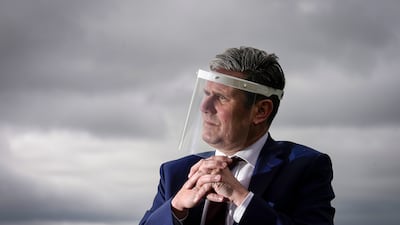
Mr Starmer in talks with care home workers and family members of residents at Cafe 1899 in Gedling Country Park during the Covid-19 pandemic in July 2020. Getty Images -
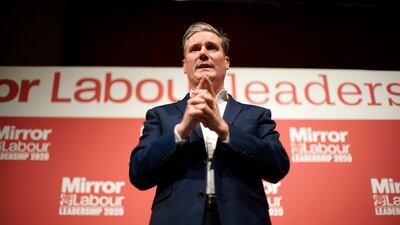
Mr Starmer, then-shadow secretary of state for exiting the EU, addresses the audience at a hustings in March 2020 in Dudley. Getty Images -
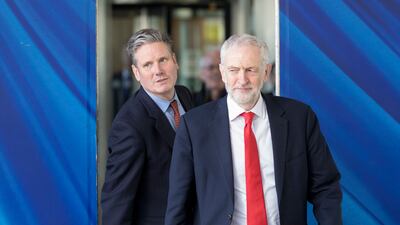
Mr Starmer and then-Labour leader Jeremy Corbyn talk to the media at the EU Commission headquarters in March 2019 in Brussels. Getty Images -
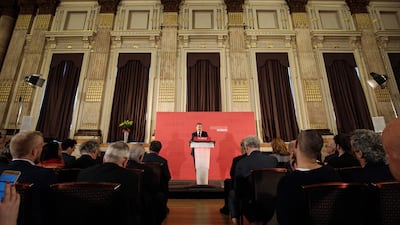
Mr Starmer delivers a speech on Labour's Brexit policy at the Institute of Civil Engineers in London in April 2017. Getty Images -

Holding a press conference as Director of Public Prosecutions to outline new guidelines on assisted suicide, in London in September 2009. Getty Images -
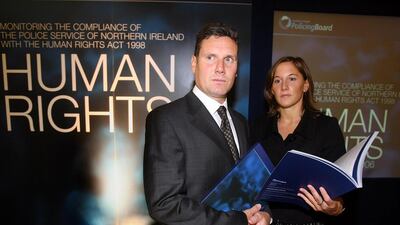
Human rights advisers Mr Starmer and Jane Gordon with the Northern Ireland Policing Board annual human rights report 2006, at the Dunadry Hotel in Co Antrim. Getty Images


Like Mr Starmer, he is pointing up “Tory chaos” – in his case, while conveniently forgetting the recent SNP chaos.
Again, he is the known selection – he was cabinet secretary for finance, effectively Scotland’s chancellor, under Alex Salmond and when she succeeded him, Ms Sturgeon.
Mr Sunak was chancellor, Mr Swinney was chancellor. They know the financial ropes; they have been there and they have done it.
Mr Starmer, by contrast, was all the while on the outside, protesting and complaining, not doing anything.
Best to stick with the tested and known or go with the untested and unknown? This is what we will be asked constantly over the coming weeks.

