


The television in my Turkish hotel room cannot get enough of it.
The first ship has left Odesa under the deal with Russia to allow Ukraine to export grain. At last, the world, desperate for Ukraine’s staple product, has a lifeline. And it’s all down to President Recep Tayyip Erdogan of Turkey.
Under Erdogan, Turkey has emerged as an international player, a broker between Russia and Ukraine, East and West.
The Turkish media are loving it. Forget their country’s economic woes, which are considerable. This is the long-promised emergence of Turkey as a global power. Erdogan and his supporters, with an election in the offing, are milking it.
Who, though, can blame them. Credit to Turkey for stepping up, for working on an agreement that has taken two months of concerted effort and even now, remains precarious.
Such is the distrust between the sides that at the conclusion of the talks there were no handshakes. One crucial clause, insisted upon by the Russians, is that the ships are boarded and inspected by Turkish officials to check for weapons.
It’s a start, however, and one that is desperately needed. For the truth is that despite the claims, the bombast, sanctions against Russia have not worked, are not working, and worse than that, they are strengthening President Vladimir Putin’s grip and harming those nations imposing them.
Putin remains very much in charge, more so, leading to attempts to highlight possible questions surrounding the Russian leader’s health, none of them proven.
Any thought that the barring of the oligarchs closest to Putin would lead to some sort of internal Kremlin court revolt against him can be discounted.

Putin has driven on, regardless. As for the embargoed billionaires, apart from the confiscation of a superyacht here and there, they too, seem relatively unaffected.
Western companies exited Russia, in compliance with the new rules. In many cases, their operations in Russia have been taken over by locals and without a hitch.
Branches of McDonald’s are rebranded Vkusno & tochka (“Tasty and that’s it”). And that is it: McDonald’s has departed, it’s been replaced, move on.
It would be foolish to suggest sanctions are not having an effect. Of course they are. But if the object of sanctions was to drive Putin from office, that simply has not happened and shows no sign of happening. More likely is growing dismay at the mounting cost of the war in terms of casualties and finance, but again, there is no mass uprising.
-
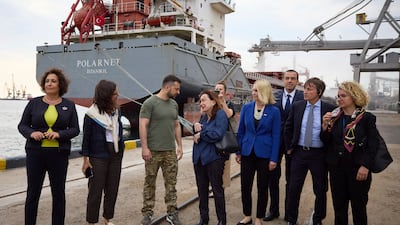
Ukrainian President Volodymyr Zelenskyy, centre, surrounded by ambassadors of different countries and UN officials, visits a port as grain is loaded on to a Turkish ship, close to Odesa. AP -
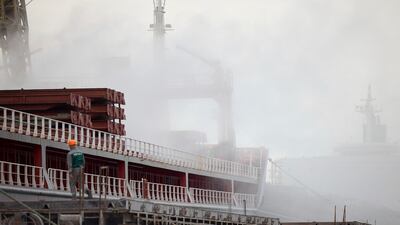
A Turkish Polarnet cargo ship is loaded with Ukrainian grain. AP -
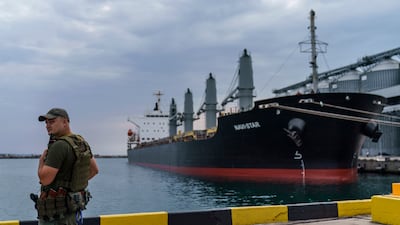
A security officer stands next to the ship 'Navi-Star' which sits full of grain as it waits to sail from Odesa. AP -
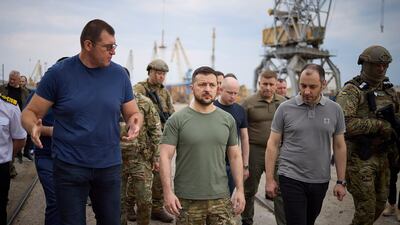
Mr Zelenskyy, centre, at the port. AP -

The first shipment of Ukrainian grain left the port of Odesa, bound for Tripoli in Lebanon, Infrastructure Minister Oleksandr Kubrakov said. AP -
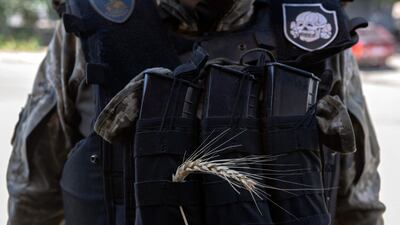
An ear of wheat adorns the vest of a Ukrainian soldier. AP -
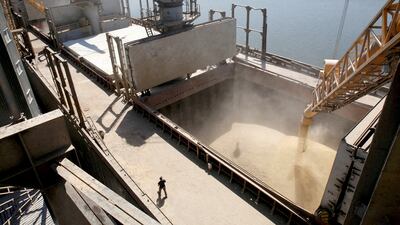
A dockyard worker watches as barley is mechanically poured into a 40,000-tonne ship at a Ukrainian agricultural exporter's terminal in the city of Nikolaev. Reuters -

A farmer harvests his field 10 kilometres from the front line, where fierce battle continues between Ukrainian troops and Russian invaders in the Dnipropetrovsk region, Ukraine. AP -
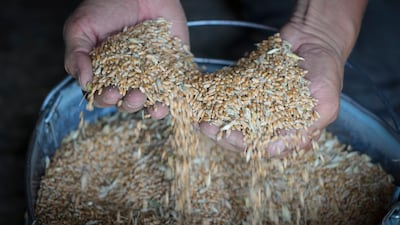
Serhiy, a farmer, shows grain in his barn in the village of Ptyche in Donetsk region. AP -

Serhiy shows a mound of grain in his barn. AP -
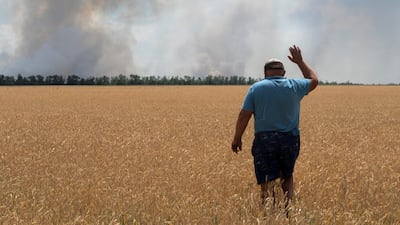
A burning field caused by the fighting at the front line in the Dnipropetrovsk region of Ukraine. AP -
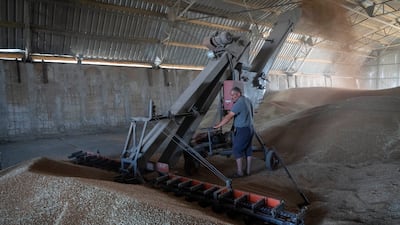
A farmer tends to his grain stock near the front line in Dnipropetrovsk. AP -
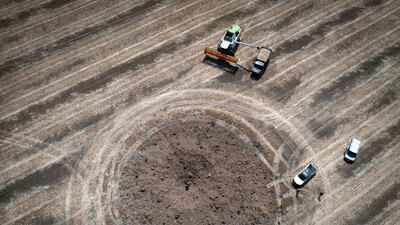
Harvesting in Dnipropetrovsk, with a crater left by a Russian rocket in the foreground. AP -
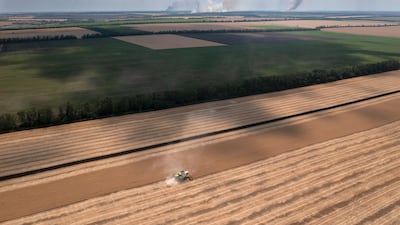
Smoke rises in the background during fierce battle on the front line, while the harvest continues. AP -

Ukraine hopes its vast grain stocks can be exported around the world as soon as possible, despite the continuing war with Russia. AP


We were told that the imposition of trade barriers would bomb Russia’s economy “back to the stone age”.
Really? It’s true that Russia is denied microchips, electronic spares and the rest. But Putin’s response, far from begging for an end as was predicted, has been to open doors with China, Iran and India, all of which are capable of getting him the parts he requires.
This has even led, ironically, to the emergence of a new class of oligarch, those who have ties with regimes prepared to trade with Russia, who can source alternative supplies.
So much, too, for the anticipated collapse of the rouble. Russia’s currency is up by almost 50 per cent since January and so far this year is one of the world’s strongest performers.
That’s because Moscow’s balance of payments is enjoying a healthy and unprecedented surplus, buoyed by energy exports, not to its traditional, and now former, partners in the West, but to its new best friends in Asia.
All that has occurred with the imposition of sanctions is the increasing division of the world into two economic blocs — between the West and Russia, China and their pals.
In that scenario, one side is hurting more than the other and it’s the one that thought its financial clout would win through. It’s the US that has gone into recession, the EU and UK that are missing Russian fuel and grappling with a worsening cost of living crisis.
In the sanctions war, as opposed to the air and ground war, there is no doubt who is losing and it’s not Russia.
So dire have been the consequences of the western actions that you’re forced to wonder what analysis was done, did anyone foresee what might result? In the UK, the two Tory leadership contenders, Rishi Sunak and Liz Truss, speak even today of tightening the sanctions, of somehow making Russia squeal more.
Sadly, given the nature of the contest and the narrowness of the electorate, they are not sufficiently challenged as to the rationale of what they’re proposing. What successes to date flowing from these policies can they point to?

Before they rushed to flex their economic muscle, believing, somewhat arrogantly, they can use money to bully the opposition into submission, a study of history would have told the western powers that sanctions rarely deliver.
Analysis by the US economic historian Nicholas Mulder concludes that the targeting of sanctions on more than 30 occasions in the past 50 years have had minimal, if not counterproductive, impact.
All they do is reinforce a “them and us” mentality in often autocratic regimes hardened to international isolation and opprobrium.
From Cuba to Korea to Iran to Venezuela to Myanmar and now Russia — take your pick — trading exclusions have not secured their objective. On the contrary, they’ve helped bolster the incumbent rulers, making them even more oppressive.
For Erdogan, ships of grain may be a welcome distraction from realities — inflation has rocketed to an incredible 80 per cent — at home, but they are also the first sign of relief amid a dark, and likely ultimately fruitless, escapade.

