


Cast your mind back to last year, and the G7 leaders assembling beside the beach in Cornwall.
Then, amid fanfare, US President Joe Biden unveiled the Build Back Better World plan or B3W, for short. It was, said Biden, to be a higher-quality alternative to China’s Belt and Road Initiative, or BRI. The G7 leaders said theirs would offer a “values-driven, high standard and transparent” partnership.
Now, cut to this week and the 2022 meeting of the G7 at Schloss Elmau in the Bavarian Alps. There, they’ve launched the Partnership for Global Infrastructure and Investment scheme, or PGII. It will, said Biden, allow countries to “see the concrete benefits of partnering with democracies”.
The sense of déjà vu is strong, as indeed it should be, since PGII is intended as a replacement for B3W. That’s because the latter never got off the ground. Even from day one, there were problems, with the then-German chancellor Angela Merkel saying it was not clear how the B3W would be financed.
That’s how it remained, with not enough clarity as to where the money, for what was seen very much as a US-driven programme (Build Back Better was a direct copy of Biden’s domestic spending and climate agenda), was going to originate. During the ensuing months, not enough G7 members made significant contributions and the big Cornwall idea fell flat.
-
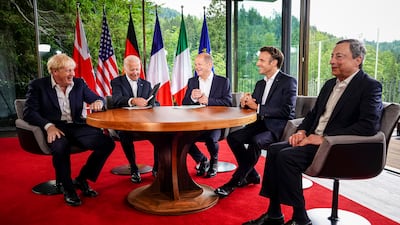
Britain's Prime Minister Boris Johnson, US President Joe Biden, German Chancellor Olaf Scholz, France's President Emmanuel Macron and Italian Prime Minister Mario Draghi chat before their meeting at Elmau Castle on Tuesday morning. Getty Images -
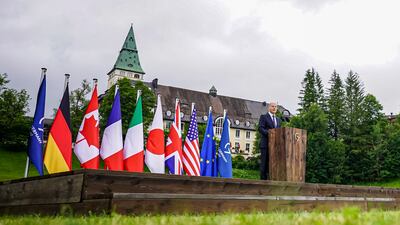
Olaf Scholz speaks at a press conference at Elmau Castle. EPA -
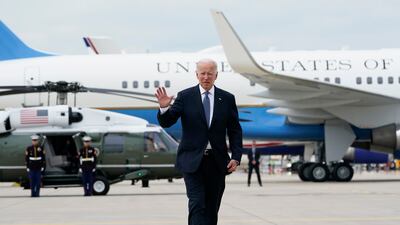
Joe Biden waves as he crosses the tarmac next to Air Force One at Munich International Airport. The US president is leaving Germany on his way to Spain to attend a Nato summit. AP -
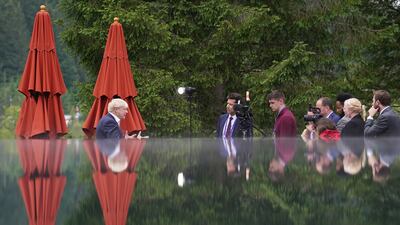
Boris Johnson speaks to press at the G7 summit. PA -

Emmanuel Macron holds a press conference at Elmau Castle. AFP -
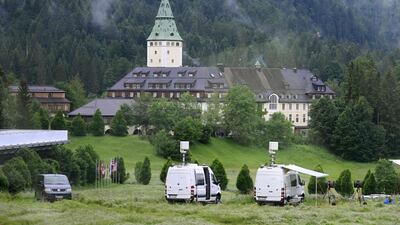
Vans equipped with electronic detection devices are stationed in front of Elmau Castle, where the G7 summit is taking place. AFP -
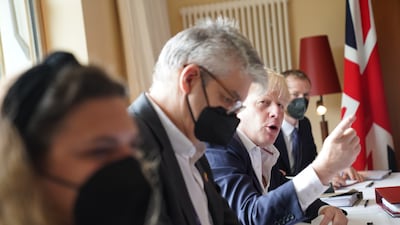
Boris Johnson makes a point during a meeting with the Prime Minister of Japan Fumio Kishida. PA -
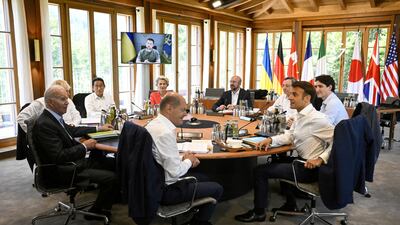
Clockwise from centre: Olaf Scholz; Joe Biden; Boris Johnson; Fumio Kishida; European Commission President Ursula von der Leyen, European Council President Charles Michel; Mario Draghi; Canada's Prime Minister Justin Trudeau, and Emmanuel Macron listen to an online address by Ukraine's President Volodymyr Zelenskyy at the G7 summit in Bavaria. Reuters -
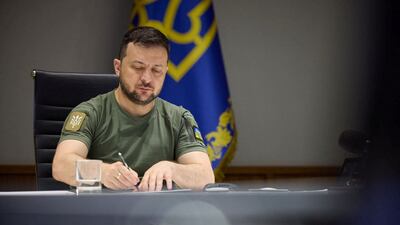
Volodymyr Zelenskyy attends a working session of G7 leaders via video link from Kyiv, Ukraine. Reuters -
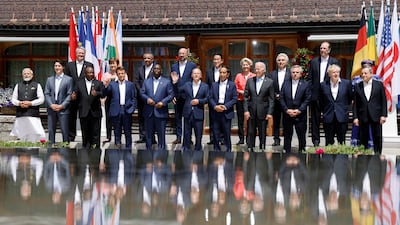
Olaf Scholz waves alongside G7 leaders and participants of the outreach programme as they pose for a 'family photo' at the Bavarian resort of Schloss Elmau. Reuters -
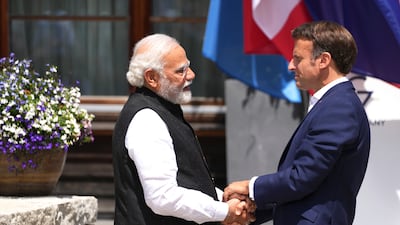
Emmanuel Macron greets India's Prime Minister Narendra Modi during the official welcome ceremony of G7 leaders. AP -
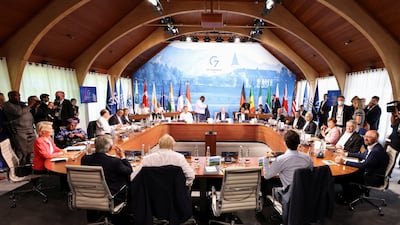
G7 leaders meet outreach guests at the summit. Reuters -
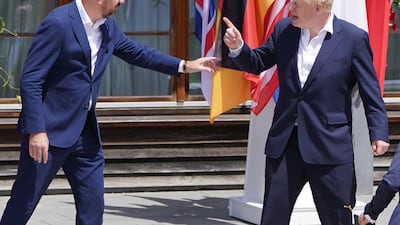
Boris Johnson speaks to Charles Michel. PA -
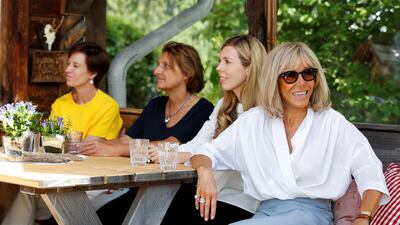
Amelie Derbaudrenghien, Britta Ernst, Carrie Johnson and Brigitte Macron at Elmauer Alm Mountain Restaurant. Reuters -
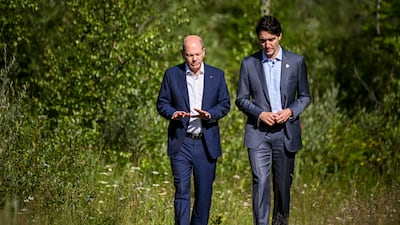
G7 leaders Olaf Scholz and Justin Trudeau talk a walk at Elmau Castle in Bavaria. EPA -
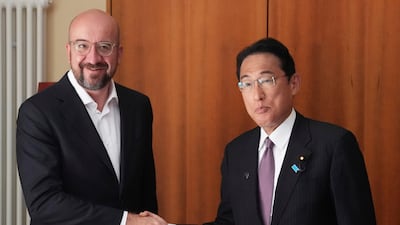
European Council President Charles Michel greets Japanese Prime Minister Fumio Kishida on the sidelines of the G7 summit at Castle Elmau in Bavaria. AP -
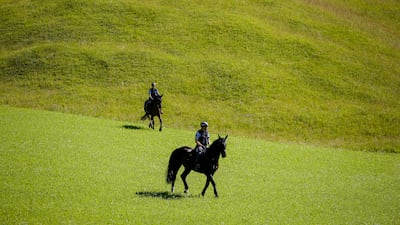
Horseback police patrol at Elmau Castle in Bavaria. EPA -
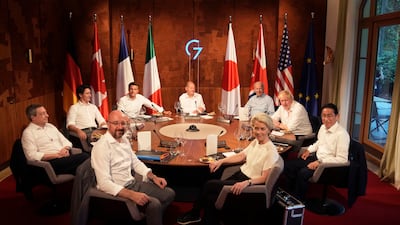
G7 leaders have dinner at Elmau Castle in Kruen, Germany. Clockwise from front left, European Council President Charles Michel, Italy's Prime Minister Mario Draghi, Canada's Prime Minister Justin Trudeau, French President Emmanuel Macron, German Chancellor Olaf Scholz, US President Joe Biden, British Prime Minister Boris Johnson, Japan's Prime Minister Fumio Kishida and European Commission President Ursula von der Leyen. AP -

From left, Mr Draghi, Ms von der Leyen, Mr Biden, Mr Scholz, Mr Johnson, Mr Trudeau, Mr Kishida, Mr Macron and Mr Michel. AFP -
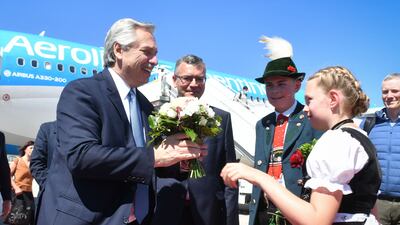
Flowers for President Alberto Fernandez of Argentina at Munich Airport as he arrives to take part in the G7 summit in Bavaria. AFP -
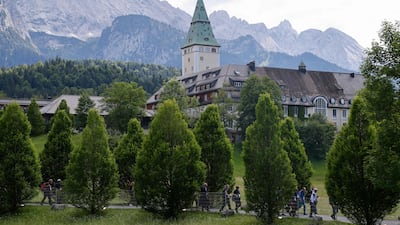
Elmau Castle in southern Germany, the venue for the G7 summit. AFP -
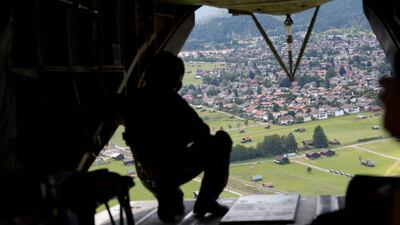
The view from a German armed forces helicopter on its way to the G7 summit at Elmau Castle. AFP -
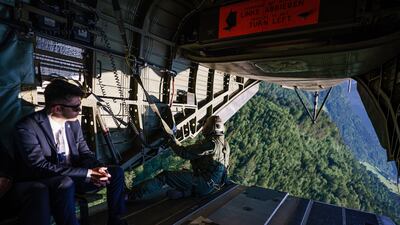
Gazing out from the helicopter. AFP -
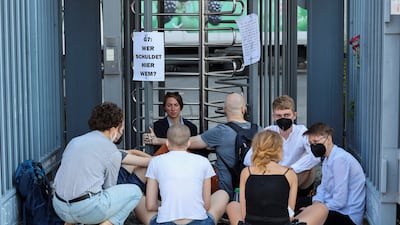
In Berlin, campaigners sit near a sign reading 'G7: Who owes who?' at the Ministry of Finance building to demand debt relief for countries of the global south. Reuters -
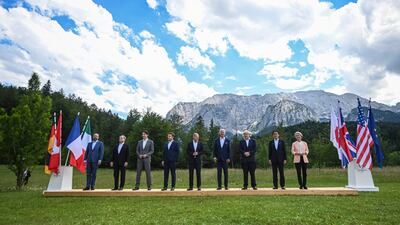
From left, Mr Michel, Mr Draghi, Mr Trudeau, Mr Macron, Mr Scholz, Mr Biden, Mr Johnson, Mr Kishida and Ms von der Leyen at the summit at Elmau Castle. EPA -
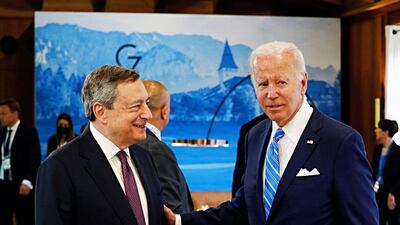
Mr Draghi talks with Mr Biden. EPA -
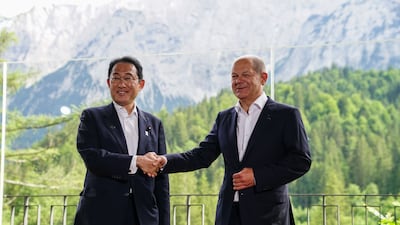
Mr Scholz shakes hands with Mr Kishida. EPA -
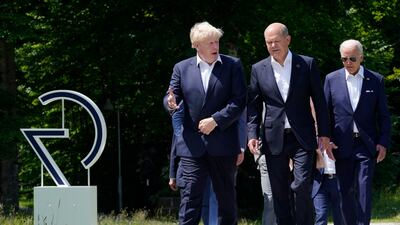
Mr Johnson, Mr Scholz and Mr Biden. AFP -
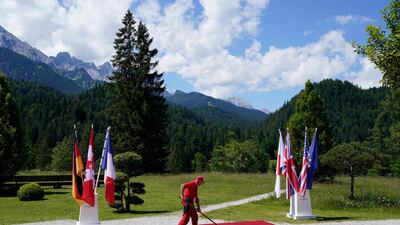
A worker cleans the red carpet at Elmau Castle in the Bavarian mountains. AFP -

Mr Kishida leads the Japanese delegation. AFP -

The G7 logo at Elmau Castle. AFP -
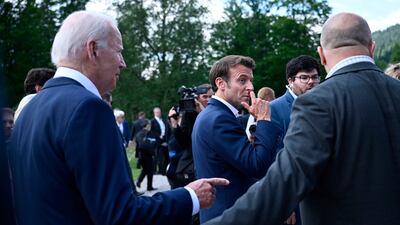
Mr Biden and Mr Macron. AP -
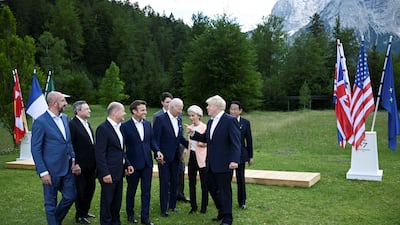
The leaders at a photocall. Reuters -
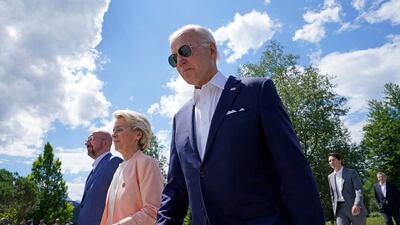
Mr Biden walks with Ms von der Leyen and Mr Michel. Reuters -
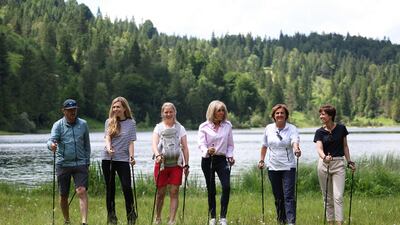
Former German alpine ski racer Christian Neureuther, British Prime Minister's wife Carrie Johnson, former German biathlete Miriam Neureuther, French President's wife Brigitte Macron, German Chancellor's wife Britta Ernst and European Council President's wife Amelie Derbaudrenghien take part in a Nordic Walk as part of the spouses' programme. Reuters -

Mr Macron, Mr Biden, Ms von der Leyen and Mr Trudeau. AP -
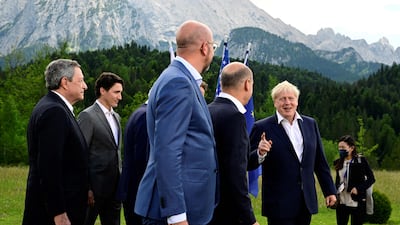
Mr Draghi, Mr Trudeau, Mr Michel, Mr Scholz and Mr Johnson. AFP -

Ms von der Leyen chats with Mr Trudeau. AFP -
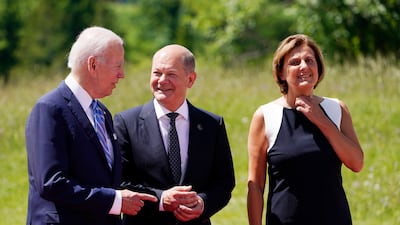
Mr Biden is welcomed by Mr Scholz and his wife Britta Ernst. AP -
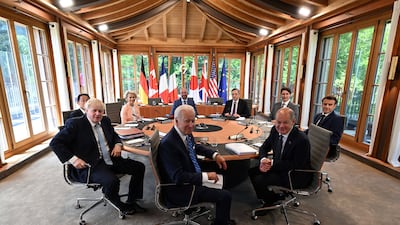
The leaders get down to business. AP -
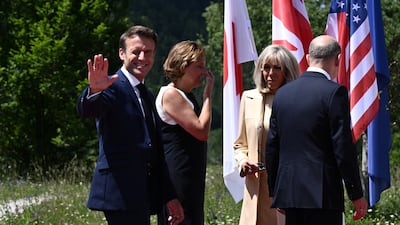
Mr Scholz and Ms Ernst welcome the Macrons. Reuters -
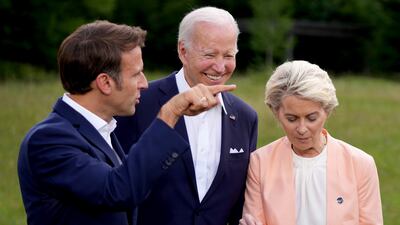
Mr Macron, Mr Biden and Ms von der Leyen. AP -
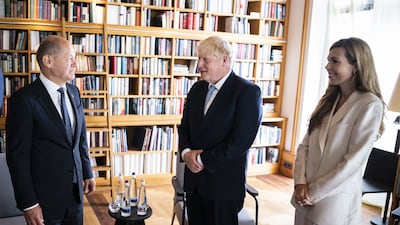
Mr Scholz greets Mr and Mrs Johnson. PA -

Mr Scholz and Ms Ernst welcome Ms von der Leyen to Elmau Castle. AFP -
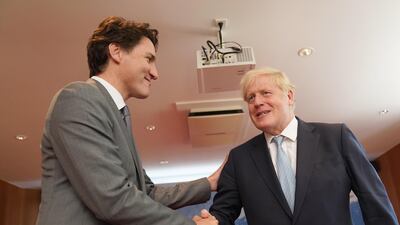
Mr Johnson meets Mr Trudeau. PA -
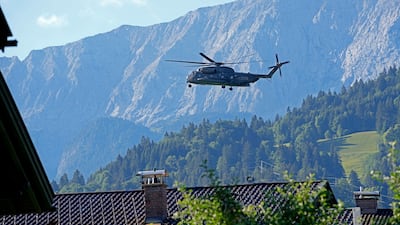
A helicopter flies over the G7 venue. AP Photo


Hence, the relaunch and the new name. But is it any better?
The driver for all this diplomatic activity and fund-raising, and eventual spending, is of course China’s BRI. Since it was started by President Xi Jinping in 2013, Belt and Road has provoked apoplexy among western governments. China is pouring trillions of dollars into emerging countries, offering them loans to develop ports, railways, roads and bridges. It’s led the communist giant to draw close to nations that are economically poor but rich in resources, sparking consternation in the West’s democracies.
They argue that while China has established and expanded trading links, the investment is also designed to be “predatory”, that the cash advances from Beijing come at a price, and the small print forces a debt-saddled country to cede valuable assets should it fail on debt repayments. The Chinese maintain this is nonsense and that BRI is there to help others raise their game and enjoy the fruits of greater prosperity from increased trade.
Whatever the truth, aiding less fortunate nations has become an ideological battleground — or at least that is how it is seen by the US in particular. The notion that China can steal their traditional thunder, using “debt diplomacy”, deploying finance as a weapon to advance its cause, is especially infuriating.

The problem is that BRI is straightforward and simple in administration and execution. The Chinese agree to do a deal. That’s it. There is no messing around, little obfuscation — it’s a direct transaction. The Americans will argue “phooey, don’t be fooled, it’s a cloak for all manner of persuasion and influence". But that is not how BRI operates in practice — China’s new partner is grateful for the attention and for the cash.
Where the US and its friends went wrong with B3W, and if they’re not careful, will do so again with its successor, is they’ve overcomplicated. So, it’s aimed at climate change and achieving gender equality and improving global health and boosting digital capability. Projects cited in Bavaria include a $2bn solar-powered development in Angola, a vaccine manufacturing plant in Senegal, $14m towards a design study for a small modular reactor in Romania, and a 1,609km submerged telecoms cable linking Singapore to France via Egypt and the Horn of Africa and costing $600m.

All highly creditable, but no obvious connection and each is complex and fraught with risk. They have the smell of ticking policy boxes about them rather than borrowing money to build a bricks-and mortar-bridge, for example.
It’s not clear either, just as with B3W, how the new incarnation will be funded. The G7 leaders have pledged to raise $600bn over five years, with a third of that being paid by the US, from federal sources, grants and private investment. The EU will find E300bn. Quite how the proportions break down, between public and private, and who these private backers are, how they will be wooed, what level of return they can expect to receive, is not specified.

In the year since Cornwall, let us not forget, the world has struggled with the fallout from widespread inflation and Russia’s invasion of Ukraine, so the private sector may have other priorities and could give less generously than before.
Again, it’s different from the China model. The G7 rival smacks of too many cooks, too many ingredients and too many objectives. The US is keen, for instance, to end the use of forced labour in global supply chains, citing China’s exploitation of the Uighur minority in Xinjiang as particularly morally outrageous, to present a more acceptable way of working.
European Commission President Ursula von der Leyen said the aim of GPII was to present a “positive powerful investment impulse to the world, to show our partners in the developing world that they have a choice”.
Similarly, Biden did not mention China explicitly in his announcement of GPII but said: “We’re offering better options for people around the world.” On the side-lines of the summit, Biden elaborated further: “When democracies demonstrate what we can do — all that we have to offer — I have no doubt that we’ll win that competition every time.”
For their part, the Chinese, far from quaking, appear oddly unperturbed. If anything they seem even more determined. Reacting to the news of GPII at his regular briefing in Beijing, China’s Ministry of Foreign Affairs spokesman Zhao Lijian said his country welcomed any project that promoted global infrastructure. “We believe there’s no such thing as relevant initiatives countering or replacing each other.” He added, however: “What we oppose are moves to advance geopolitical calculations and smear the BRI in the name of promoting infrastructure development.”
It can’t be fanciful to suggest that in12 months’ time, the G7 will assemble and proclaim the advent of an exciting, investment fund bearing a new title and another set of initials.

