


Latest: Boris Becker sentenced to two and a half years in prison.
A few years ago, we took our children to a “master class” at our local tennis club with Boris Becker.
The tennis star was not playing the game, not demonstrating his shots and skills, but telling the kids what it took to get to the top, the sacrifices that he made and the pressures involved. To be honest, the watching parents were more enthralled than their offspring.
Becker was charming, self-effacing and funny. What came across, though, was the weirdness of his life: first as a child prodigy, then when he sprang to international superstardom as a relative unknown, winning Wimbledon in 1985, aged just 17.
He went on to win two more Wimbledon titles, the Australian Open twice and the US Open. In all, he won 15 championships and was World Number One before retiring in 1999. His career earnings amounted to more than $50 million.
Those days and triumphs now seem like a distant memory. He was declared bankrupt in June 2017 over an unpaid loan of more than £3m on his estate in Mallorca, Spain. Today, Becker, 54, faces prison, having been found guilty in a London criminal court of transferring hundreds of thousands of pounds from his business account following his insolvency, failing to declare a property in Germany, and concealing €825,000 of debt. He could face a lengthy jail term when he is sentenced on April 29.
Becker told the jury the money went on an expensive divorce from his first wife in 2001, child maintenance payments and “expensive lifestyle commitments”, including his £22,000-a-month rented house in Wimbledon, south-west London. He spoke of being “shocked” and “embarrassed” when he was declared bankrupt and claimed he had co-operated with those given the task of securing his assets, including offering up his wedding ring.
The jury acquitted him of a further 20 charges, including nine counts of failing to hand over trophies and medals from his tennis career, including two Wimbledon men's singles trophies.
-

Boris Becker kisses the Wimbledon Men's Singles trophy, after his 1985 victory over South Africa's Kevin Curren at the London tournament. Getty Images -
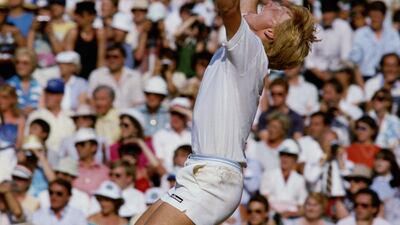
Becker celebrates his 1985 Wimbledon win. Aged 17 years, 227 days, he was the youngest male Grand Slam winner at the time. Getty Images -
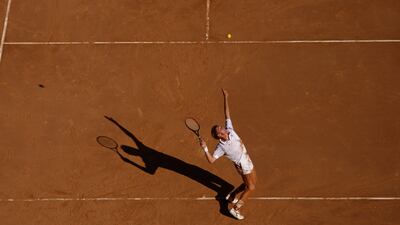
Becker serves during the final of the 1989 Monte Carlo Open Tennis Championship in France. He lost to Argentina's Alberto Mancini. Getty Images -
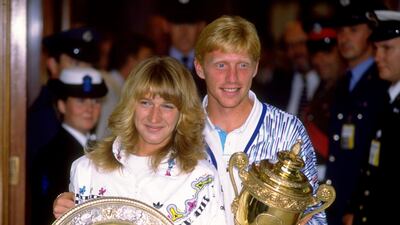
German stars Steffi Graf and Becker were both singles champions at Wimbledon in 1989. Becker defeated Sweden's Stefan Edberg. Getty Images -
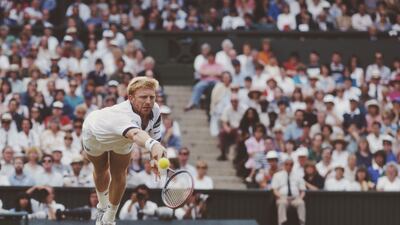
Becker dives to make a return during the 1994 Wimbledon Men's Singles semi-final He lost to Croatia's Goran Ivanisevic. Getty Images -

Becker holds aloft the trophy after defeating Michael Chang to win the 1996 Men's Singles final of the Australian Open. It was his sixth and final Grand Slam title. Getty Images -

Becker poses with his wife Lilly Becker at an awards ceremony in Munich in 2013. The couple separated in 2018. Getty Images -

Novak Djokovic celebrates with coach Becker, after winning the Men's Singles title at the 2016 French Open. Getty Images -

Becker with his sons Elias and Noah at the 2020 Laureus World Sports Awards in Berlin. Getty Images -

The former tennis world no 1 arrives for an insolvency hearing at The City of Westminster Magistrates Court, London in September 2020. Getty Images -
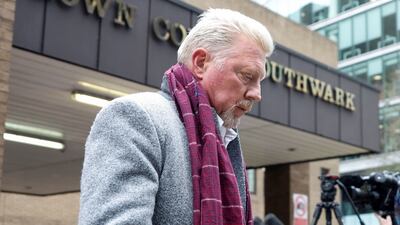
Becker leaves after his bankruptcy offences trial at Southwark Crown Court in London. He was found guilty of removal of property, two counts of failing to disclose estate and concealing debt. Reuters


It was all so different when he was in his prime. On the tennis court, Becker cut a very different figure from the one seen recently. He was young, boisterous, oozing self-confidence with a dramatic serve and volley style that was exciting to watch. Becker’s play was never boring.
Nicknamed “Boom Boom” for his fast serve, he was famous as well for throwing himself at the ball during rallies, for diving across the court, usually at the net. All 6 feet 3 inches of him would leap horizontally, racket thrust out, to retrieve a shot. The Becker Hecht, or flying lunge, was an iconic spectacle and the fans adored him for it. His flaming ginger hair and his temper-fuelled outbursts merely added to the colourful mix.
But, as he told us parents and children that day, his daring, almost crazy, manner belied incredible discipline and dedication. Punishment, too, as he drove himself and was driven by his architect and tennis academy-owning father, Karl-Heinz.
Of course, there have been many sports stars who emerge at an early age. Some, though, are sheltered by their team and club. Tennis is not like that — it’s an individual sport, one where there is nowhere to hide, in which it’s all down to the player to win or lose. There is no club structure to act as a shield. You’re very much on your own.
Golf is similar and it cannot be coincidence that Tiger Woods, who was similarly thrust into global celebrity status, also suffered away from the course.

Listening to Becker talk to the children, even though he was on his best behaviour, holding back on details, it was possible to observe his inner torment. In the way he played tennis, and in many of his public dealings since, he is the swashbuckling Boris. He’s amusing, fast and witty — direct, too. As a TV commentator and panellist, he appears relaxed and jolly.
It’s off the tennis court, off camera, that the problems resided and the demons kicked in. When the cash was pouring in from playing, they were masked. So much was coming in that what he did with it hardly seemed to matter. He got used to the lifestyle, to free-spending. It was when he retired that the issues surfaced. The cash flow dried up but Becker did not rein it in.
He was searching, too, for something to replace the adrenalin rush of tennis. “I had won so much by 22, a number of Wimbledon titles, US Open, Davis Cup, World Number One. You look for the next big thing and that isn't in tennis.”
For a while it was poker — he’s a good player and took part in professional tours, winning more than $100,000 and a ranking in the world’s top 200. It was no substitute, however, and nothing really was — not forays into property, tennis equipment and clothing.
That constant drive meant he was always restless, unable to settle. It also made him easily influenced by advisers and moneymen, who were flocking to him with new ventures and projects, new routes for spending what funds he had left — with the promise of greater wealth ahead.
This is the tragedy of Becker: if he had settled down after quitting competitive play and opened his own tennis school, done some coaching, coupled with commentating, accompanied with charity work, all would have been fine. He would not be preparing to enter a prison cell.
He was not capable of doing that. It was humdrum, the rewards were not great enough, he was not the sort to stay in one place for any length of time. Same as in his tennis, he liked to go as near as possible to the white line, to the edge, to the very limit. That first materialised in 2002 when he stood trial in Germany for tax evasion.
It was a sign of what would later occur in London, when he was accused of deliberately making false statements on his tax return, saying he lived in tax-free Monaco when really, he was continuing to live in Germany. Famously headstrong as a player, he’d ignored warnings and bought an apartment in Munich. He received a suspended prison sentence, was fined €300,000 and was ordered to pay another €200,000 to charity.
It could have been worse, but for the fact he’d managed to pay off the tax debt. There was an element of that on display in his latest judicial escapade, when the picture painted was of someone ducking and diving, like he did on court, scrabbling to find a bit of cash here and there.
What was interesting about the tax case was that it related to the period between 1991 and 1993. That’s when he became an officially registered inhabitant of Monaco while purchasing a flat in Munich. He only 23 years old at the time, his head saying stay in Monaco and pay no tax, while his youthful heart yearned for home in Germany.
Becker broke the law and must be punished. It’s a terrible end, but as he described to us all those hours of practice, the early morning starts, the total commitment to tennis, in someone who was still a child, the image we were left with was one of loneliness. None of what has been revealed should shock; all of it was sadly predictable.

