

The British Conservative politician Norman Tebbit, who served in Margaret Thatcher’s Cabinet from 1981 to 1987, has died aged 94. Gruesomely, his life is best remembered for a near-death experience. He was pulled from the debris of Brighton’s Grand Hotel in 1984 after an IRA bomb tore through a wing of the building. His wife, Margaret, was paralysed from the neck down as a result of the attack.
Never one to shy away from voicing divisive opinions, Tebbit forged a reputation as a gritty right-winger and was known to his critics, somewhat unflatteringly, as "the Chingford skinhead" (he was also once described as "the great political street-fighter of his generation"). He was made UK employment secretary in 1981 at a time when more than 2.5 million people were jobless, with claims that 6,000 were joining the dole queue daily. Trade unions organised marches to call attention to the issue and, in reference to some of those rallies turning ugly, Tebbit countered with the famous quote about his grandfather: “He didn’t riot. He got on his bike and looked for work."
He incurred more flak with his proposed "cricket test", a scheme to determine how well an immigrant or their descendants had been assimilated on account of which national cricket team they supported – whether it was England or their “heritage team” – which could then serve as a barometer of Britishness. Tebbit expanded on the idea, saying: “A large proportion of Britain's Asian population fail to pass the cricket test. Which side do they cheer for? It's an interesting test. Are you still harking back to where you came from or where you are?" The much-ridiculed cricket test never got off the ground.
-
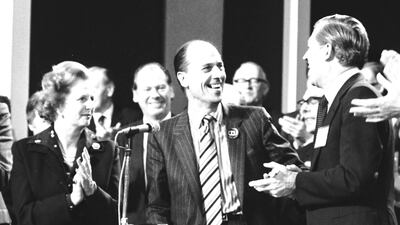
Norman Tebbit, at the time UK employment secretary, receives a standing ovation from prime minister Margaret Thatcher and Conservative Party chairman Cecil Parkinson for his speech at the 1981 party conference in Blackpool, northern England. Tebbit has died at the age of 94. PA -
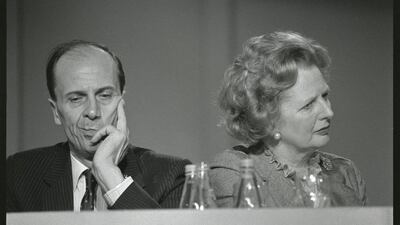
Tebbit, by then Conservative Party chairman, and Thatcher listen to speeches at the 1985 party conference in Blackpool. Reuters -
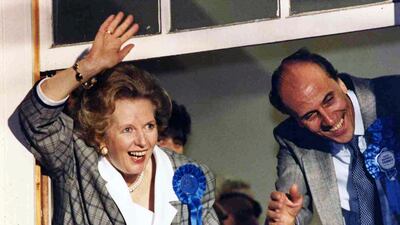
Tebbit and Thatcher wave to supporters at Conservative Party headquarters in central London, after victory in Britain's 1987 general election. AP -

Tebbit during a 1997 debate in the House of Lords. He entered the UK Parliament's upper chamber in 1992. PA -
Tebbit with Labour MP Austin Mitchell listen to speakers in London's Trafalgar Square, at the Anti-Maastricht Alliance's 1999 Save the Pound march. PA -
Tebbit and his wife Margaret outside the Grand Hotel in Brighton, on England's south coast, on the 25th anniversary of the 1984 IRA bombing that injured the couple and left Mrs Tebbit disabled. PA -
Tebbit attends the funeral of Mrs Thatcher at London's St Paul's Cathedral in 2013. PA


Only months after the Brexit referendum in 2016, Tebbit wrote in the Daily Telegraph that UK law was facing challenges from a “rival legal system with its own courts, such as that now represented by the network of Sharia”, and that “Islam challenges our way of life in our own country”. It was difficult to grasp precisely what he was referring to, as the unofficial Sharia councils in Britain had no legal power. But Tebbit was peddling a myth widely held within Conservative circles, to the extent that the prime minister at the time, Theresa May, set up an inquiry into Sharia in Britain.
Tebbit's hopeless misunderstanding of Islam became apparent through several crass public comments. Not content with describing the veil as a means of shying away from the rest of the community and "thoroughly rejecting our culture", he also claimed the religion had been "so unreformed since it was created that nowhere in the Muslim world has there been any real advance in science, or art or literature, or technology in the last 500 years".
Norman Beresford Tebbit was born on March 29, 1931, in Enfield, north London. His working-class childhood was suffused with a strong academic performance, earning him a place at Edmonton Grammar School. Tebbit was a pilot in the military and the commercial sector, and was also a trade union official. But it was in politics that he was to make his name. In 1970, he was elected to represent Epping then, four years later, Chingford, the Essex seat he would hold for more than 20 years.
Despite, or perhaps because of, his grounding, Tebbit, with Thatcher’s guidance, sought with the 1982 Trade Union Act to further diminish union power. In days when strikes were rife, the legislation made unions liable for damages stemming from what was deemed illegal protest action. The role of trade and industry secretary beckoned for Tebbit, and subsidies to already struggling industries were cut.
Tebbit was nearly killed by the IRA bomb, an attack on numerous Conservative members staying in The Grand Hotel on the Brighton seafront for the 1984 party conference. The horror of his brush with death was captured by photographers and the appalling image of Tebbit in his pyjamas being carried from the scene on a stretcher is an enduring one.
He recovered well, however, becoming Conservative Party chairman and chancellor of the Duchy of Lancaster. But reports circulated that relations with Thatcher, to whom he had been very close, had started to fray, not least because he was identified in some quarters as her potential successor as prime minister. These suspicions were scotched, though. Having helped to orchestrate another general election victory in 1987, Tebbit quit the government on a promise to his wife that he would earn enough money from businesses outside the political sphere to help pay for her care, a pledge he duly honoured.

The Thatcher-Tebbit fulcrum became evident once more when she offered him the post of education secretary, which he rejected. Still, in 1990, Tebbit showed undaunted support for his prime minister as she faced a leadership challenge, which he refrained from joining, although he later apparently aligned himself with her successor, John Major.
Tebbit left the House of Commons for the Lords in 1992, where he was guided by the hidden hand of Thatcher once more, the pair this time reunited in their objection to the Maastricht Treaty that established the EU, the ratification of which they saw as “treason”. Beginning to voice more and more scepticism of Major, Tebbit hinted he had not pursued the party leadership because he mistakenly believed Major espoused right-wing values – he once said Major had "the mulishness of a weak man with stupidity". The party sank gradually and Tony Blair’s "New" Labour took office in 1997. Tebbit’s own decision-making subsequently appeared to rankle, as he later explained: "When I look at what happened to the party, I tell myself that perhaps I failed in a duty. I suppose I am one of those who have it on my conscience that I allowed Mr Blair to become prime minister."
In the House of Lords, Tebbit, who was made a life peer, remained an entrenched supporter of Thatcherism and disavowed some of the centrist policies of the party with David Cameron at the helm. Tebbit’s politics can be rather well summed up by his assertion: “It is certainly safe, in view of the movement to the right of intellectuals and political thinkers, to pronounce the brain death of socialism.” He retired from the Lords in March 2022.
He spent much of his time caring for his wife who, as a wheelchair user, was a vigorous campaigner for access for disabled people. He condensed their highs and lows into an entertaining memoir Upwardly Mobile, in which he expressed deep admiration for his wife and the fortitude she had shown following the Brighton blast, after which she spent two years in hospital. A tiresome theme of Tebbit’s book, however, was his bleating about the penury that marred his working life. Tebbit could hardly be said to have been short of money, yet by his own measure apparently he was. He went on to write several more books, with varied success. Margaret Tebbit died in December 2020. The couple had three children, William, John and Alison, all of whom survive their parents.

