

Saeb Erekat, the secretary general of the Palestine Liberation Organisation who died on Tuesday, burst on to the international media scene three decades ago on prime-time American news.
At the height of the First Intifada in 1989, ABC Nightline ran a series of debates and reports on the conflict between Palestinians and Israelis.
Host Ted Koppel, a veteran journalist and son of German Jews who fled Adolf Hitler, gave the Palestinians a significant part of the three-hour series to explain their point of view.
Erekat, who was then in his mid-30s, was the youngest member of a Palestinian panel that debated with Israeli figures at a packed Henry Crown Symphony Hall in Jerusalem.
He was also, by far, the least composed.
Next to him was Haidar Abdel Shafi, the late Palestinian statesman and a model of decorum and eloquence, and Hanan Ashrawi, a savvy communicator on TV and his colleague until the end of his life.
It was a historic opportunity to address the US public directly and capitalise on the non-violence that marked the first Palestinian Intifada.
Abdel Shafi and Ms Ashrawi scored points with the sceptical audience, only to be undermined by the outbursts from Erekat, who had a PhD from Britain and came from a district on the outskirts of Jerusalem.
The nerves he clearly felt during the debates followed him into his political career, but his first impressions did not prevent him from becoming a fixture of on-and-off peace negotiations with Israel.
Nor did they stop him becoming – to many around the world at least – the face of those Palestinian negotiations.
-
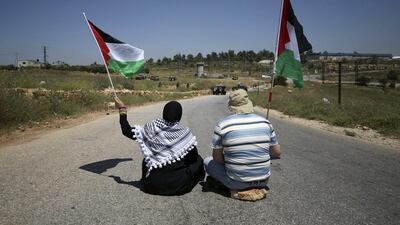
Palestinian protesters wave flags as Israeli troops take position during a protest against Jewish settlements in the West Bank village of Nabi Saleh, near Ramallah. Reuters -
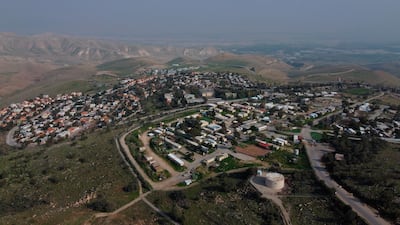
Now that Prime Minister Benjamin Netanyahu has secured a new term in office, there’s little to prevent him from annexing large parts of the West Bank as early as this summer. AP -
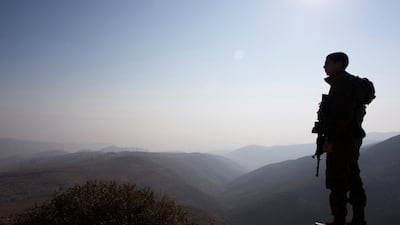
An Israeli soldier stands guard during a tour made by Israeli parliament members in the Jordan Valley near the Jewish settlement of Maale Efrayim. Reuters -
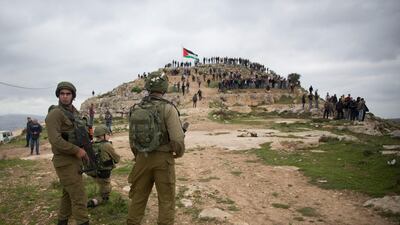
Israeli soldiers take position as Palestinian demonstrators gather during a protest against expansion of Israeli settlements in the West Bank. AP -
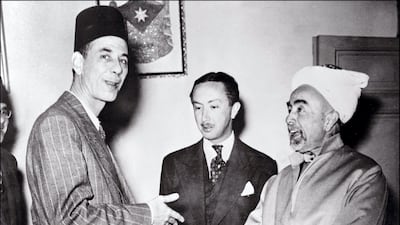
King Abdullah (r) of Transjordan on May 13, 1948 in Amman with Abed Al Rahman Azzam, the secretary general of the Arab League and Abd Al Elah Ibn Ali, the Prince Regent of Iraq, the day before the beginning of the first Arab-Israeli War. AFP -
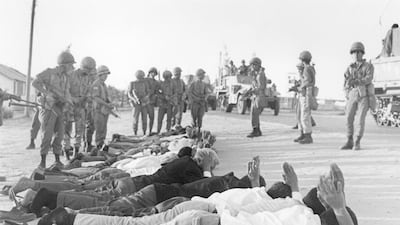
Palestinians surrender to Israeli soldiers in June 1967 in the occupied territory of the West Bank after Israel launched a pre-emptive attack on Egypt and Syria and seized the Gaza Strip, Sinai Peninsula and the Golan Heights in Syria as well as the West Bank and Arab East Jerusalem. AFP -
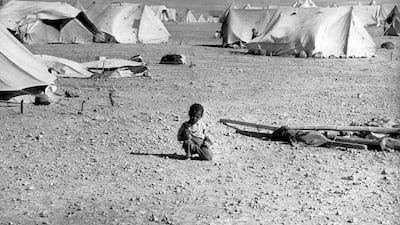
A Palestinian child plays in a refugee camp in Jordan on June 23, 1967. AFP -
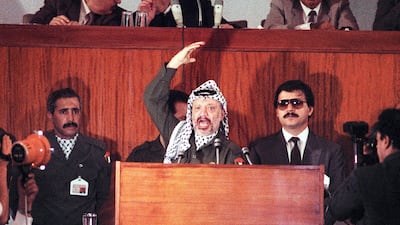
PLO chairman Yasser Arafat delivers a speech to the Palestine National Council meeting to make the historic proclamation of a Palestinian state in the Israeli-occupied territories and to recognize Israel in the Palace of Nations conference hall on November 12, 1988, in Algiers. AFP -

US President Bill Clinton stands between PLO leader Yasser Arafat and Israeli Prime Minister Yitzahk Rabin as they shake hands for the first time on September 13, 1993 at the White House. AFP -
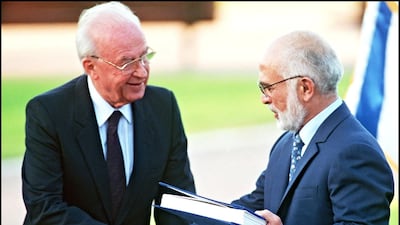
Hussein Ibn Talal, King of Jordan and Israeli Premier Yitzhak Rabin shake hands after they exchanged the documents of the Peace Treaty at Beit Gabriel conference centre on November 10, 1994 on the southern shore of the Sea of Galilee. AFP -
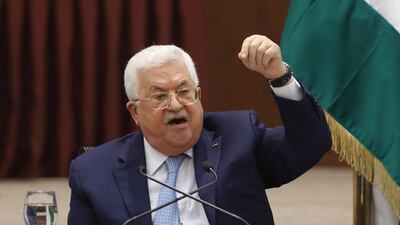
Palestinian President Mahmoud Abbas speaks during the Palestinian leadership meeting and threatened to end security coordination with Israel and the United States, saying Israeli annexation would ruin chances for peace. AFP -
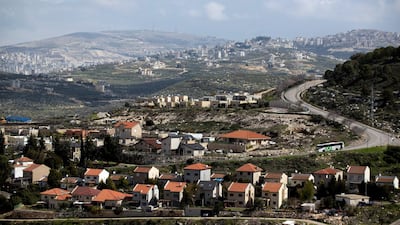
Houses in the Israeli settlement of settlement of Kedumim are seen in the foreground as part of the Palestinian city of Nablus is seen in the background (far left) in the Israeli-occupied West Bank. Reuters -
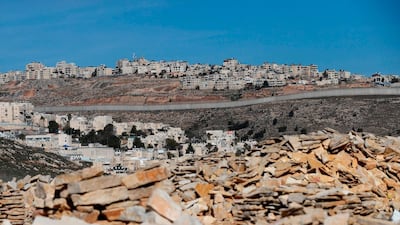
Israel's controversial concrete barrier (C) separating the Jewish settlement of Neve Yaakov (foreground) in the northern part of east Jerusalem and the Palestinian area of al-Ram (background) in the occupied West Bank. AFP -

An Israeli activist holds a banner during a protest against the US peace plan for the Middle East, in front of the US ambassador's residence in Jerusalem, on May 15, 2020, as Palestinians commemorate the 72nd anniversary of the 1948 Nakba or "catastrophe". AFP -
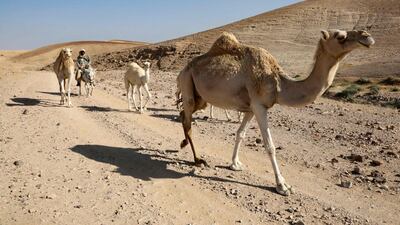
A Palestinian shepherd tends to his camels on arid land considered to be in "Area C" (under Israeli security and administrative control), southeast of Yatta town in the southern West Bank district of Hebron. AFP -
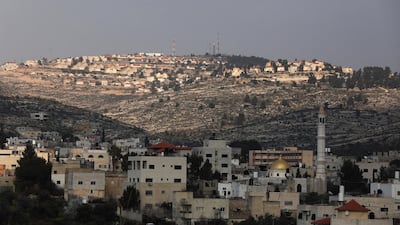
A general view of the Israeli settlement of Elon Moreh, as seen from the Palestinian village of Azmout near the West Bank City of Nablus. EPA -
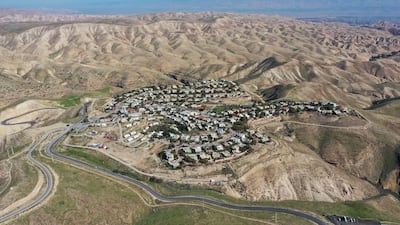
The West Bank Jewish settlement of Maale Michmash. AP


His lack of composure did not hinder his rise to the top of the PLO as its secretary general and did not stop him being a stalwart voice calling clearly for a two-state solution and a viable, independent Palestinian nation.
This year, Erekat summed up the convoluted and complex decades-long Palestinian struggle for freedom in stark and simple terms.
"It's our inalienable, sacred, long overdue and internationally recognised right to be free," he told The National as he laid out the Palestinian rejection of US President Donald Trump's new roadmap to peace.
“Our right to self-determination has been systematically denied by Israel, now with the support of the US.
“It is not news for us that the efforts of the Trump team are not in the direction of an independent, sovereign and contiguous state of Palestine, but towards that of normalisation of the Israeli colonial occupation over the land and people of Palestine."
Erekat was at the heart of the framework of deals that started the Palestinian peace process, starting as deputy to Abdel Shafi in the talks that led Yitzhak Rabin, Yasser Arafat and Bill Clinton to meet at the White House in 1994 to sign the first Oslo Accords.
As Abdel Shafi cautioned that the deals paid only lip service to Palestinian rights while making the PLO and the Palestinian Authority dependent on co-operation with Israel, Erekat pushed on and led the Palestinian delegation from 1996.
He worked for years to further the path of dialogue, even at times when it seemed remote.
In the Palestine Papers, leaked documents mainly from his own office that chronicled the workings of the negotiations with Israel from the late 1990s until 2010, he came across as an affable, self-deprecating negotiator.
Despite criticism from Palestinian colleagues that he was weak, he appeared to have recognised the power of Israel without ever being intimidated by it.
But the early momentum Erekat helped to create in the 1990s faded and entrenched positions, including his own, became harder to break.
In Palestinian politics, his career charted the course of the PLO from armed group to political party, but also its course from radical leftist struggle to its contemporary moribund, sickly fixture.
A close ally of Arafat, Erekat clashed with current President Mahmoud Abbas when the elder leader of the Palestinians yielded to pressure to appoint a prime minister with real powers in 2003.
He ultimately kept his place after Arafat died a year later, and remained central to Palestinian politics.
-
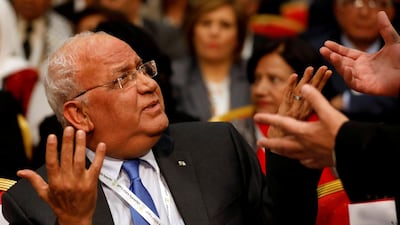
Palestinian chief negotiator Saeb Erekat gestures during the Palestinian National Council meeting in Ramallah, in the occupied West Bank on April 30, 2018. Reuters -
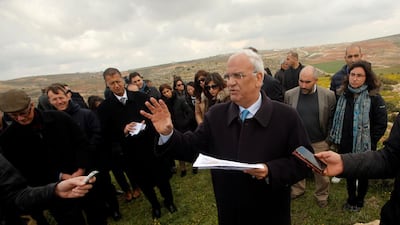
Palestinian chief negotiator Saeb Erekat gestures as he speaks to foreign diplomats during a tour near Jewish settlements in the West Bank village of Jaloud near Nablus on March 16, 2017. Reuters -

Palestinian chief negotiator Saeb Erekat holds a map as he speaks to media about the Israeli plan to appropriate land, in Jordan Valley near the West Bank city of Jericho, on January 20, 2016. Reuters -
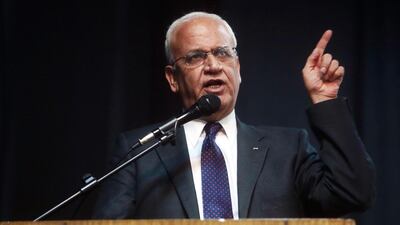
Palestinian chief negotiator Saeb Erekat delivers an address at the Arab School in Santiago de Chile, Chile, on August 14, 2015. EPA -

Saeb Erekat, the Palestinian Authority's chief negotiator, speaks at an Institute for National Security Studies forum in Tel Aviv, Israel on November 2, 2011. Reuters -

Saeb Erekat, the Palestinian Authority's chief negotiator, speaks during a rally held upon his return from Cairo to the West Bank city of Jericho on January 25, 2011. Reuters -

US Middle East envoy George Mitchell and chief Palestinian negotiator Saeb Erekat wave before Mitchell's meeting with Palestinian President Mahmoud Abbas in the West Bank city of Ramallah on October 1, 2010. Reuters -
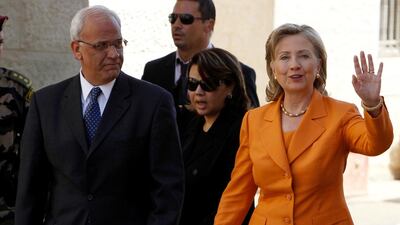
US Secretary of State Hillary Clinton waves as she walks with chief Palestinian negotiator Saeb Erekat upon her arrival for a meeting with Palestinian President Mahmoud Abbas in the West Bank city of Ramallah on September 16, 2010. Reuters -

Former US Secretary of State Madeleine Albright and Senior Palestinian negotiator Saeb Erekat wave before meeting Palestinian President Mahmoud Abbas in the West Bank city of Ramallah on December 6, 2007. Reuters -

US Secretary of State Condoleezza Rice waves as she stands next to Saeb Erekat, a senior aide to Palestinian President Mahmoud Abbas, upon her arrival for a meeting with Abbas in the West Bank city of Ramallah on October 17, 2007. Reuters -

Palestinian President Mahmoud Abbas and senior Palestinian negotiator Saeb Erekat meet Hamas leader Khaled Meshaal and Hamas politburo deputy chief Moussa Abu Marzouk in Damascus on January 21, 2007. Reuters -

Israeli Deputy Prime Minister and Vice Premier Shimon Peres attends a meeting with Palestinian Authority negotiator Saeb Erekat in Tel Aviv on October 14, 2005. Reuters -
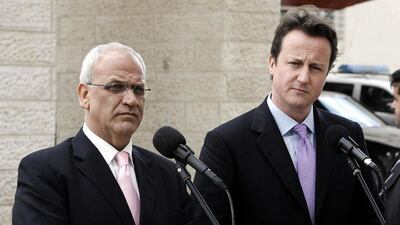
Leader of the Conservative Party David Cameron and Chief Palestinian spokesman Saeb Erekat listen as a journalist asks a question in Ramallah, Palestine on the last day of his two-day tour of the area on March 2, 2007. Reuters -
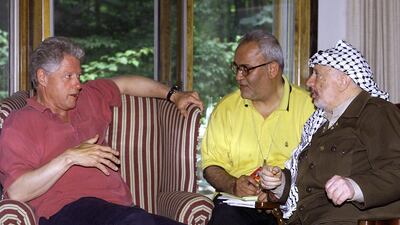
US President Bill Clinton meets with Palestinian President Yassar Arafat and Chief Palestinian negotiator Saeb Erekat during the third day of a Middle East summit at Camp David, July 14, 2000. Reuters -
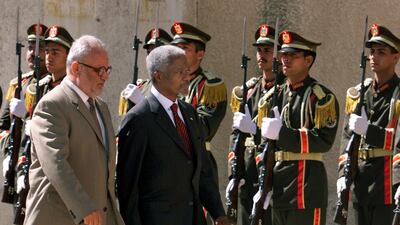
United Nations General Secretary Kofi Annan walks with Palestinian Peace Negotiator Saeb Erekat on his way to meet with Palestinian President Yasser Arafat in Ramallah on June 22, 2000. Reuters -

Palestinian leader Yasser Arafat, seated right, consults with Saeb Erekat, right, as Israeli Prime Minister Ehud Barak, seated left, sign a land-for-security agreement in the Egyptian resort town of Sharm el-Sheikh as US Secretary of State Madeleine Albright, background right, Egyptian President Hosni Mubarak, center background, and Jordan's King Abdullah II, left background, look on on September 5, 1999. AP Photo -
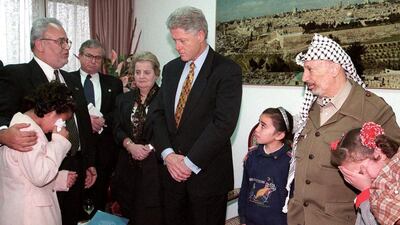
Palestinian chief negotiator Saeb Erekat comforts a Palestinian girl whose father is being held in an Israeli jail as she tells her story to Secretary of State Madeleine Albright, US President Bill Clinton, and Palestinian President Yasser Arafat on December 14, 1998. Reuters -
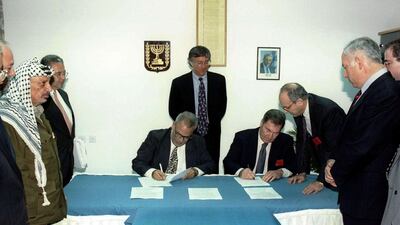
US special envoy Dennis Ross looks on as Saeb Erekat, the chief Palestinian negotiator, and Dan Shomron, the chief Israeli negotiator, initial the documents that bring to a conclusion the long-delayed and overdue Israeli troop redeployment in the West Bank city of Hebron, early January 15, 1997. Reuters


But that placed Erekat in a leadership that many Palestinians blame for failures to protect their rights or achieve peace.
That leadership was also accused of being nepotistic, corrupt and ageing.
After his early clashes with Mr Abbas, Erekat helped the Palestinian president to rule for more than a decade without elections, and monopolised the voice of the cause.
While he was a knowledgeable and passionate champion of the Palestinian cause, he ultimately became part of an elite presiding over the Palestinian malaise, and passed without seeing the national rights he had given so much of his life trying to obtain.

