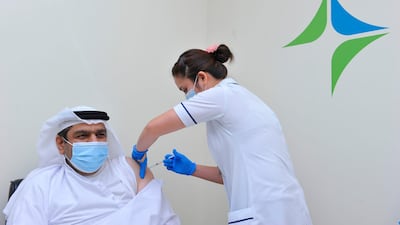
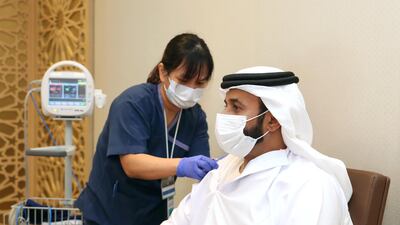
This week, callers to the customer service number of Seha, Abu Dhabi’s public healthcare provider, have been greeted with a new pre-recorded message. “Dear customer, we would like to inform you that the Covid-19 vaccine is available.”
The UAE has announced that the Sinopharm vaccine, manufactured in China, is officially registered for use. Phase 3 trials have shown it to have an overall efficacy of 86 per cent.
The development of viable vaccines against coronavirus barely a year after it was first reported to exist is an unprecedented triumph in the history of medical science. It is, moreover, a testament to the strength of international co-operation during a year in which the pandemic suppressed cross-border travel and disrupted global supply chains. The Sinopharm vaccine has been trialled in various countries, including the UAE, Bahrain, Jordan and Morocco.
Preparations to deploy the vaccine widely will mark a turning point at which we could not have arrived without the legion of volunteers who participated in various trial stages. Sinopharm trials began in the UAE in July, only a few months after the country reported its first cases. By September, when public health officials approved the vaccine for emergency use, 31,000 volunteers had participated. They embodied a wide cross-section of society, including government ministers, frontline workers, religious leaders and teachers, among others.
The early start to the process mirrors progress being made in the UK, which is the first country to begin mass deployment of a vaccine that has been tested in a large clinical trial. Unlike the UAE, where the vaccine is now available on a voluntary basis to anyone booking an appointment with Seha, the UK programme prioritises nine vulnerable groups of people. It utilises the Pfizer vaccine, which was tested on 43,000 individuals and shows 95 per cent efficacy. Morocco is also preparing for a mass vaccination campaign to begin this month, initially with the Sinopharm jab, followed by the vaccine developed by Oxford University and Astra Zeneca.
The Sinopharm vaccine is notable for relying on proven technology. It involves a killed version of coronavirus to boost the body’s immune response, whereas the Pfizer vaccine use memory RNA to target the virus’s spike proteins.
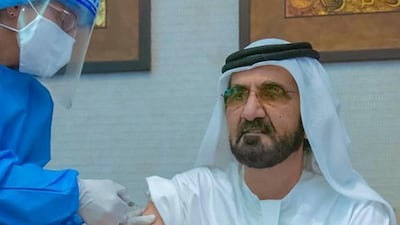
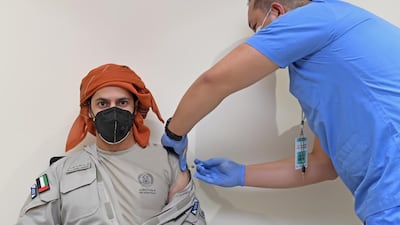
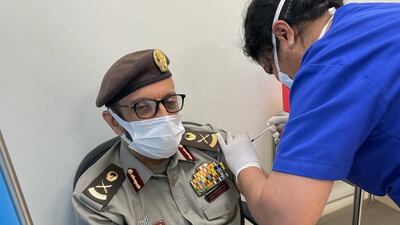
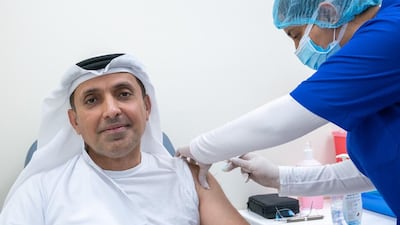
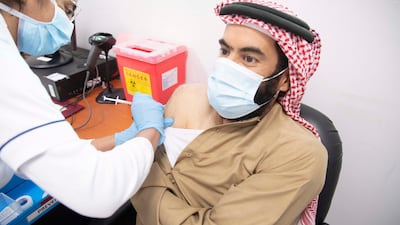
Sheikh Mohammed bin Rashid receives the Sinopharm vaccine to protect against Covid-19 on November 3, 2020. Courtesy: Dubai Media Office
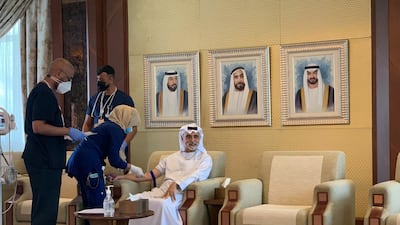
Sheikh Nahyan bin Mubarak receives the first of two shots of a vaccine that was trialled in the UAE. Wam
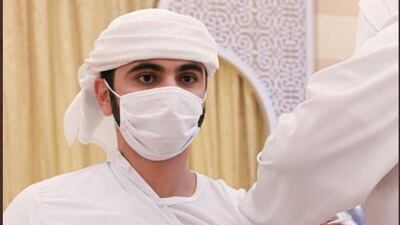
Sheikh Mansoor bin Mohammed, chairman of Dubai’s Supreme Committee of Crisis and Disaster Management, receives the Pfizer-BioNTech vaccine. Courtesy: Sheikh Mansoor
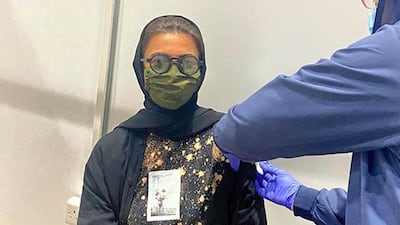
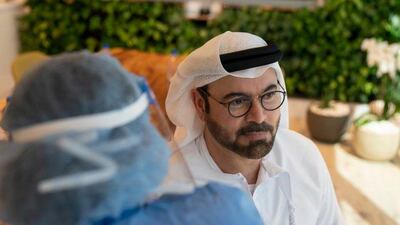
Noura Al Kaabi, Minister of Culture and Youth, gets the Sinopharm jab.
Mohammad Al Gergawi, Minister of Cabinet Affairs, receives the Covid-19 Sinopharm vaccine on Saturday, October 31. Courtesy: UAE Government Twitter
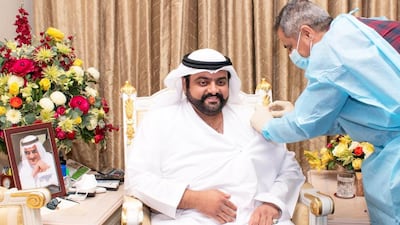
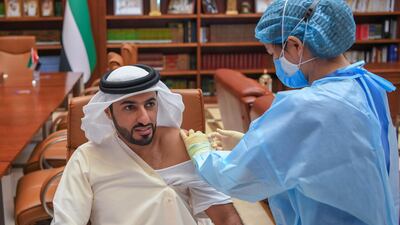
Sheikh Mohammed bin Hamad Al Sharqi, Crown Prince of Fujairah, receives his first dose of the Covid-19 vaccine on Wednesday. Wam
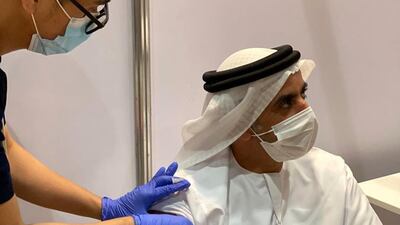
Sheikh Saif bin Zayed, Deputy Prime Minister and Minister of Interior, takes the Sinopharm vaccine. Courtesy: Sheikh Saif bin Zayed Twitter
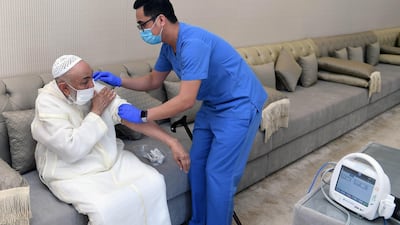
Sheikh Abdullah bin Bayyah, UAE Fatwa Council, is vaccinated with the Sinopharm innoculation on January 4, 2021. Wam
Sheikh Khalid bin Mohammed, chair of Abu Dhabi's Executive Office, takes the first dose of the Sinopharm vaccine. Courtesy: Abu Dhabi Media Office
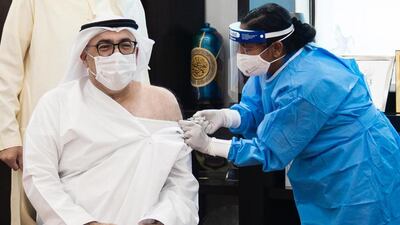
The UAE's health minister, Abdulrahman Al Owais, receives the Sinopharm vaccine.
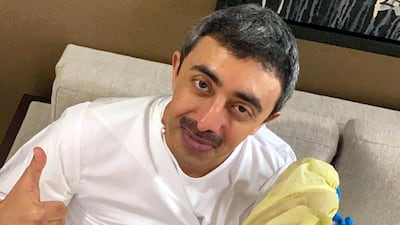
Sheikh Abdullah bin Zayed, Minister of Foreign Affairs and International Co-operation, gives a thumbs up as he is vaccinated against Covid-19.
Sheikh Rashid bin Humaid Al Nuaimi, president of the UAE Football Association, receives the Covid-19 vaccine.
Khalifa bin Dary, executive director of Dubai Ambulance Services Corporation, receives his first dose of the Pfizer-BioNTech vaccine. Courtesy: Dubai Media Office
Lt Col Sheikh Zayed bin Hamad Al Nahyan, director of special patrols at Abu Dhabi Police, receives the Covid-19 vaccine. Courtesy: Abu Dhabi Police
Maj Gen Mohammed Al Marri, director general of the General Directorate of Residency and Foreigners Affairs Dubai, receives his first dose of the Pfizer-BioNTech vaccine. Courtesy: Dubai Media Office
Maj Gen Talal Al Falasi, director general of Dubai's State Security Department, receives his first dose of the Pfizer-BioNTech vaccine. Courtesy: Dubai Media Office
Abdullah Al Falasi, director general of Dubai Government Human Resources Department, receives his first dose of the Pfizer-BioNTech vaccine. Courtesy: Dubai Media Office
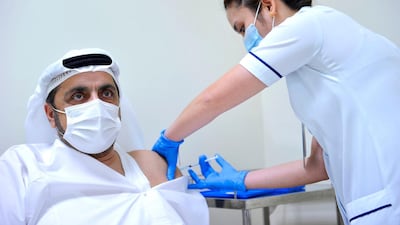
Amer Sharif, head of Dubai's Covid-10 Command and Control Centre, receives his first dose of the Pfizer-BioNTech vaccine. Courtesy: Dubai Media Office
Obaid Al Shamsi, director general of the National Emergency Crisis and Disasters Management Authority, takes the first dose of Covid-19 vaccine
According to the UAE trial results, the Sinopharm vaccine has a high seroconversion rate, creating antibodies against coronavirus in 99 per cent of those administered with it. The trial also showed it to be 100 per cent effective in “preventing moderate and severe cases of the disease”, according to the Ministry of Health and Prevention. After booking an appointment with Seha, individuals can receive the first of two shots. The second follows three weeks later.
While the availability of a viable vaccine to the public will signal the start of a return to normal life, mass vaccination is sure to be a gradual progress, whether in the UAE or elsewhere. In the meantime, the public’s health and its hope for a brighter tomorrow will continue to rely on vigilance, care and a sense of civic responsibility on the part of individuals.
The rewards are clear. In Abu Dhabi, where a rigorous regime of public-health measures have largely kept the virus at bay, authorities announced yesterday that most restrictions will be lifted within the next fortnight. The emirate will resume “all economic, tourism, cultural and entertainment activities,” officials said. That is not only a sign of what we can look forward to, but also how much we achieved in the face of a remarkably challenging year.

What vitamins do we know are beneficial for living in the UAE
Vitamin D: Highly relevant in the UAE due to limited sun exposure; supports bone health, immunity and mood. Vitamin B12: Important for nerve health and energy production, especially for vegetarians, vegans and individuals with absorption issues. Iron: Useful only when deficiency or anaemia is confirmed; helps reduce fatigue and support immunity. Omega-3 (EPA/DHA): Supports heart health and reduces inflammation, especially for those who consume little fish.
Estimates of the number of deaths caused by the famine range from 400,000 to 1 million, according to a document prepared for the UK House of Lords in 2024. It has been claimed that the policies of the Ethiopian government, which took control after deposing Emperor Haile Selassie in a military-led revolution in 1974, contributed to the scale of the famine. Dr Miriam Bradley, senior lecturer in humanitarian studies at the University of Manchester, has argued that, by the early 1980s, “several government policies combined to cause, rather than prevent, a famine which lasted from 1983 to 1985. Mengistu’s government imposed Stalinist-model agricultural policies involving forced collectivisation and villagisation [relocation of communities into planned villages]. The West became aware of the catastrophe through a series of BBC News reports by journalist Michael Buerk in October 1984 describing a “biblical famine” and containing graphic images of thousands of people, including children, facing starvation.
Band Aid
Bob Geldof, singer with the Irish rock group The Boomtown Rats, formed Band Aid in response to the horrific images shown in the news broadcasts. With Midge Ure of the band Ultravox, he wrote the hit charity single Do They Know it’s Christmas in December 1984, featuring a string of high-profile musicians. Following the single’s success, the idea to stage a rock concert evolved. Live Aid was a series of simultaneous concerts that took place at Wembley Stadium in London, John F Kennedy Stadium in Philadelphia, the US, and at various other venues across the world. The combined event was broadcast to an estimated worldwide audience of 1.5 billion.
Mercer, the investment consulting arm of US services company Marsh & McLennan, expects its wealth division to at least double its assets under management (AUM) in the Middle East as wealth in the region continues to grow despite economic headwinds, a company official said.
Mercer Wealth, which globally has $160 billion in AUM, plans to boost its AUM in the region to $2-$3bn in the next 2-3 years from the present $1bn, said Yasir AbuShaban, a Dubai-based principal with Mercer Wealth.
“Within the next two to three years, we are looking at reaching $2 to $3 billion as a conservative estimate and we do see an opportunity to do so,” said Mr AbuShaban.
Mercer does not directly make investments, but allocates clients’ money they have discretion to, to professional asset managers. They also provide advice to clients.
“We have buying power. We can negotiate on their (client’s) behalf with asset managers to provide them lower fees than they otherwise would have to get on their own,” he added.
Mercer Wealth’s clients include sovereign wealth funds, family offices, and insurance companies among others.
From its office in Dubai, Mercer also looks after Africa, India and Turkey, where they also see opportunity for growth.
Wealth creation in Middle East and Africa (MEA) grew 8.5 per cent to $8.1 trillion last year from $7.5tn in 2015, higher than last year’s global average of 6 per cent and the second-highest growth in a region after Asia-Pacific which grew 9.9 per cent, according to consultancy Boston Consulting Group (BCG). In the region, where wealth grew just 1.9 per cent in 2015 compared with 2014, a pickup in oil prices has helped in wealth generation.
BCG is forecasting MEA wealth will rise to $12tn by 2021, growing at an annual average of 8 per cent.
Drivers of wealth generation in the region will be split evenly between new wealth creation and growth of performance of existing assets, according to BCG.
Another general trend in the region is clients’ looking for a comprehensive approach to investing, according to Mr AbuShaban.
“Institutional investors or some of the families are seeing a slowdown in the available capital they have to invest and in that sense they are looking at optimizing the way they manage their portfolios and making sure they are not investing haphazardly and different parts of their investment are working together,” said Mr AbuShaban.
Some clients also have a higher appetite for risk, given the low interest-rate environment that does not provide enough yield for some institutional investors. These clients are keen to invest in illiquid assets, such as private equity and infrastructure.
“What we have seen is a desire for higher returns in what has been a low-return environment specifically in various fixed income or bonds,” he said.
“In this environment, we have seen a de facto increase in the risk that clients are taking in things like illiquid investments, private equity investments, infrastructure and private debt, those kind of investments were higher illiquidity results in incrementally higher returns.”
The Abu Dhabi Investment Authority, one of the largest sovereign wealth funds, said in its 2016 report that has gradually increased its exposure in direct private equity and private credit transactions, mainly in Asian markets and especially in China and India. The authority’s private equity department focused on structured equities owing to “their defensive characteristics.”
Our family matters legal consultant
Name: Hassan Mohsen Elhais
Position: legal consultant with Al Rowaad Advocates and Legal Consultants.
TEACHERS' PAY - WHAT YOU NEED TO KNOW
Pay varies significantly depending on the school, its rating and the curriculum. Here's a rough guide as of January 2021:
- top end schools tend to pay Dh16,000-17,000 a month - plus a monthly housing allowance of up to Dh6,000. These tend to be British curriculum schools rated 'outstanding' or 'very good', followed by American schools
- average salary across curriculums and skill levels is about Dh10,000, recruiters say
- it is becoming more common for schools to provide accommodation, sometimes in an apartment block with other teachers, rather than hand teachers a cash housing allowance
- some strong performing schools have cut back on salaries since the pandemic began, sometimes offering Dh16,000 including the housing allowance, which reflects the slump in rental costs, and sheer demand for jobs
- maths and science teachers are most in demand and some schools will pay up to Dh3,000 more than other teachers in recognition of their technical skills
- at the other end of the market, teachers in some Indian schools, where fees are lower and competition among applicants is intense, can be paid as low as Dh3,000 per month
- in Indian schools, it has also become common for teachers to share residential accommodation, living in a block with colleagues
Learn more about Qasr Al Hosn
In 2013, The National's History Project went beyond the walls to see what life was like living in Abu Dhabi's fabled fort:
The flights
Fly Etihad or Emirates from the UAE to Moscow from 2,763 return per person return including taxes. Where to stay
Trips on the Golden Eagle Trans-Siberian cost from US$16,995 (Dh62,414) per person, based on two sharing.
4.35pm: Tilal Al Khalediah 5.10pm: Continous 5.45pm: Raging Torrent 6.20pm: West Acre 7pm: Flood Zone 7.40pm: Straight No Chaser 8.15pm: Romantic Warrior 8.50pm: Calandogan 9.30pm: Forever Young
How to become a Boglehead
Bogleheads follow simple investing philosophies to build their wealth and live better lives. Just follow these steps.
• Spend less than you earn and save the rest. You can do this by earning more, or being frugal. Better still, do both.
• Invest early, invest often. It takes time to grow your wealth on the stock market. The sooner you begin, the better.
• Choose the right level of risk. Don't gamble by investing in get-rich-quick schemes or high-risk plays. Don't play it too safe, either, by leaving long-term savings in cash.
• Diversify. Do not keep all your eggs in one basket. Spread your money between different companies, sectors, markets and asset classes such as bonds and property.
• Keep charges low. The biggest drag on investment performance is all the charges you pay to advisers and active fund managers.
• Keep it simple. Complexity is your enemy. You can build a balanced, diversified portfolio with just a handful of ETFs.
• Forget timing the market. Nobody knows where share prices will go next, so don't try to second-guess them.
• Stick with it. Do not sell up in a market crash. Use the opportunity to invest more at the lower price.
Suggested picnic spots
Abu Dhabi
Umm Al Emarat Park
Yas Gateway Park
Delma Park
Al Bateen beach
Saadiyaat beach
The Corniche
Zayed Sports City
Dubai
Kite Beach
Zabeel Park
Al Nahda Pond Park
Mushrif Park
Safa Park
Al Mamzar Beach Park
Al Qudrah Lakes
- At 9.16pm, three suicide attackers killed one person outside the Atade de France during a foootball match between France and Germany - At 9.25pm, three attackers opened fire on restaurants and cafes over 20 minutes, killing 39 people - Shortly after 9.40pm, three other attackers launched a three-hour raid on the Bataclan, in which 1,500 people had gathered to watch a rock concert. In total, 90 people were killed - Salah Abdeslam, the only survivor of the terrorists, did not directly participate in the attacks, thought to be due to a technical glitch in his suicide vest - He fled to Belgium and was involved in attacks on Brussels in March 2016. He is serving a life sentence in France
Living in...
This article is part of a guide on where to live in the UAE. Our reporters will profile some of the country’s most desirable districts, provide an estimate of rental prices and introduce you to some of the residents who call each area home.
PFA Team of the Year: David de Gea, Kyle Walker, Jan Vertonghen, Nicolas Otamendi, Marcos Alonso, David Silva, Kevin De Bruyne, Christian Eriksen, Harry Kane, Mohamed Salah, Sergio Aguero
The company offers payments/bribes to win key contracts in the Middle East
May 2017
The UK SFO officially opens investigation into Petrofac’s use of agents, corruption, and potential bribery to secure contracts
September 2021
Petrofac pleads guilty to seven counts of failing to prevent bribery under the UK Bribery Act
October 2021
Court fines Petrofac £77 million for bribery. Former executive receives a two-year suspended sentence
December 2024
Petrofac enters into comprehensive restructuring to strengthen the financial position of the group
May 2025
The High Court of England and Wales approves the company’s restructuring plan
July 2025
The Court of Appeal issues a judgment challenging parts of the restructuring plan
August 2025
Petrofac issues a business update to execute the restructuring and confirms it will appeal the Court of Appeal decision
October 2025
Petrofac loses a major TenneT offshore wind contract worth €13 billion. Holding company files for administration in the UK. Petrofac delisted from the London Stock Exchange
In Windhoek, Namibia - Top two teams qualify for the World Cup Qualifier in Zimbabwe, which starts on March 4.
UAE fixtures
Thursday February 8, v Kenya; Friday February 9, v Canada; Sunday February 11, v Nepal; Monday February 12, v Oman; Wednesday February 14, v Namibia; Thursday February 15, final
'How To Build A Boat'
Jonathan Gornall, Simon & Schuster