
Joe Biden began the first hours of his US presidency with orders of business, not with the customary balls that celebrated the pre-pandemic inaugurations of his predecessors.
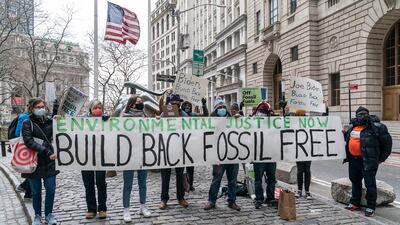
Mr Biden enacted 17 executive orders laying out an impressive agenda on Covid-19, immigration, government ethics and climate change. Within the last of these spheres was a decision for the US to rejoin the 2015 Paris Climate Agreement, a monumental commitment to fighting climate change subscribed to by 195 countries, along with the EU.
The US was one of the early champions of the agreement, which lays out climate targets for each signatory with the aim of limiting global warming to 2ºC above pre-Industrial Revolution levels or, if possible, even 1.5ºC. Former president Donald Trump, who criticised the deal as being unfair for Americans, withdrew the US’s signature in 2017. When he did so, many of America's allies were dismayed. French President Emmanuel Macron went so far as to publish a video in which he invited American climate scientists to move to France.

With Wednesday's executive order, along with another restoring domestic environmental regulations scuppered under Mr Trump, Mr Biden hopes to turn the tide and rebill America as a global centre for environmentalism. This change in Washington's approach is sorely needed. The US remains the second-largest emitter of greenhouse gases in the world.
The challenge of climate change has also been thrown into stark relief in the light of the Covid-19 pandemic. Governments around the world are under pressure to accelerate growth to drive their economies out of the morass created by repeated lockdowns and the evisceration of the global travel sector. Many will be tempted to put carbon-reduction strategies on hold.
But the crippling of economic activity resulting from the pandemic has, in many cases, also reduced greenhouse gas emissions and improved air quality, as the UAE's Minister of Climate Change, Dr Abdullah Al Nuaimi, recently pointed out in an opinion piece for The National. No silver lining can diminish the tragedy of this pandemic, of course, but its environmental impact reinforces the importance of ensuring that the economic recovery ahead is a "green" one. As Dr Sultan Al Jaber, the UAE's special envoy for climate change, said in an address during Abu Dhabi Sustainability Week, climate change is the most critical challenge facing the world after Covid-19. And long after the pandemic is resolved, the effects of climate change will remain.
Few nations are as capable as the US of maximising economic growth in harmony with responsible environmental stewardship. It developed the world's largest economy at the same time that its universities pioneered environmental sciences and its private sector pioneered environmental technology. Solar panels were invented in an American laboratory, and US electric car company Tesla is now the most valuable automotive manufacturer in the world.
As the US flip-flopping with the Paris agreement shows, politics in Washington can be inconsistent and short-sighted. Mr Biden wants to enact a vision for the environment that looks at a much larger picture. He has the tools to do so, but he will need to rally a national political atmosphere that can sustain it.

