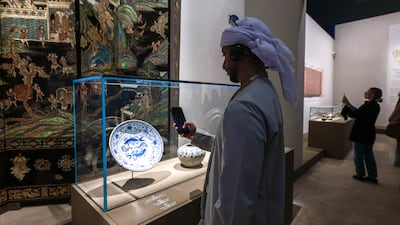

The Gulf has sometimes been portrayed in the West as, until recently, a remote corner of the world, a place defined largely by its desert environment and the relative isolation of its communities. Two new exhibitions in Abu Dhabi museums suggest a different and more compelling account of the history of the region, namely, that far from being a peripheral place, the Gulf was a crossroads of commerce and culture – much like it is today.
At Louvre Abu Dhabi, a major exhibition about how the Indian Ocean connected communities from East Africa and the Arabian Peninsula to India, China and South-East Asia explores a millennium of maritime exchange through more than 200 objects. In December, the Zayed National Museum will explore more than 7,000 years of the camel’s place in the life on the Arabian Peninsula. Together, these exhibitions tell a story of land and sea that helps explain the UAE’s enduring role in connecting people and places.
The Louvre exhibition makes this history tangible. Six detailed ship models evoke the vessels that carried goods across the Indian Ocean. A third-century Buddha sculpture from Gandhara, in present-day Pakistan, offers another reminder that religious and artistic traditions travelled alongside commercial cargoes. The Gulf’s pearl industry was part of this wider network, linking its waters to markets and communities far beyond Arabia.
The camel exhibition will turn the focus inland. Bones dating to between 4500 and 4000BC, discovered at Baynunah in Abu Dhabi, provide evidence of an extinct wild camel species. Remains from Dubai’s Saruq Al Hadid illustrate the later relationship between humans and domesticated camels. Meanwhile, recordings of Taghrooda poetry and Alheda’a, the traditional practice of calling camels, demonstrate how deeply the animal remains embedded in Emirati cultural expression.
These exhibitions will present a reminder of how the people of the Gulf participated in networks of exchange and developed traditions suited to their environment. Such connections are still evident today. Ports remain vital to the UAE’s international trade, but are now complemented by aviation and rail links. The camel also endures with the animal featuring in racing, competitions and poetry – its place as part of the Emirates’ national identity is irreplaceable.
There is also a wider significance in the way these exhibitions tell their stories. Preserving heritage should mean more than celebrating familiar symbols or indulging in nostalgia. Understanding how the past shaped the present helps us today to recognise the complexity of the societies that preceded our modern times.
For anyone seeking to understand the UAE, exhibitions such as these are a good place to start. They represent a vital reminder that the country’s cosmopolitan outlook is not a recent invention, but part of a much longer history of exchange and encounter. In other words, they show how the Gulf embraced globalisation before the term even existed.

