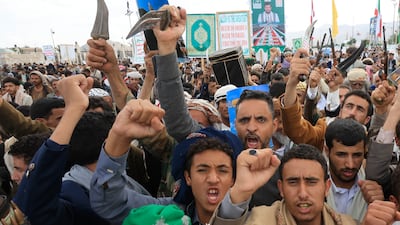

G7 foreign ministers meeting at the UN General Assembly in New York on Monday delivered a blunt message to Tehran – end your arming and financing of Yemen’s Houthi rebels. The appeal came after seven of the world’s biggest economies warned that Iran’s continued support for the violent militia threatens international trade and global stability.
The G7’s sense of urgency is not abstract. Recent Houthi strikes that reached Riyadh’s international airport and Aramco infrastructure in other parts of Saudi Arabia cross a line that should draw universal condemnation. Airports and energy facilities are part of the infrastructure serving civilians in the Gulf and global markets, not military targets. The Gulf’s prosperity, and by extension a meaningful share of the world’s energy security and trade, rests on these assets remaining protected.
That said, international condemnation alone, no matter how forceful, will not deter the Houthis. In addition, a purely military response has thus far proved unsatisfactory. Although the need for a political track remains essential, there is another part of the Houthi problem that may provide a pressure point through which to curb the rebels’ violence: their finances.

The Houthis run a diversified war economy whose sophistication and effectiveness run counter to the group’s self-image as austere anti-imperialists. They tax goods that pass through territory under their control, exploit port revenues, profit from fuel and commodity smuggling, and operate channels to move money internationally. Some independent estimates of their maritime revenues alone run into the hundreds of millions of dollars a month.
Monday’s G7 statement comes not long after the Houthis’ capture of the coastal city of Mokha as well as several strategic islands in the Red Sea. This has given the armed group more control over the Bab Al Mandeb strait, setting them up to extract additional revenue from those who seek to use this international maritime chokepoint. These battlefield gains add another commercial cog to the group’s financial machinery.
Arguably, the international community has spent too long asking where the Houthis might strike next, and not nearly enough asking how they are getting the resources to keep striking. Given this, a serious strategy to restore calm in Yemen cannot stop at diplomatic statements. It must target the financial architecture sustaining the Houthis with the same seriousness applied to their military capabilities.
Sanctions enforcement, port oversight and disruption of smuggling networks should no longer be regarded as secondary measures. If the Houthis attack civilian targets in Yemen and the wider Gulf, they must expect accountability. Hitting them in the wallet must be part of a comprehensive effort to force them to change course.

