
If there is one thing that artificial intelligence has become very good at producing, it is hyperbole. Depending on who is speaking, AI is either about to transform civilisation or destroy it. Advocates say the technology will revolutionise work, education and science. Critics warn of job losses, broken trust in information and systems going rogue.
Last week, Anthropic researcher Jacob Coxon quit the high-profile AI company with warnings about a powerful self-improving superintelligence that “could kill us all by the end of the decade”. On Tuesday, ideological opposites – far-right activist Steven Bannon and left-wing US senator Bernie Sanders – united to call for more regulation of Silicon Valley “oligarchs”. Meanwhile, a report released this week by business and technology insights company Gartner said worldwide spending on AI is forecast to reach $2.7 trillion this year.
As is often the case, however, the truth is somewhere in the middle. A useful example of a more measured assessment of AI came this week with details of a digital model that can simulate how human cells respond to drugs and experiments. GenBio AI, co-founded by Eric Xing, president of MBZUAI, and Nobel Laureate David Baker, first announced the AIDO Cell system in late August. “To truly understand life, we must model and simulate it across every scale,” Mr Xing said. “GenBio AI’s world model is our path toward a future where biology becomes computable, predictable and ultimately programmable.”
Technology has not suddenly solved drug discovery. Nor is it replacing laboratory science. Nevertheless, this example suggests something more important – a potentially practical use of AI that can save researchers time, allow more experiments to be run and hopefully, with time, identify promising avenues for new treatments. This is where the AI debate should be focused.
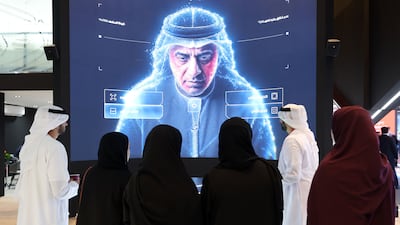
Returning some sense of perspective to our approach regarding AI is essential, given its inexorable rise. The prominence of AI at this week’s Arab Media Summit in Dubai was another reminder of how quickly the technology is moving into everyday professional life. The summit featured many discussions of AI’s effect on journalism and the launch of a report on its impact across Arab media.
None of this means that well-founded questions about AI should be dismissed. The more capable and independent these systems become, the more prudent it is to have mechanisms for testing them before deployment and monitoring them afterwards. Industry slowdowns and kill switches should not be treated as signs of pessimism. If a system can cause serious damage when it fails, it is sensible to have ways of stopping it.
The core challenge is to distinguish proportionate safeguards from attempts to stifle innovation. AI is arguably developing too quickly, and its potential benefits are too substantial for either blanket enthusiasm or blanket opposition to be helpful.
The ideal outcome is not glamorous, but it does make sense: test what works, measure what does not, regulate genuine risks and ensure humans remain responsible for consequential decisions. Test and verify. This is what will cut through polarised and one-dimensional views of this revolutionary technology.

