


Speaking to The National this week, Qasim Al Araji, Iraq’s National Security Adviser, was right when he said Iran's unprecedented direct attack on Israel last weekend had created a “new deterrent policy” in the region. Indeed, there is widespread acknowledgement that the Middle East is confronted by a novel and unpredictable security paradigm. A major concern, however, is that deterrence has its limits and perhaps doesn’t quite offer the stability its proponents think it does.
An examination of deterrence in the Middle East reveals that building a security framework based on a dangerous game of bluff is not the path to the kind of peace that the people of this region aspire to. Neither does it provide Israel or Iran with the kind of security and freedom from attack that both states insist they want.
-

Israel's air defence system intercepts projectiles amid an attack by Iran, as seen from Ramallah in the occupied West Bank. Screengrab from AFPTV / AFP -

Missiles fired from Iran towards Israel are intercepted over the northern part of the country. AFP -

Explosions light up the sky in Hebron in the Palestinian territories during the attack. Screengrab from AFPTV / AFP -

Explosions occur over Hebron. Screengrab from AFPTV / AFP -
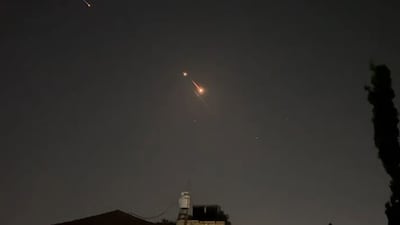
Explosions light up the skies over Jerusalem during the attack. Screengrab from AFPTV / AFP -

Explosions occur over Jerusalem. Screengrab from AFPTV / AFP -

Israel's Iron Dome air defence system moves to intercept missiles fired from Iran. AP -
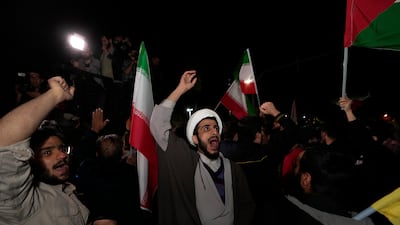
Iranian demonstrators chant slogans during an anti-Israel gathering in Tehran. AP -

People in Tehran appear to celebrate in the street after the attack on Israel. Wana (West Asia News Agency) / Reuters -
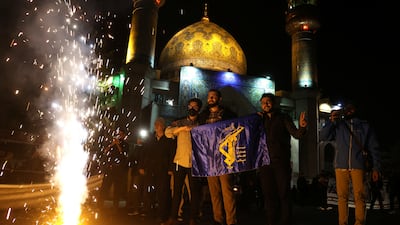
Iranians appear to celebrate in the street after the attack. Wana (West Asia News Agency) / Reuters -
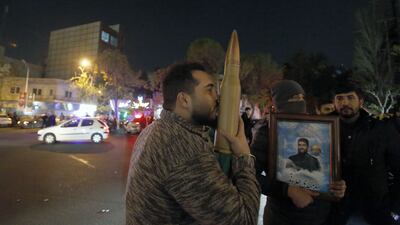
A man kisses a mock rocket during an anti-Israel rally in Tehran after Iran launched the attack. EPA -
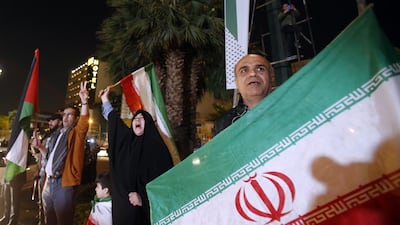
People hold Iranian and Palestinian flags at Palestine Square in Tehran. EPA -

US President Joe Biden meets members of his national security team about the attack on Israel by Iran. The White House / AP


The limits of deterrence were obvious long before the current war that is spilling across the Middle East. Successive Israeli governments thought they had established deterrence with repeated attacks on Gaza over the years. Instead, this policy of responding to attacks from Palestinian militants with overwhelming and indiscriminate force, coupled with the immiseration and disenfranchisement of Palestinian civilians, led to complacency that left Israel vulnerable to the kind of brutal assault witnessed on October 7. In fact, most of the security Israel does enjoy has come from political treaties, not force of arms, and the country still faces many threats and considerable hostility.
For its part, Iran thought it had established deterrence with its extensive network of armed proxies stretching from Yemen to Lebanon, as well as building a large military at home. Instead, Tehran faces a great deal of international isolation, economic sanctions – more of which look likely from the EU soon – and perpetual insecurity that has left its military leadership appearing exposed and anxious. In addition, the bluff of Iranian deterrence has been repeatedly called in the form of strikes on Islamic Revolutionary Guard Corps-linked bases in Iraq and Syria, the killing of scientists connected to Tehran’s nuclear programme, and the high-profile US assassination of Iranian general Qassem Suleimani in 2020.
Yes, the Israeli strike against IRGC targets in Iran’s Damascus embassy compound changed the calculus of Middle East security. It also started a cycle of tit-for-tat reprisals that has left the people of this region on tenterhooks, fearful of the next escalation.
Upping the ante in this way has offered few benefits for anyone; it is in no one’s interests for this regional escalation to continue. Israeli leaders may talk tough – radical Finance Minister Bezalel Smotrich’s irresponsible call for a "disproportionate" attack on Iran is par for the course – but the truly security-minded in Israel’s leadership would understand that it is the time to make up for its previous strategic failures by standing down and focusing on the core issue: ending the conflict with the Palestinians, the horrors of which have been overshadowed by this renewed Israeli-Iranian rivalry.
As the UN Security Council debates fully admitting Palestine to the international community of states, it is a moment for clear and strategic thinking. The Gaza war, in large part due to the denial of Palestinian rights and statehood, is the crux of the biggest security problem in the Middle East. It is a problem that will not be fixed by Israel and Iran engaging in a dangerous stand-off in which there is no true winner. Deterrence is a form of political procrastination that puts off solving today’s problems for a tomorrow that may never come. The Middle East needs better.

