


It has taken a long time to get to Israel's latest government, which, led by Prime Minister Benjamin Netanyahu, was sworn in at the very end of 2022. His success ends a cycle of inconclusive politics that saw five elections in less than four years.
But it does not end the division of the episode, fuelled by longstanding injustices, and many Israelis and Palestinians fear that far worse than inconclusive politics is on the horizon.
Things quickly got off to a tense start. Just before the new year, the UN General Assembly voted to seek the opinion of the International Court of Justice on the legality of Israel's policies in the occupied Palestinian territories. The move came amid Mr Netanyahu's Likud party listing the expansion and protection of West Bank settlements as a top priority for the new Israeli coalition.
While it should never have been the case, Palestinian security and rights have been under threat in such a manner for decades. But figures in the latest government are also probing unprecedented avenues of tension.
-
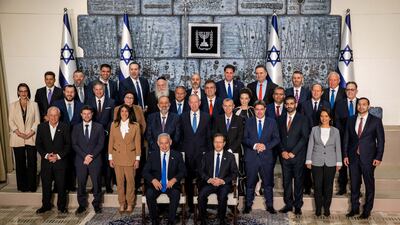
President Isaac Herzog and Prime Minister Benjamin Netanyahu with members of the new Israeli government. Reuters -
Prime Minister Benjamin Netanyahu and his wife Sara attend a toast for the new speaker of Israel's parliament. Reuters -

Benjamin Netanyahu after the traditional group photo with Israel's new government. EPA -

Benjamin Netanyahu during the first cabinet meeting of his new government in Jerusalem. AFP -
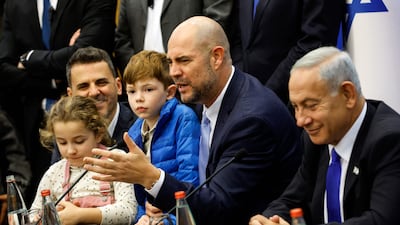
New Knesset speaker Amir Ohana, centre, with his partner Alon, left, their children, and Benjamin Netanyahu at the Knesset in Jerusalem. AFP -
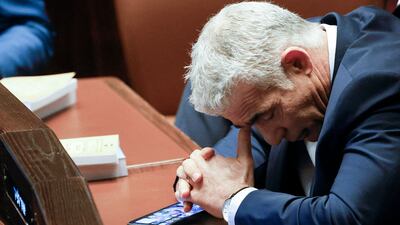
Outgoing Prime Minister Yair Lapid attends a special session of Israel's parliament, the Knesset, to swear in a new government. AFP -
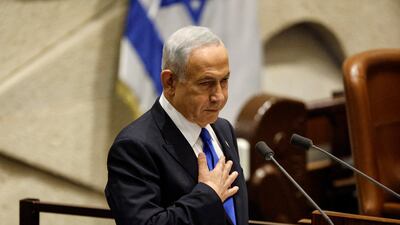
Israeli Prime Minister-designate Benjamin Netanyahu speaks at the special session. EPA -
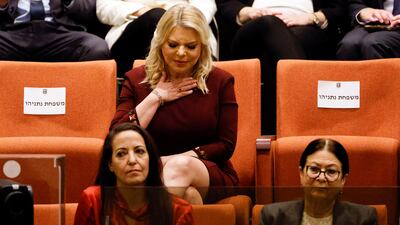
Sara Netanyahu, centre top, Benjamin Netanyahu's wife, Lihi Lapid, centre left, Yair Lapid's wife, and Esther Hayut, President of the Supreme Court of Israel. Reuters -
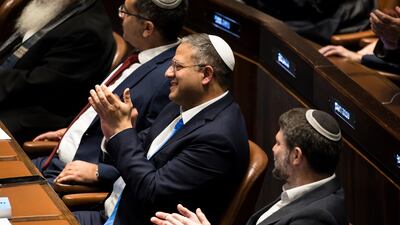
Designated Minister of National Security Itamar Ben Gvir, left, and designated Israeli Minister of Finance Bezalel Smotrich, right, at the session in parliament. Getty Images -

Member of Knesset Aryeh Deri attends a special session of the Knesset, Israel's parliament, to approve and swear in a new right-wing government, in Jerusalem. AP -

Designated Minister of National Security Itamar Ben Gvir speaks at the swearing-in session. Getty Images -

Protesters against the new Netanyahu government outside the Knesset, Israel's parliament, as it is sworn in. EPA -

Israelis protest against the new government. EPA


The most egregious example yet took place on Thursday, when Israeli National Security Minister Itamar Ben-Gvir entered Al Aqsa Mosque compound in occupied East Jerusalem. In September, he did the same on the campaign trail to much condemnation. By repeating the storming of the compound so soon into his ministerial career, Mr Ben-Gvir is proving to the world that being in government will not temper his extreme ideological goals.
However tense relations between Palestinians and Israelis have been over the decades, certain norms have been largely respected throughout the conflict. The situation at places of religious significance, particularly the Al Aqsa mosque, is perhaps the most obvious and important example.
The arrangement – often labelled the status quo – at Islam's third holiest site puts Al Aqsa’s administration in the hands of the Jerusalem Islamic Waqf, under the custodianship of Jordan. This arrangement is recognised widely across the globe, including by the UN, the Arab League, the US and the EU, to name only a few parties. It is a complex affair, but it works. It does no less than save lives in a terrible conflict.
That is why so many Israelis are decrying Mr Ben-Gvir's actions. Opposition leader and former prime minister Yair Lapid said on Twitter the day before the visit that the new minister "must not go". Needless to say, Palestinians, in addition to Arabs around the world, are outraged as well. The Palestinian Foreign Ministry condemned it as an "unprecedented provocation”.
In a recent phone call, the foreign ministers of the UAE and Jordan, Sheikh Abdullah bin Zayed and Ayman Al Safadi, stressed their countries' condemnation of Ben-Gvir’s provocation, saying that the move was "a violation of international law and a grave escalation". While Mr Ben-Gvir was not explicitly named, Saudi Arabia nonetheless condemned the move. The US ambassador to Israel stressed his country's position that the status quo must not be altered. The UAE and China have called for an emergency UN Security Council meeting.
Such a diverse cohort of countries showing such unanimous opposition to Tuesday's scenes presents Israel's new government with a stark choice. Many of the condemning countries and organisations are not enemies of Israel, but partners. Ties with Jordan form a crucial strategic relationship that has prevented a great deal of violence for decades. Israel's relations with the Emirates offer some of the most promising avenues for peace in years of the otherwise seemingly intractable conflict.
This is momentum and security that is too precious to squander. By getting what could well be an enduring coalition into power, Mr Netanyahu has achieved the hugely complex task of winning a strong basis and mandate. That should be used to build peace not division. After such little time in this new government, he must act urgently to correct what seems to be a damaging course that could have huge consequences at home and abroad.

