Insight and opinion from The National’s editorial leadership
September 18, 2022
From all around the world, national leaders will be travelling to London to attend the funeral of Queen Elizabeth II, which is taking place on Monday, and the state reception the evening before. The expansive guest list demonstrates the intense impression the late monarch made throughout her 70-year period on the British throne. The Middle East is well represented, with leaders such as Jordan's King Abdullah having left for the country on Friday. Many more are set to be present.
The presence of the GCC's leaders, whose respective royal families have built not just strong national ties with the UK but also personal ones through the monarchy, will be particularly heartfelt. On the day of the Queen's death, Sheikh Mohammed bin Rashid, Vice President and Ruler of Dubai, said: "Her incredible lifetime of service and duty to the United Kingdom is unparalleled in our modern world."
Conversations during this time have not just been about remembrance, but also the future. On Saturday, President Sheikh Mohamed spoke to King Charles III by telephone to congratulate him on his accession to the throne, wishing him well as he takes up the mantle that his mother bore so well for so long. Earlier that same day, Sheikh Mohamed spoke with UK Prime Minister Liz Truss.
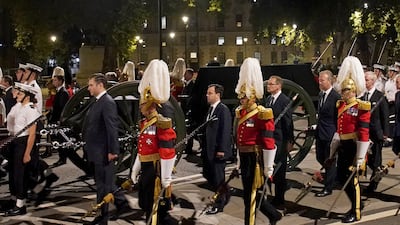
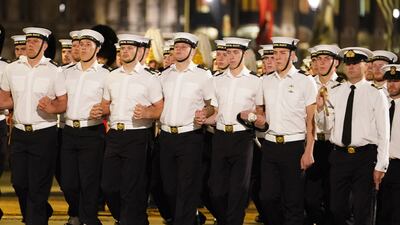
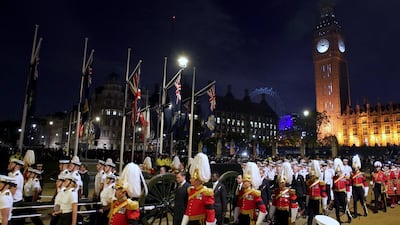
An early morning rehearsal took place on Thursday for the funeral of Queen Elizabeth II in London. All photos: PA
The funeral will take place in London on Monday.
A procession down The Mall during the early morning rehearsal.
Members of the military take part.
The procession makes its way through central London as Big Ben looms.
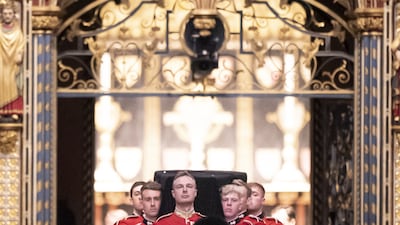
Soldiers outside Westminster Abbey.
The eyes of the world will be on Westminster Abbey.
Many more of these discussions about the future will happen after the funeral, but before the event it is natural that most have focused on remembrance.
On Thursday, Saudi Arabia’s King Salman bin Abdulaziz Al Saud offered his condolences to King Charles III by phone. On Friday, The National spoke to recently retired veteran Kuwaiti diplomat Khaled Al Duwaisan, who met the Queen on more than 150 occasions. About the final time, at her platinum jubilee in June, Mr Al Duwaisan said: “I can’t believe that at this age, her mind, her body, her sense of humour – she was wonderful.“ He also discussed how her passing was felt deeply in Kuwait and the help that her relationship with the country offered during Iraq's invasion of the country in 1990. And on Wednesday, Mansoor Abulhoul, the UAE's ambassador to the UK, wrote in an op-ed for The National that: "For Emiratis, she represented the very best of British identity and character ... The UK is an important friend and ally, and the Queen served as monarch for the entire history of our country. So today we feel profound sadness, as well as gratitude."
It is not just leaders and officials who are having these conversations. Nouria Naji, director of the Yemen Education and Relief Organisation that works to improve access to education for poorer children in the country, described "a great honour and great pride" at being made an Officer of the Order of the British Empire for transforming the lives of women and children in Yemen. In the UAE, residents have been flocking to Dubai's Queen Elizabeth 2 Hotel to leave flowers and pay their respects. Next to the memorial, Suma Gogana spoke of the moment as a "huge loss for everyone".
Tomorrow will be the culminating point of what has been a fittingly ceremonial and historic period to say goodbye to Queen Elizabeth, who will go down as one of the great modern leaders. In his interview, Mr Al Duwaisan summed up the momentousness of the episode, saying “Britain will not be the same as when she was in power”.
That is true, but in the days and weeks ahead, more about the exciting future of a new UK will become clear. Its friends in the Gulf and around the world will be watching closely.

Fraudsters send an unsolicited email that appears to be from a financial institution or online retailer. The hoax email requests that you provide sensitive information, often by clicking on to a link leading to a fake website.
2) Smishing
The SMS equivalent of phishing. Fraudsters falsify the telephone number through “text spoofing,” so that it appears to be a genuine text from the bank.
3) Vishing
The telephone equivalent of phishing and smishing. Fraudsters may pose as bank staff, police or government officials. They may persuade the consumer to transfer money or divulge personal information.
4) SIM swap
Fraudsters duplicate the SIM of your mobile number without your knowledge or authorisation, allowing them to conduct financial transactions with your bank.
5) Identity theft
Someone illegally obtains your confidential information, through various ways, such as theft of your wallet, bank and utility bill statements, computer intrusion and social networks.
6) Prize scams
Fraudsters claiming to be authorised representatives from well-known organisations (such as Etisalat, du, Dubai Shopping Festival, Expo2020, Lulu Hypermarket etc) contact victims to tell them they have won a cash prize and request them to share confidential banking details to transfer the prize money.
Cecelia Crocker was on board Northwest Airlines Flight 255 in 1987 when it crashed in Detroit, killing 154 people, including her parents and brother. The plane had hit a light pole on take off
George Lamson Jr, from Minnesota, was on a Galaxy Airlines flight that crashed in Reno in 1985, killing 68 people. His entire seat was launched out of the plane
Bahia Bakari, then 12, survived when a Yemenia Airways flight crashed near the Comoros in 2009, killing 152. She was found clinging to wreckage after floating in the ocean for 13 hours.
Jim Polehinke was the co-pilot and sole survivor of a 2006 Comair flight that crashed in Lexington, Kentucky, killing 49.
Employees leaving an organisation are entitled to an end-of-service gratuity after completing at least one year of service.
The tenure is calculated on the number of days worked and does not include lengthy leave periods, such as a sabbatical. If you have worked for a company between one and five years, you are paid 21 days of pay based on your final basic salary. After five years, however, you are entitled to 30 days of pay. The total lump sum you receive is based on the duration of your employment.
1. For those who have worked between one and five years, on a basic salary of Dh10,000 (calculation based on 30 days):
a. Dh10,000 ÷ 30 = Dh333.33. Your daily wage is Dh333.33
b. Dh333.33 x 21 = Dh7,000. So 21 days salary equates to Dh7,000 in gratuity entitlement for each year of service. Multiply this figure for every year of service up to five years.
2. For those who have worked more than five years
c. 333.33 x 30 = Dh10,000. So 30 days’ salary is Dh10,000 in gratuity entitlement for each year of service.
Note: The maximum figure cannot exceed two years total salary figure.
Countdown to Zero exhibition will show how disease can be beaten
Countdown to Zero: Defeating Disease, an international multimedia exhibition created by the American Museum of National History in collaboration with The Carter Center, will open in Abu Dhabi a month before Reaching the Last Mile.
Opening on October 15 and running until November 15, the free exhibition opens at The Galleria mall on Al Maryah Island, and has already been seen at the Jimmy Carter Presidential Library and Museum in Atlanta, the American Museum of Natural History in New York, and the London School of Hygiene and Tropical Medicine.
Goalkeepers: Ibrahim Alma, Mahmoud Al Youssef, Ahmad Madania. Defenders: Ahmad Al Salih, Moayad Ajan, Jehad Al Baour, Omar Midani, Amro Jenyat, Hussein Jwayed, Nadim Sabagh, Abdul Malek Anezan. Midfielders: Mahmoud Al Mawas, Mohammed Osman, Osama Omari, Tamer Haj Mohamad, Ahmad Ashkar, Youssef Kalfa, Zaher Midani, Khaled Al Mobayed, Fahd Youssef. Forwards: Omar Khribin, Omar Al Somah, Mardik Mardikian.
ENGLAND SQUAD
Joe Root (captain), Dom Sibley, Rory Burns, Dan Lawrence, Ben Stokes, Ollie Pope, Ben Foakes (wicketkeeper), Moeen Ali, Olly Stone, Chris Woakes, Jack Leach, Stuart Broad
UAE currency: the story behind the money in your pockets